
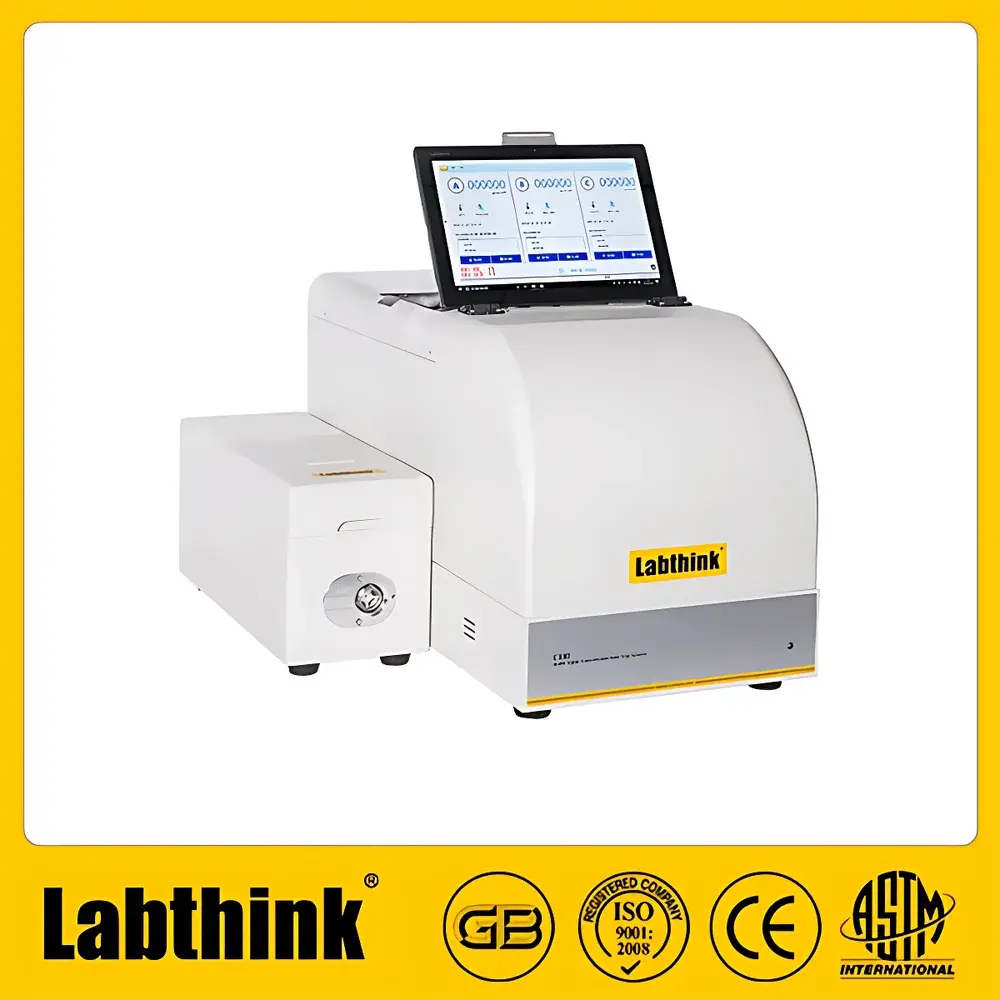
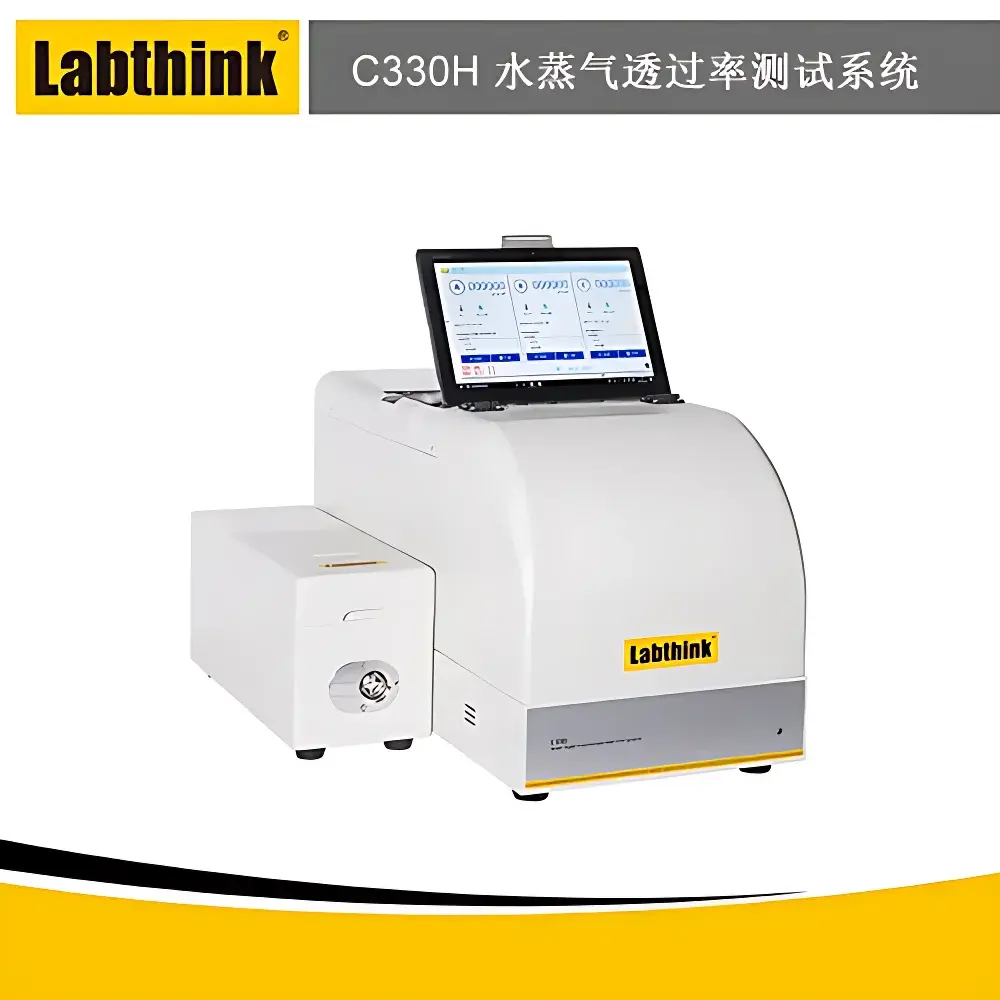
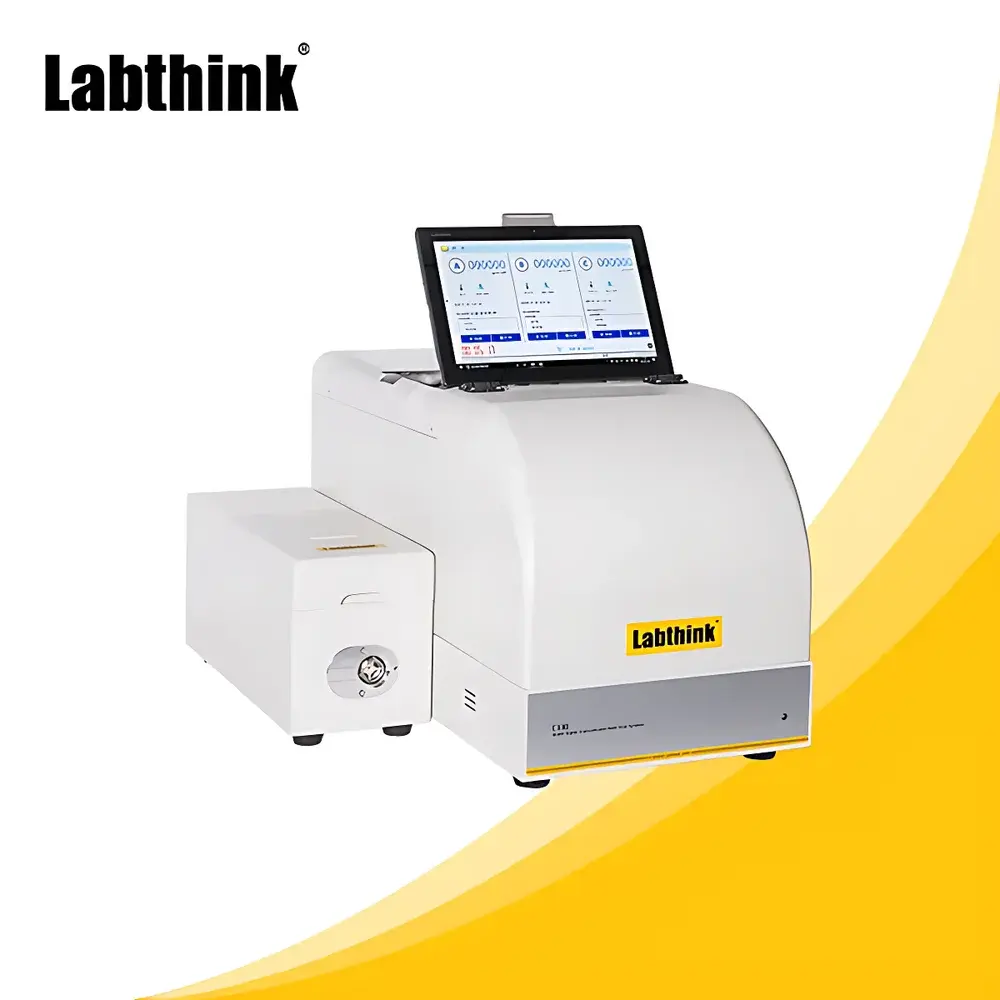
Labthink C330H Electrolytic Sensor-Based Water Vapor Transmission Rate (WVTR) Tester
| Brand | Labthink |
|---|---|
| Origin | Shandong, China |
| Manufacturer Type | Manufacturer |
| Origin Category | Domestic |
| Model | C330H |
| Quotation | Upon Request |
| Test Principle | Electrolytic (Coulometric) Sensor per ISO 15106-3 |
| Test Range | 0.005–50 g/(m²·day) |
| Resolution | 0.001 g/(m²·day) |
| Repeatability | ±0.005 g/(m²·day) or ±2%, whichever is greater |
| Temperature Control | 10–55 °C ±0.2 °C |
| Humidity Control | 5–90 %RH ±1 %RH |
| Test Chambers | 3 independent |
| Sample Area | 50 cm² |
| Max Sample Size | 108 mm × 108 mm |
| Max Sample Thickness | ≤3 mm |
| Package Testing | Optional (up to 3 L) |
| Data Management | DataShield™ Audit-Trail Enabled |
| Compliance Options | 21 CFR Part 11, GMP Computer System Validation Support |
Overview
The Labthink C330H is a high-precision, tri-chamber water vapor transmission rate (WVTR) testing system engineered for quantitative permeation analysis of barrier materials used in photovoltaic backsheet, flexible packaging, pharmaceutical blister foils, medical device pouches, and high-performance polymer films. It operates on the electrolytic (coulometric) sensor principle defined in ISO 15106-3, where water vapor diffusing across a conditioned test specimen is carried by dry carrier gas (≥99.999% N₂) to a Faraday-based sensor. The sensor quantifies moisture concentration via electrochemical decomposition—generating a current proportional to the molar flux of H₂O—and enables trace-level WVTR calculation with inherent linearity and long-term stability. Unlike gravimetric or infrared-based methods, the electrolytic approach delivers superior sensitivity below 0.01 g/(m²·day), making it ideal for evaluating advanced EVA, PVDF, PET/AlOx, and SiOx-coated substrates critical to solar module longevity and battery cell encapsulation integrity.
Key Features
- Triple independent test chambers with real-time, chamber-specific temperature and humidity monitoring—enabling simultaneous parallel testing of identical samples (per ASTM F3299 statistical requirements) or three distinct materials under identical environmental conditions.
- Patented monolithic test block integrating fluid-dynamic channel design and thermally optimized heat distribution—minimizing boundary-layer effects and ensuring uniform RH gradient across the sample surface.
- Labthink-developed electrolytic moisture sensor with coulometric detection: calibrated per Faraday’s law, offering sub-ppm water vapor sensitivity, 5-year operational lifespan without recalibration.
- Spatial 3D thermal stabilization architecture—maintaining ±0.2 °C temperature uniformity across all chambers and sample interfaces, critical for reproducible diffusion kinetics at elevated temperatures (e.g., 40 °C / 85 %RH accelerated aging protocols).
- Integrated 12-inch Windows 10 touch interface with dual-mode operation: automated standard-test workflow (ASTM/ISO-compliant report generation) and advanced research mode with granular control over gas flow rates, dwell times, and stepwise RH ramping.
Sample Compatibility & Compliance
The C330H accommodates flat sheet specimens up to 108 mm × 108 mm and 3 mm thick, with standardized test area of 50 cm². It supports rigid and semi-flexible films—including fluoropolymers, metallized PET, AlOx/SiOx barrier coatings, and multilayer laminates—as well as sealed packages up to 3 L volume (optional fixture). All hardware and firmware comply with ISO 15106-3, ASTM F3299, GB/T 21529, and YBB 00092003-2015. Optional validation packages include IQ/OQ documentation, 21 CFR Part 11-compliant electronic signatures, audit-trail-enabled DataShield™ software, and GMP-aligned computer system validation (CSV) support for regulated QC laboratories.
Software & Data Management
DataShield™ is a secure, role-based data governance platform embedded within the C330H control software. It provides time-stamped, immutable audit trails for all test events—including parameter changes, calibration logs, user logins, and result exports. Raw sensor output, environmental metadata, and calculated WVTR values are stored in encrypted SQLite databases with configurable retention policies. Export formats include CSV, PDF (with embedded digital signatures), and XML for LIMS integration. Network options include Ethernet (RJ45), Wi-Fi (802.11ac), and optional cellular telemetry for remote fleet monitoring. All communication adheres to TLS 1.2+ encryption standards.
Applications
- Photovoltaic industry: Quantifying WVTR of backsheet layers (TPT, TPE, KPK) to predict delamination risk and module power degradation under damp-heat (IEC 61215) stress.
- Pharmaceutical packaging: Validating moisture barrier performance of cold-form blisters, Alu-Alu laminates, and desiccant-containing sachets per USP and FDA guidance.
- Medical device sterilization: Assessing peel strength–moisture interaction in Tyvek®/PET pouches and validating shelf-life models for ISO 11607-1 compliance.
- Flexible electronics: Measuring ultra-low WVTR (<0.005 g/m²/day) of thin-film encapsulation for OLED displays and perovskite solar cells.
- Food packaging R&D: Benchmarking nanocomposite films, PLA-based bioplastics, and vacuum-metallized cellulose against shelf-life predictive models.
FAQ
What standards does the C330H comply with?
ISO 15106-3, ASTM F3299, GB/T 21529, and YBB 00092003-2015.
Can the system test both flat films and sealed packages?
Yes—flat specimens are tested using standard clamping fixtures; package testing (≤3 L) requires an optional chamber adapter kit.
Is 21 CFR Part 11 compliance available?
Yes—available as a factory-installed option including electronic signatures, audit trail, and system access controls.
What carrier gas is required?
Ultra-high-purity nitrogen (≥99.999%) at ≥0.28 MPa inlet pressure; gas source is customer-supplied.
How is sensor calibration verified?
Using NIST-traceable permeation standards (e.g., certified PET film) and internal zero-gas verification cycles prior to each test sequence.



