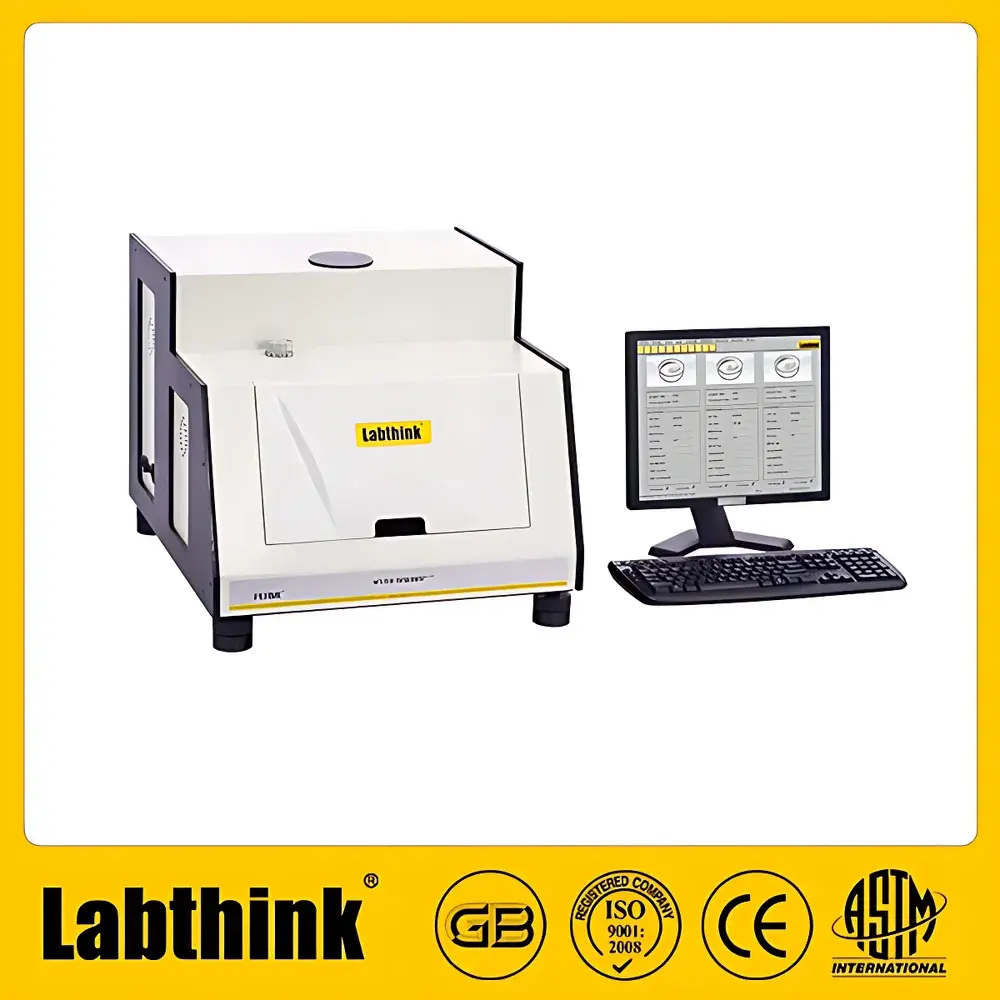
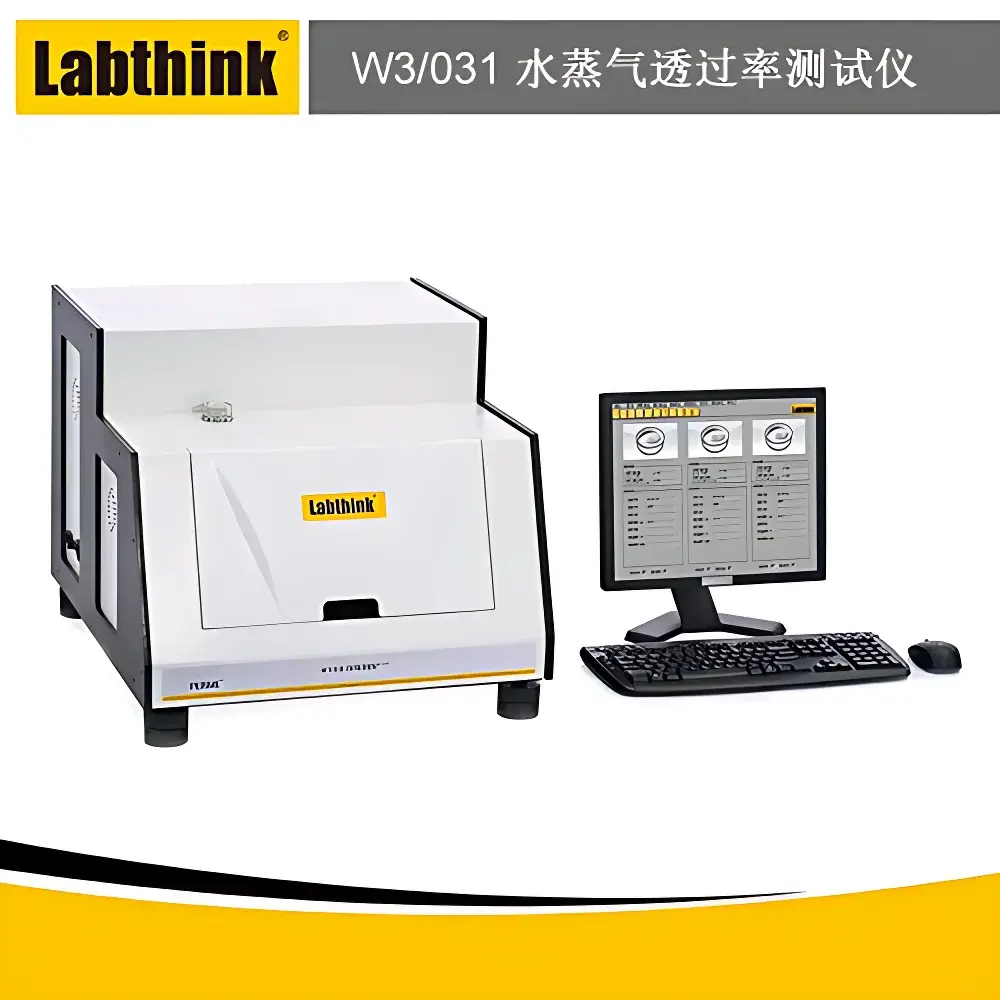
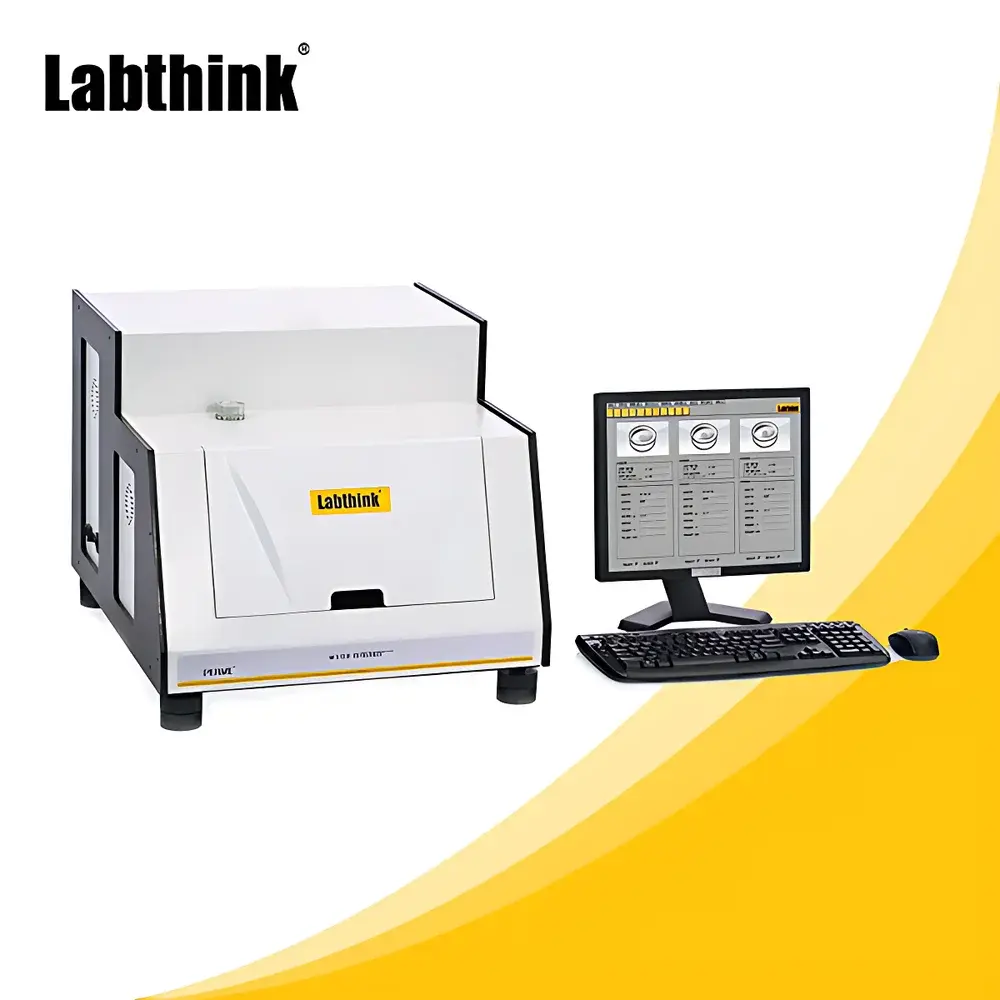
Labthink W3/031 Gravimetric Cup Method Water Vapor Transmission Rate (WVTR) Tester
| Brand | Labthink |
|---|---|
| Model | W3/031 |
| Origin | Shandong, China |
| Manufacturer | Labthink Instruments Co., Ltd. |
| Category | Packaging Industry–Specific WVTR Tester |
| Test Principle | Gravimetric Cup Method (ASTM E96 Desiccant Method) |
| Test Range | 0.1–10,000 g/m²·24h |
| Sample Capacity | 1–3 independent cups |
| Resolution | 0.0001 g |
| Weight Accuracy | ±0.01 g |
| Temperature Control | 15–55 °C, ±0.1 °C |
| Humidity Control | 10–98% RH, ±1% RH |
| Test Area | 33 cm² |
| Sample Thickness Limit | ≤3 mm |
| Sample Diameter | Φ74 mm |
| Chamber Volume | 27 L |
| Air Supply | 0.6 MPa, Φ4 mm polyurethane tubing |
| Power | AC 85–264 V, 47–63 Hz |
| Dimensions | 580 × 680 × 470 mm (L×W×H) |
| Net Weight | 83 kg |
| Compliance | GB 1037, GB/T 16928, ASTM E96, ASTM D1653, ISO 2528, TAPPI T464, DIN 53122-1, JIS Z0208, YBB00092003 |
Overview
The Labthink W3/031 Gravimetric Cup Method Water Vapor Transmission Rate (WVTR) Tester is an engineered solution for precise, repeatable measurement of water vapor permeation through flexible packaging materials—including silicone gel films, transdermal patches, medical dressings, laminates, and polymer-based barrier substrates. It operates on the gravimetric cup method (also known as the desiccant method per ASTM E96), in which a conditioned test specimen seals a permeation cup containing desiccant. Under controlled temperature and relative humidity (RH) conditions across the specimen’s two surfaces, water vapor migrates from the high-humidity side to the dry side. The cumulative mass gain of the cup—measured at defined intervals via high-resolution microbalance—is used to calculate the steady-state water vapor transmission rate (WVTR) in g/m²·24h. This principle delivers traceable, standards-aligned results without optical interference or calibration drift associated with sensor-based systems, making it the reference method for regulatory submissions and quality control in pharmaceutical, medical device, and food packaging R&D and production environments.
Key Features
- Triple independent test stations: Three sealed permeation cups operate simultaneously under identical or individually programmed environmental conditions—enabling parallel testing of replicate samples or multi-material comparison within a single run.
- Precision gravimetric architecture: Integrates a high-stability analytical balance (0.0001 g resolution, ±0.01 g accuracy) housed within a thermally isolated weighing chamber, minimizing convection-induced noise and thermal drift during long-duration tests (up to 168 h).
- Advanced environmental control: Dual-zone climate system maintains precise, independent control of chamber temperature (15–55 °C, ±0.1 °C) and RH (10–98% RH, ±1% RH) using PID-regulated heating, refrigeration, and saturated salt/desiccant humidity generation—fully compliant with ASTM E96 Procedure A and ISO 2528 Annex A.
- Embedded computing platform: Real-time Linux-based controller replaces legacy microcontroller architectures, enabling deterministic task scheduling, fault logging, and seamless integration with external lab networks via Ethernet.
- Automated cup handling sequence: Motorized lift-and-seal mechanism ensures consistent cup closure force and eliminates operator-induced variability in seal integrity—a critical factor in low-WVTR measurements (<1 g/m²·24h).
Sample Compatibility & Compliance
The W3/031 accommodates circular specimens up to Φ74 mm and thicknesses ≤3 mm, supporting standard formats for silicone gel adhesives, hydrocolloid dressings, PET/AL/PE laminates, PTFE membranes, and coated paperboard. Its mechanical design permits optional customization for thicker or irregular substrates upon request. All test protocols adhere strictly to internationally recognized standards including ASTM E96 (Procedure A, B, and C), ISO 2528, GB/T 1037, and YBB00092003 (Chinese Pharmacopoeia packaging guidance). Data acquisition and reporting meet GLP requirements, with full audit trails, electronic signatures, and time-stamped event logs compatible with FDA 21 CFR Part 11–compliant validation packages when deployed with Lystem™ Laboratory Data Sharing System.
Software & Data Management
The instrument runs Labthink’s proprietary WinWVTR software, featuring a role-based user interface with configurable access levels (Operator, Supervisor, Administrator). It supports automated calculation of WVTR, permeance, and diffusion coefficient; statistical evaluation (mean, SD, CV%, confidence intervals); and customizable report templates aligned with internal SOPs or regulatory submission formats (e.g., ICH M4Q). When connected to a local area network, the W3/031 integrates natively with Lystem™—a centralized data hub that enables cross-instrument result aggregation, trend analysis, electronic batch record linkage, and secure cloud backup. All raw weight vs. time datasets are stored in open CSV format with metadata (test ID, operator, timestamp, environmental setpoints, cup ID), ensuring full traceability and third-party analytics compatibility.
Applications
- Transdermal drug delivery system (TDDS) development: Quantifying moisture barrier performance of silicone-based pressure-sensitive adhesives and backing layers under physiological RH gradients (e.g., 90% RH / 37 °C).
- Pharmaceutical blister and pouch qualification: Verifying WVTR compliance for cold-chain packaging of hygroscopic APIs and lyophilized biologics.
- Medical device packaging validation: Supporting ISO 11607-1 Annex D barrier performance assessments for sterile barrier systems.
- Food packaging shelf-life modeling: Correlating measured WVTR values with accelerated aging studies for retort pouches, coffee bags, and snack wrappers.
- Material R&D benchmarking: Comparative analysis of nanocomposite films, ALD-coated polymers, and bio-based barriers against industry reference standards.
FAQ
What standards does the W3/031 comply with?
The instrument fully supports ASTM E96 (all procedures), ISO 2528, GB/T 1037, GB/T 16928, TAPPI T464, DIN 53122-1, JIS Z0208, and YBB00092003.
Can the W3/031 test non-planar or textured silicone gel films?
Yes—provided the sample can be clamped uniformly across the 33 cm² test area without edge leakage; custom fixtures are available for high-conformability gels.
Is calibration traceable to national metrology institutes?
Yes—weight calibration uses NIST-traceable stainless steel砝码; temperature and RH sensors are calibrated against PTB- or NIM-certified references.
Does the system require compressed air?
Yes—clean, oil-free, dry air at 0.6 MPa is required for humidity control actuation and cup sealing; an optional integrated air dryer module is available.
How is data integrity ensured for regulated environments?
WinWVTR enforces electronic signatures, session locking, change history logging, and exportable audit trails—all validated for 21 CFR Part 11 compliance when configured with Lystem™.
Related Products