
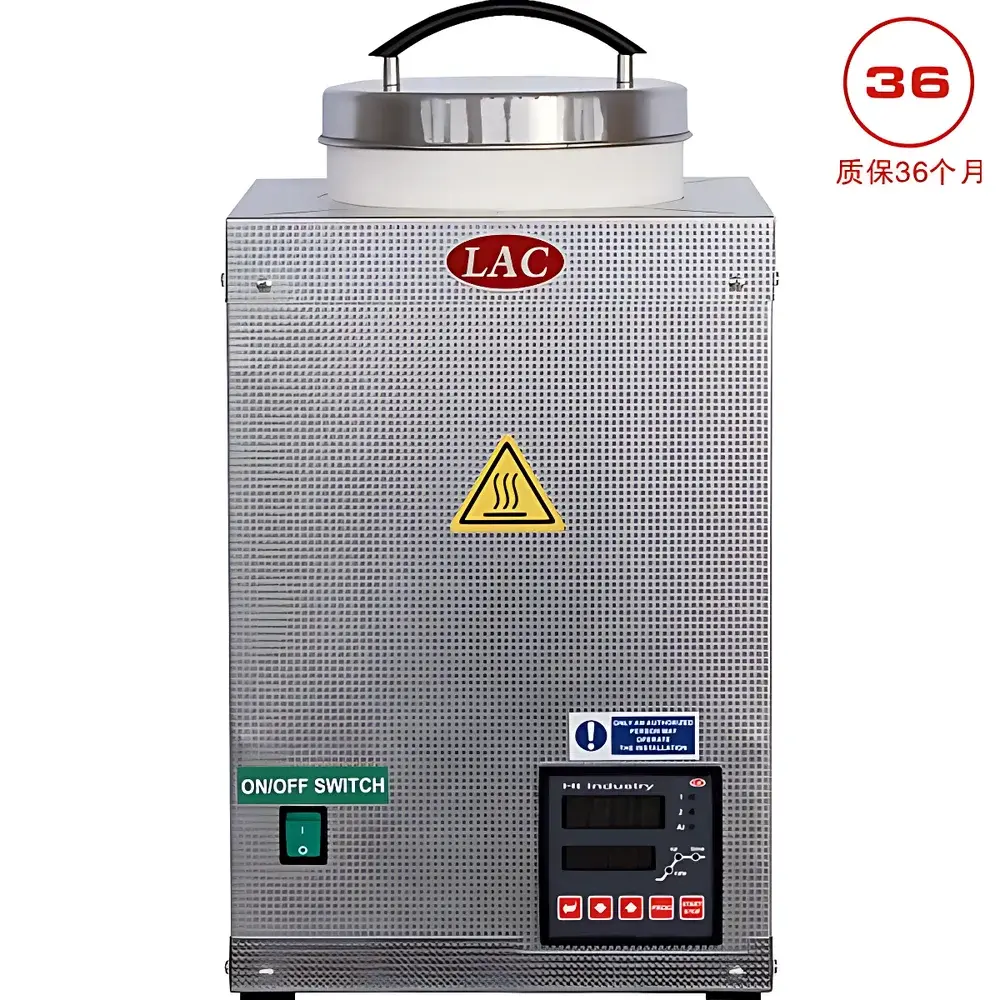
LAC LMV2/12 Corrosion-Resistant Muffle Furnace
| Brand | LAC |
|---|---|
| Origin | Czech Republic |
| Model | LMV2/12 |
| Type | Box-Type Muffle Furnace |
| Max Temperature | 1200 °C |
| Temperature Control Accuracy | ±1 °C |
| Max Power | 1.8 kW |
| Heating Time to Max Temp | 55 min |
| Heating Element | Resistance Wire (Externally Mounted) |
| Internal Chamber Dimensions | Ø110 × 160 mm (Diameter × Height) |
| Controller Standard | HT40AL (2 Ramp + 2 Soak Programs) |
| Optional Controllers | HT205 (30 Programs × 15 Steps, LAN), HT200 (30 Programs × 25 Steps, LAN + USB) |
| Atmosphere Options | Inert Gas Inlet Port (with Flowmeter & Pressure Gauge) |
| Communication Interfaces | RS232, EIA-485, HTMonit Software Suite (Included with Interface) |
Overview
The LAC LMV2/12 is a compact, top-loading box-type muffle furnace engineered for laboratories requiring reliable high-temperature thermal processing under chemically aggressive conditions. Designed and manufactured in the Czech Republic by LAC, a long-standing European specialist in industrial and laboratory thermal equipment, this furnace employs a corrosion-resistant architecture where the resistance heating elements are fully isolated from the process chamber—mounted externally and shielded behind a robust ceramic muffle. This structural separation prevents direct exposure of heating components to corrosive vapors, acidic off-gases, or halogenated decomposition products commonly generated during ashing, calcination, or thermal treatment of polymers, catalysts, or electrochemical materials. The furnace operates up to 1200 °C with a certified control accuracy of ±1 °C, achieved via an integrated S-type thermocouple and precision PID regulation. Its vertical loading configuration optimizes workspace ergonomics and facilitates rapid sample insertion and retrieval without compromising thermal uniformity across the cylindrical chamber (Ø110 × 160 mm).
Key Features
- Externally mounted resistance heating elements enclosed within a high-purity ceramic muffle—eliminates contamination risk and extends service life in corrosive environments.
- Integrated exhaust ducting and vented lid design minimizes condensate accumulation and prevents back-diffusion of volatile reaction byproducts into the chamber.
- Standard HT40AL digital controller supports two independent ramp-and-soak profiles, enabling basic thermal protocols for ashing, drying, or pre-firing.
- Optional HT200 and HT205 programmable controllers offer advanced thermal profiling: up to 30 multi-step programs with configurable ramp rates, dwell times, and end-of-cycle actions; both include LAN connectivity for networked lab integration.
- Gas inlet port compatible with inert (N₂, Ar) or reducing (5% H₂/N₂) atmospheres—supplied with calibrated flowmeter and pressure gauge for reproducible atmosphere control.
- Compliant with IEC 61000-6-3 (EMC) and IEC 61000-6-2 (Immunity); designed to meet general safety requirements per IEC 61010-1 for laboratory electrical equipment.
Sample Compatibility & Compliance
The LMV2/12 accommodates crucibles, boats, and small ceramic or quartz fixtures up to Ø100 mm in diameter. Its corrosion-resistant construction makes it suitable for samples generating SOₓ, Cl₂, HF, or organic volatiles—including PVC ashing, battery cathode material calcination, pharmaceutical excipient residue testing (USP ), and ASTM D3175-compliant coal ash determination. The furnace meets general requirements for GLP-compliant thermal processing when paired with HT200/HT205 controllers featuring audit-trail-capable software (HTMonit) and electronic signature support per FDA 21 CFR Part 11. All controllers provide traceable temperature logging with timestamped data export (CSV, XML) and optional real-time remote monitoring.
Software & Data Management
HTMonit is LAC’s native PC-based software suite, delivered with optional communication interfaces (RS232, EIA-485, or Ethernet). It enables full remote operation—including program upload/download, real-time temperature graphing, alarm configuration, and automated report generation. Data files include controller ID, thermocouple calibration offset, ambient temperature reference, and cycle metadata—supporting ISO/IEC 17025 documentation requirements. When used with HT200/HT205 controllers, HTMonit records full audit trails: user login events, parameter modifications, start/stop timestamps, and deviation alerts—all stored locally and exportable for QA review.
Applications
- Gravimetric ash content analysis per ASTM D3174, ISO 1171, and EN 14778.
- Thermal decomposition studies of flame-retardant polymers and composite matrices.
- Pre-sintering and binder burnout in ceramic and metallurgical R&D.
- Calibration and verification of thermocouples and temperature sensors (per ISO/IEC 17025 Clause 6.4.10).
- Residue-on-ignition testing in environmental soil and sludge analysis (EPA Method 9080).
- Controlled-atmosphere heat treatment of Li-ion battery precursors under N₂ or Ar.
FAQ
Is the LMV2/12 suitable for halogen-containing sample ashing?
Yes—the external heater placement and ceramic muffle barrier prevent halogen-induced oxidation of heating elements, making it appropriate for PVC, PTFE, or brominated flame retardant ashing.
Can the furnace operate continuously at 1200 °C?
Yes, rated for continuous duty at maximum temperature; recommended maximum continuous operating time per cycle is 8 hours to maintain thermocouple stability and muffle integrity.
What calibration documentation is provided?
Each unit ships with a factory calibration certificate traceable to Czech Metrology Institute (ČMI) standards, including as-found/as-left data for the S-type thermocouple and controller output verification.
Does the HT40AL controller support data logging?
No—data logging requires HT200/HT205 controllers with HTMonit software; HT40AL provides only local display and manual setpoint adjustment.
Is third-party software integration possible?
Yes—via Modbus RTU over RS232/EIA-485 or TCP/IP using HT200/HT205 controllers, enabling integration with LabVantage, STARLIMS, or custom SCADA systems.



