
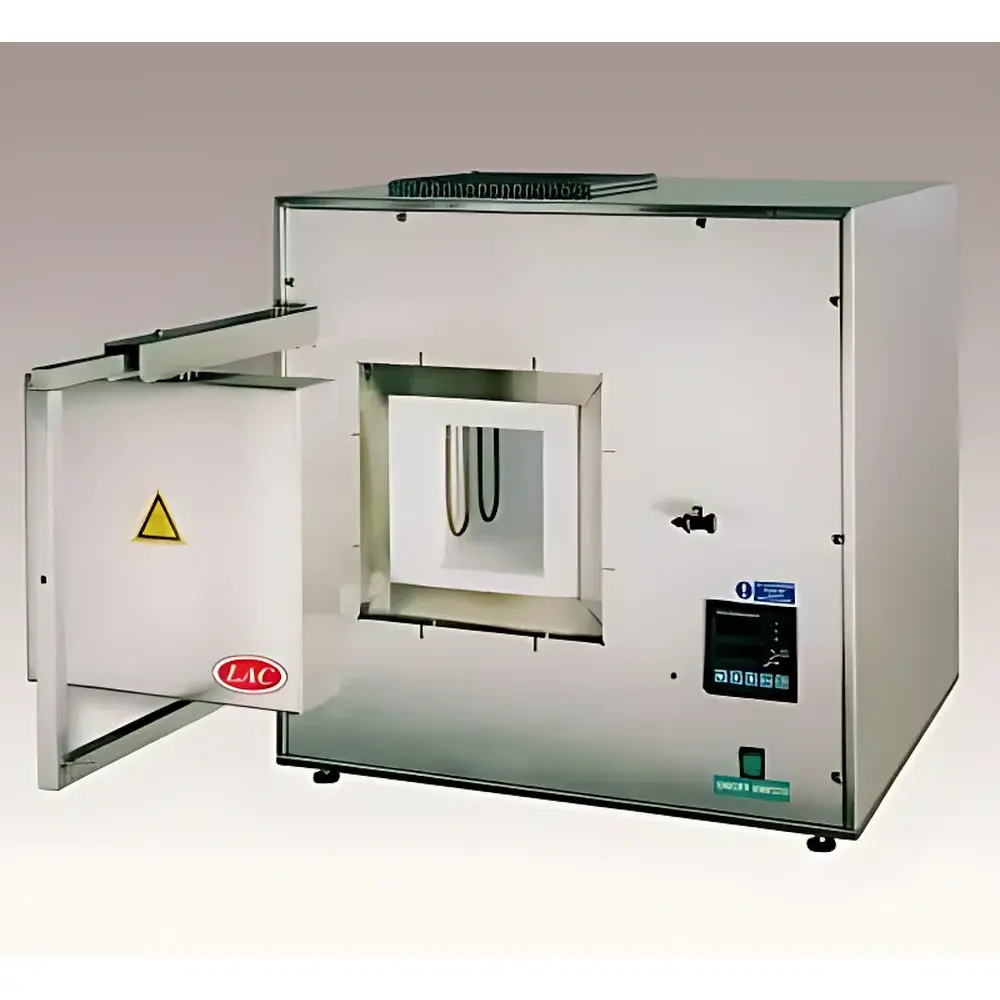
LAC VP-10-17 High-Temperature Muffle Furnace (1700 °C)
| Origin | Czech Republic |
|---|---|
| Manufacturer Type | Authorized Distributor |
| Origin Category | Imported |
| Model | VP-10-17 |
| Temperature Range | 1700 °C |
| Chamber Volume | 10 L |
| External Dimensions | 850 × 1595 × 775 mm |
| Internal Dimensions | 200 × 200 × 250 mm |
| Power Rating | 6 kW |
| Weight | 290 kg |
| Voltage | 380 V AC, 3-phase |
| Heating Element | Kanthal Super ™ FeCrAl alloy wire |
| Temperature Sensor | Type B thermocouple (PtRh30–PtRh6) mounted at chamber top |
| Controller | Industrial programmable PID controller with real-time clock, 30 stored multi-step programs (≥15 segments each) |
| Optional Interfaces | RS-232 / RS-485 |
| Compliance | CSN EN ISO 9001:2001 certified |
Overview
The LAC VP-10-17 is a high-temperature muffle furnace engineered for precision thermal processing in research laboratories, materials science facilities, and industrial R&D environments requiring stable, repeatable operation up to 1700 °C. Designed and manufactured by LAC s.r.o.—a Czech-based enterprise with over 15 years of specialization in electric thermal equipment—the VP-10-17 employs resistive heating via premium-grade Kanthal Super™ FeCrAl alloy heating elements, ensuring long service life and minimal resistance drift under prolonged exposure to extreme temperatures. Its muffle configuration isolates the process chamber from direct contact with heating elements and combustion byproducts, enabling contamination-free heat treatment of sensitive samples including ceramics, refractory metals, dental alloys, and advanced composites. The furnace complies with CSN EN ISO 9001:2001 quality management standards and is constructed to meet European safety directives for Class II industrial heating appliances.
Key Features
- Robust frameless construction reinforced with stainless steel retaining rings—eliminates rust-prone weld seams and enhances structural integrity during thermal cycling.
- Multi-layer insulation system incorporating high-purity alumina-silica fiber modules and low-conductivity ceramic board—reduces surface temperature rise and minimizes standby power consumption.
- Uniform axial and radial temperature distribution (±3 °C at 1700 °C, measured per ASTM E220 calibration protocol), validated across the full 10 L working volume.
- Integrated safety architecture: door-mounted limit switch de-energizes heating circuit upon opening; rear-mounted cooling fan prevents controller overheating during extended operation.
- Industrial-grade PID controller with non-volatile memory supporting up to 30 user-defined thermal profiles, each comprising ≥15 programmable ramp/soak steps with time-and-date scheduling via built-in real-time clock.
- Type B thermocouple (PtRh30–PtRh6) permanently installed at the chamber ceiling for accurate reference-point measurement traceable to ITS-90.
Sample Compatibility & Compliance
The VP-10-17 accommodates crucibles, sintering boats, and sample holders made from alumina, silicon carbide, molybdenum disilicide, or graphite—materials selected for compatibility with oxidizing or inert atmospheres up to 1700 °C. Its sealed muffle design supports optional air-purging configurations (e.g., nitrogen or argon purge kits) to mitigate oxidation during heat treatment of reactive metals. The furnace meets mechanical and electrical safety requirements outlined in EN 61000-6-2 (immunity) and EN 61000-6-4 (emissions), and its operational documentation supports GLP-compliant recordkeeping when paired with optional RS-232/RS-485 data logging interfaces. While not intrinsically rated for explosive atmospheres, it is routinely deployed in ISO 17025-accredited testing labs for ASTM C20, ISO 5017, and DIN 51066-compliant ash content, loss-on-ignition, and calcination procedures.
Software & Data Management
The VP-10-17’s embedded controller provides local parameter adjustment via membrane keypad and LCD display, with full program navigation and real-time temperature graphing. Optional digital interfaces enable bidirectional communication with laboratory information management systems (LIMS) or SCADA platforms. When configured with the optional temperature cycle monitoring software, users can export time-stamped CSV logs containing setpoint, actual temperature, power output, and alarm status—each entry stamped with UTC timestamp and operator ID for audit readiness. Data files comply with FDA 21 CFR Part 11 requirements when deployed with validated electronic signature modules and access-controlled user accounts.
Applications
- Ceramic sintering and densification of oxide and non-oxide refractories (e.g., Al2O3, ZrO2, SiC).
- Thermal gravimetric analysis (TGA) sample preparation and pre-firing of crucibles used in ASTM E1131 workflows.
- Dental laboratory applications: casting investment burnout, porcelain firing, and metal alloy annealing per ISO 22674 specifications.
- Metallurgical research: homogenization heat treatments, grain growth studies, and phase transformation kinetics in Ni-based superalloys.
- Environmental testing labs: ash residue quantification in coal, biomass, and municipal solid waste per EPA Method 2540E.
- Academic materials science: synthesis of phosphors, battery cathode precursors, and catalyst supports requiring precise thermal ramp control.
FAQ
What atmosphere options are supported inside the VP-10-17 chamber?
The standard configuration operates in ambient air. Optional gas inlet/outlet ports allow connection to regulated N2, Ar, or forming gas lines for controlled-atmosphere processing.
Is the VP-10-17 suitable for vacuum applications?
No—this model is not designed for vacuum operation. It lacks vacuum seals, flanges, or pressure-rated insulation. For vacuum-compatible high-temperature furnaces, consult LAC’s V-series product line.
Can the controller store custom ramp rates and hold times independently per program step?
Yes—each of the 30 stored programs supports individual ramp rate (°C/min), soak duration (min/h), and target temperature settings per segment, with resolution down to 1 °C and 1 min.
What maintenance intervals are recommended for the heating elements and insulation?
Under typical usage (≤10 cycles/week to 1700 °C), visual inspection of heating element integrity and insulation compression is advised every 6 months; replacement intervals average 18–24 months depending on thermal cycling frequency and peak temperature dwell time.
Does the furnace include factory calibration documentation?
Yes—each unit ships with a traceable calibration certificate referencing NIST-traceable standards, verifying thermocouple accuracy and temperature uniformity at three points (800 °C, 1200 °C, and 1700 °C) per IEC 60584-1.



