
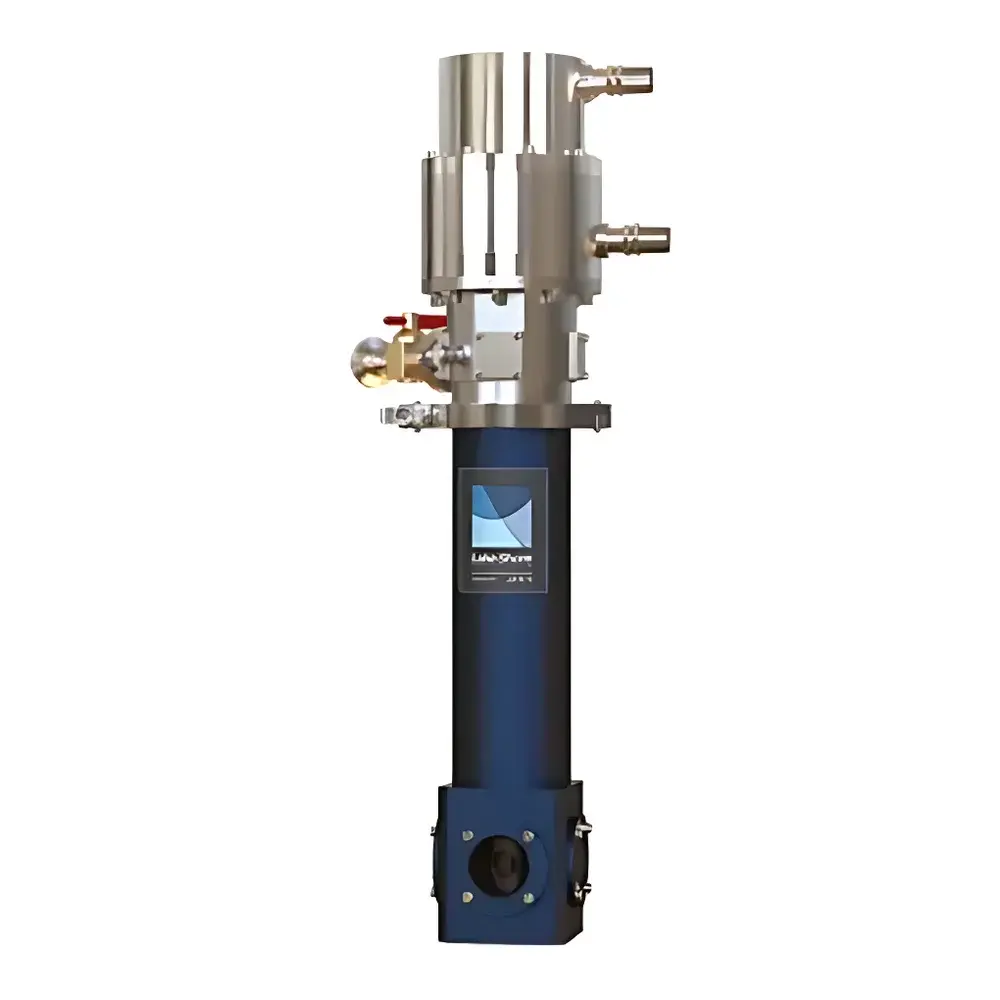
Lake Shore CCS-400H Optical High-Temperature Cryogenic Thermostat
| Brand | Lake Shore |
|---|---|
| Origin | USA |
| Model | CCS-400H |
| Cooling Type | Closed-Cycle Refrigeration |
| Temperature Range | 5 K to 800 K |
| Sample Environment | High-Vacuum Chamber |
| Typical Temperature Stability | ±50 mK |
| Cooling Time (to base temperature) | 2–2.5 h |
| Optical Window Diameter | 83–85 mm |
| Recommended Cryocooler Maintenance Interval | 13,000 h |
| Vibration Level | <40 nm (RMS, at sample stage) |
| Cold Head Mounting | Flexible (top-mount configuration standard) |
| Weight | 16–30 kg |
| Height | 66–94 cm |
| Compliance | Designed for ASTM E220, ISO/IEC 17025-compliant lab environments |
Overview
The Lake Shore CCS-400H Optical High-Temperature Cryogenic Thermostat is a closed-cycle, helium-free cryogenic platform engineered for precision optical and electrical characterization across an exceptionally broad thermal range—from 5 K up to 800 K. Unlike conventional liquid-helium-dependent systems, the CCS-400H integrates a high-reliability pulse-tube or Gifford-McMahon cryocooler with a thermally optimized vacuum chamber architecture, enabling stable, vibration-damped sample environments without cryogen refills. Its defining capability lies in the seamless integration of high-temperature optical access: the system maintains vacuum integrity while supporting continuous thermal cycling through ambient and elevated temperatures, making it uniquely suited for in situ spectroscopic, ellipsometric, photoluminescence, and magneto-optical Kerr effect (MOKE) measurements under controlled thermal stress. The sample stage resides within a high-vacuum (<1×10⁻⁶ Torr typical) environment, minimizing convective heat transfer and gas-phase absorption—critical for mid-IR to THz transmission studies and low-noise electrical transport.
Key Features
- Helium-free operation: Eliminates dependency on liquid cryogens, reducing operational cost, safety hazards, and logistical constraints associated with cryogen handling and storage.
- Extended thermal range: Stable, programmable control from 5 K to 800 K—enabling phase-transition studies, high-temperature carrier dynamics, and thermal degradation analysis of quantum materials and wide-bandgap semiconductors.
- Vibration-optimized design: Mechanical decoupling between cold head and sample stage achieves <40 nm RMS positional stability—essential for confocal microscopy, nano-optical probing, and interferometric applications.
- Modular optical access: Standard 83–85 mm diameter optical window ports support customizable window materials (e.g., CaF₂ for UV–VIS, Si for IR, quartz for VIS–NIR, polyethylene for THz), with anti-reflection coatings available per spectral band.
- Electrical interface flexibility: Multiple feedthrough options—including DC, BNC, SMA, and triaxial configurations—support four-probe resistivity, Hall effect, capacitance-voltage (C–V), and low-noise current–voltage (I–V) measurements with minimal thermal EMF and crosstalk.
- Configurable sample mounting: Interchangeable sample holders include optical alignment stages, thermal-sink-compatible mounts for high-power devices, and four-terminal geometry fixtures compatible with Lake Shore’s resistivity and Hall measurement standards.
Sample Compatibility & Compliance
The CCS-400H accommodates solid, conductive, and insulating samples up to 25 mm in diameter and 10 mm in thickness. Its vacuum-compatible construction meets ASTM E220 requirements for thermal calibration traceability and supports GLP/GMP-aligned experimental workflows. All electrical feedthroughs and window flanges conform to ISO-KF and CF vacuum standards. The system is designed for compatibility with third-party optical tables, magnetic field platforms (up to ±9 T with external superconducting magnets), and ultra-high vacuum (UHV) retrofit kits. For regulated environments, optional audit-trail logging and password-protected parameter locking align with FDA 21 CFR Part 11 data integrity expectations when integrated with Lake Shore’s CryoSoft™ control suite.
Software & Data Management
Control and monitoring are managed via Lake Shore’s CryoSoft™ software (Windows-based), offering real-time PID tuning, multi-zone temperature profiling, automated ramp/soak sequences, and synchronized data acquisition from integrated sensors (PT100, Cernox™, diode). The software supports IEEE-488 (GPIB), USB, and Ethernet interfaces, enabling integration into LabVIEW, Python (PyVISA), or MATLAB automation frameworks. All temperature setpoints, sensor readings, and alarm events are time-stamped and exportable in CSV or HDF5 format. Optional firmware upgrades provide enhanced thermal stability algorithms and compliance-ready electronic logbook functionality with user authentication and change history.
Applications
- Temperature-dependent photoluminescence (PL) and electroluminescence (EL) spectroscopy of perovskites, 2D materials, and quantum dots
- In situ Raman and FTIR studies of lattice dynamics across metal–insulator transitions
- High-temperature Hall mobility and carrier concentration mapping in GaN, SiC, and oxide semiconductors
- THz time-domain spectroscopy (THz-TDS) of superconducting gaps and phonon resonances
- Magneto-optical characterization (Faraday/Kerr rotation) under variable thermal bias
- Calibration reference for blackbody sources and infrared detector responsivity testing
FAQ
What cooling technology does the CCS-400H use?
It employs a closed-cycle pulse-tube or Gifford-McMahon cryocooler—no liquid helium required.
Can the CCS-400H operate continuously at 800 K?
Yes—its high-temperature stage is actively cooled during heating to maintain thermal gradient control and prevent cold-head overheating.
Is vacuum pumping hardware included?
No—the system requires an external turbomolecular pump and backing pump; vacuum components comply with ISO-KF 40 and CF 63 standards.
How is temperature uniformity maintained across the sample surface?
Via a copper or oxygen-free high-conductivity (OFHC) sample holder with embedded heaters and calibrated sensors, coupled with active feedback loops ensuring ±50 mK spatial uniformity over 10 mm diameter regions.
Are custom window materials supported beyond standard offerings?
Yes—Lake Shore provides qualification documentation and mounting solutions for user-supplied windows, including sapphire, MgF₂, and diamond substrates.



