
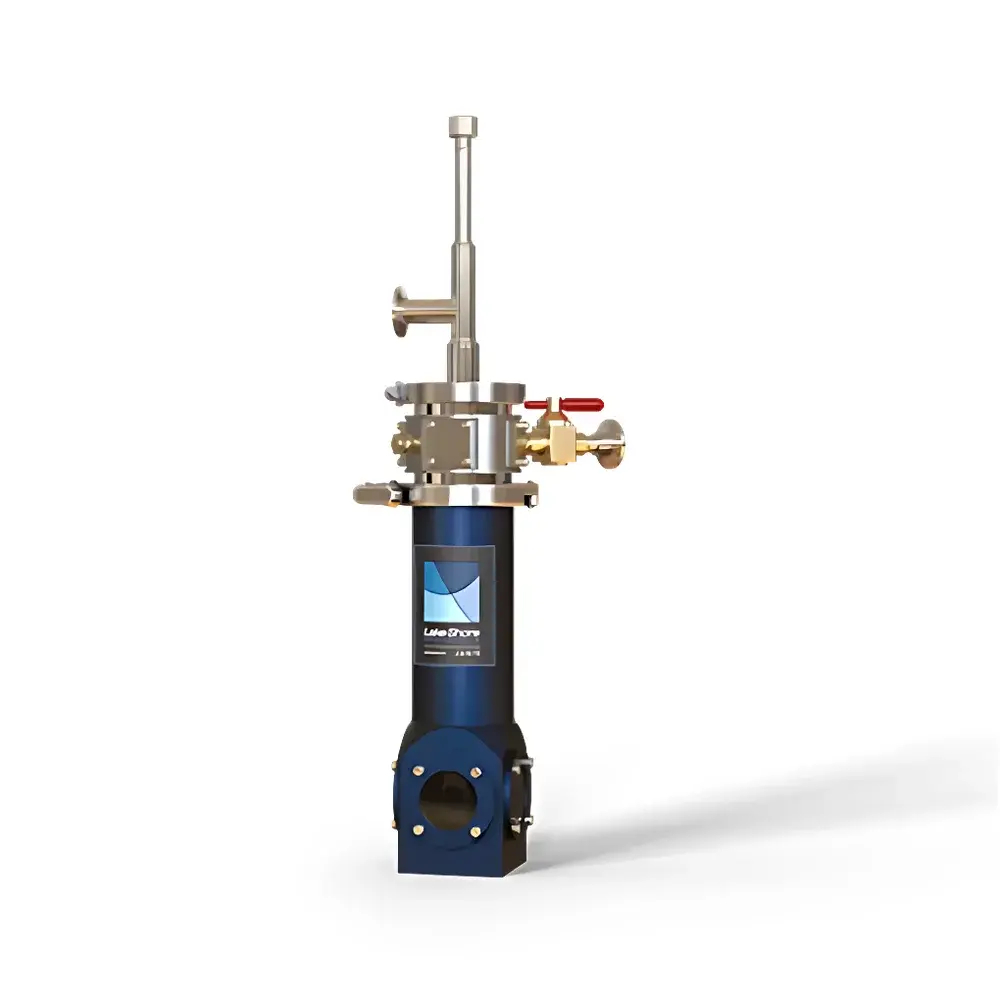
Lake Shore ST Series Continuous-Flow Cryogenic Thermostats
| Brand | Lake Shore |
|---|---|
| Origin | USA |
| Manufacturer Status | Authorized Distributor |
| Origin Category | Imported |
| Model | ST Series |
| Pricing | Available Upon Request |
Overview
The Lake Shore ST Series Continuous-Flow Cryogenic Thermostats are precision-engineered cryogenic sample environments designed for high-reproducibility low-temperature measurements in research and industrial laboratories. Based on the proven Janis ST platform and distributed globally by Lake Shore Cryotronics, these thermostats operate via continuous-flow cooling using liquid helium (LHe) or liquid nitrogen (LN₂), enabling rapid cooldown to base temperatures as low as 2 K (with LHe) and stable operation across a broad thermal range—from sub-2 K up to 800 K depending on configuration. The core thermodynamic architecture employs a cold finger heat sink coupled with resistive heating and calibrated temperature sensing at the sample stage, delivering closed-loop temperature control with millikelvin stability and repeatability. Unlike bath-type cryostats, the continuous-flow design minimizes thermal mass and enables dynamic thermal profiling, making it ideal for time-resolved spectroscopy, transport measurements, and quantum device characterization where thermal inertia must be minimized.
Key Features
- Base temperature range: <2 K to 800 K (model-dependent); standard operation from 2 K to 500 K
- Rapid cooldown: ≤15 minutes to 4.2 K (LHe), ≤30 minutes to 5 K (ST-500 series)
- Modular vacuum chamber with lightweight aluminum outer jacket and radiation shield
- Integrated cold finger, electrical feedthroughs (up to 64 leads), and standardized flange interfaces (CF, KF, or custom)
- Omnidirectional mounting capability with minimal impact on thermal transfer efficiency
- Compatibility with Lake Shore’s RGC series closed-cycle helium refrigerators for fully cryogen-free operation
- Optimized mechanical design for ultra-low vibration performance (±15 nm RMS in ST-500 variants)
- Configurable optical access: single- or multi-window options with AR-coated fused silica, CaF₂, or sapphire windows (UV–IR transmission)
Sample Compatibility & Compliance
The ST Series accommodates diverse sample geometries and experimental configurations—including bulk crystals, thin films, nanowires, and microfabricated devices—within a high-vacuum or ultra-high-vacuum (UHV) environment (base pressure down to 1 × 10⁻¹¹ Torr in ST-400 UHV models). All systems meet ASTM E29–23 requirements for temperature measurement uncertainty reporting and support GLP/GMP-compliant workflows through traceable calibration certificates (NIST-traceable Pt resistance thermometers and Cernox® sensors). UHV-compatible variants comply with ISO 27893:2021 for vacuum system integrity and are qualified for integration into existing UHV chambers per user-specified flange standards (e.g., DN100 CF, ISO-KF40). Electrical feedthroughs conform to MIL-STD-202G for insulation resistance and dielectric withstand, ensuring signal fidelity during low-noise DC/AC transport or Hall effect measurements.
Software & Data Management
Temperature regulation is managed via Lake Shore’s CrossLink™ software suite, which supports multi-channel PID control, programmable ramp/soak profiles, and real-time data logging at up to 10 Hz sampling rate. CrossLink is compatible with Windows-based laboratory PCs and integrates natively with LabVIEW™, Python (via PyVISA), and MATLAB® for automated experiment orchestration. Audit trails, electronic signatures, and 21 CFR Part 11–compliant user access controls are available in enterprise license configurations. All ST systems ship with factory-calibrated sensor coefficients stored in nonvolatile memory, eliminating manual coefficient entry and reducing setup error. Data export formats include CSV, HDF5, and TDMS for seamless import into analysis platforms such as OriginPro®, Igor Pro®, or custom Python pipelines.
Applications
- Quantum transport studies (Hall effect, magnetoresistance, quantum oscillations)
- Fourier-transform infrared (FTIR) and Raman spectroscopy under cryogenic conditions
- Electron spin resonance (ESR) and magnetic resonance imaging (MRI) probe development
- Low-temperature photoluminescence (PL) and cathodoluminescence (CL) microscopy
- Superconducting device testing (SQUIDs, Josephson junctions, qubit substrates)
- In situ magnetooptical Kerr effect (MOKE) and magneto-transport in electromagnetic fields up to 12 T (with optional insert compatibility)
- Calibration of cryogenic radiation detectors (e.g., transition-edge sensors, MKIDs)
FAQ
What cryogens are required for operation?
Standard operation uses liquid helium (for ≤4.2 K) or liquid nitrogen (for ≥77 K). Optional RGC closed-cycle refrigerator integration eliminates the need for liquid cryogens.
Can the ST Series be integrated into an existing UHV system?
Yes—ST-400 and ST-400-H models are engineered for direct UHV integration with customizable flanges, bake-out compatibility (up to 150 °C), and all-metal seals.
Is optical alignment supported for FTIR or microscopy applications?
Yes—ST-FTIR includes a motorized 51 mm linear stage and rotary sample holder; ST-500 variants feature near-working-distance optics (<1 mm) and sub-20 nm vibration isolation.
What level of temperature stability can be achieved?
Typical stability is ±1 mK over 1 hour at constant setpoint; with active feedback and low-noise heaters, short-term fluctuations are <±0.5 mK (RMS).
Are custom configurations available for space-constrained setups?
Yes—Lake Shore offers engineering consultation for footprint reduction, alternate feedthrough layouts, extended cold fingers, and application-specific window stacks.



