
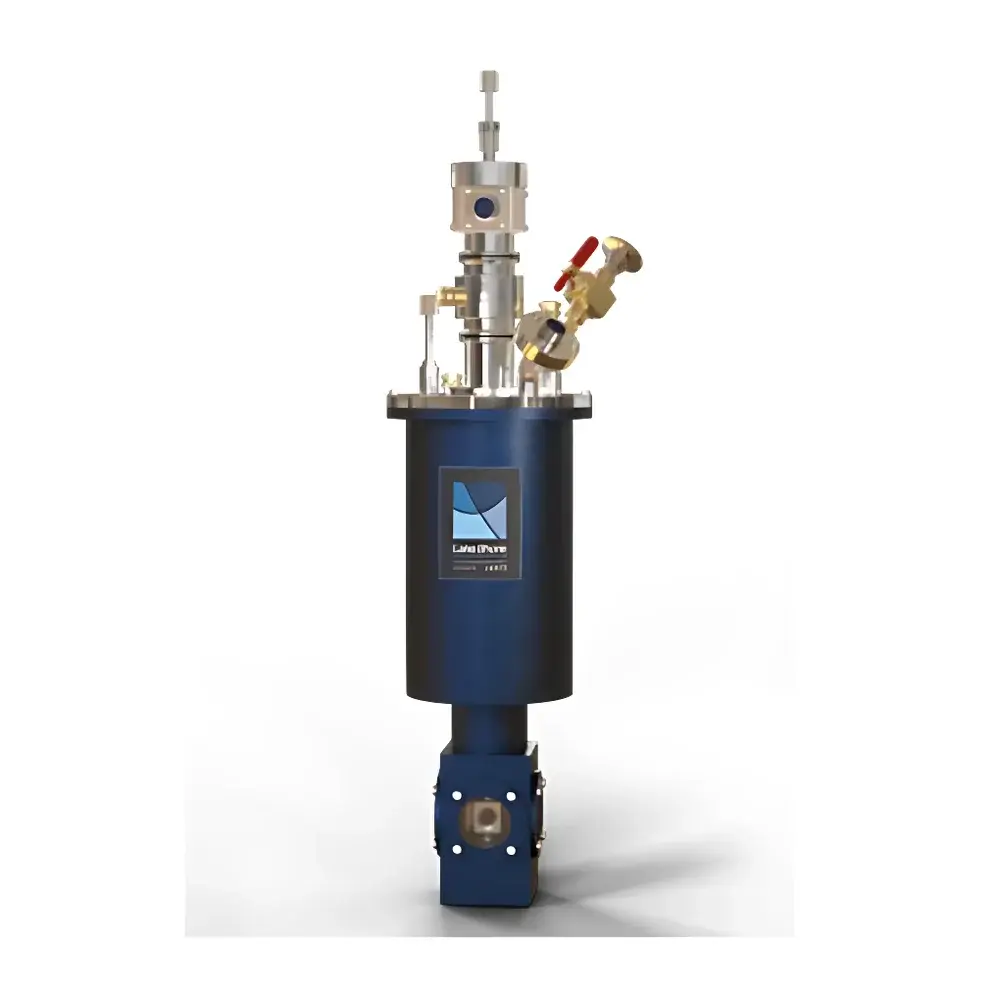
Lake Shore VNF-100 Optical Top-Loading Cryogenic Thermostat
| Brand | Lake Shore |
|---|---|
| Origin | USA |
| Model | VNF-100 |
| Cooling Method | Liquid Nitrogen (LN₂) |
| Temperature Range | 65 K to 325 K (VNF-100) |
| Typical Temperature Stability | ±50 mK |
| Sample Environment | Flowing Nitrogen Vapor |
| Sample Types | Non-conductive & Conductive Solids, Liquids, Powders |
| Sample Exchange Time | ≤10 min |
| Cool-down to 77 K | ≤30 min |
| LN₂ Capacity | 1.2 L |
| Typical Hold Time | 6–8 h |
| Optical Window | Standard (VNF-100), Optional (VNF-100-TH) |
| Sample Chamber Inner Diameter | 30 mm (VNF-100), 22.35 mm (VNF-100-TH) |
| Height | 583 mm (VNF-100), 812.8 mm (VNF-100-TH) |
| Weight | 11.5 kg (net), 15.9 kg (shipping) |
| Shipping Dimensions | 762 × 508 × 431.8 mm |
Overview
The Lake Shore VNF-100 Optical Top-Loading Cryogenic Thermostat is a precision-engineered, liquid nitrogen–cooled thermal platform designed for optical and electrical characterization of materials under controlled cryogenic conditions. Unlike closed-cycle refrigerators or immersion cryostats, the VNF-100 operates via a flowing nitrogen vapor environment—where the sample resides in thermally stable, low-turbulence gaseous nitrogen generated by controlled evaporation of LN₂ upstream of the sample chamber. This architecture eliminates direct thermal contact between the sample and cryogen, minimizing mechanical stress, condensation risks, and thermal gradients—making it especially suitable for delicate, non-adhering, or low-thermal-mass specimens such as powders, viscous liquids, thin films, and suspended microstructures. The top-loading configuration enables rapid, tool-free access to the sample stage without system warm-up, supporting high-throughput experimental workflows in spectroscopy, magneto-optical studies, photoluminescence mapping, and low-temperature transport measurements.
Key Features
- Optimized dual-zone temperature control: Primary LN₂ flow regulation via calibrated vaporization path with integrated Pt sensor; secondary resistive heater + sensor mounted directly on sample stage for fine-tuning and dynamic ramping (±0.1 K resolution)
- Top-loading design with removable sample positioning assembly—enabling full optical and physical access to the sample region in under 10 seconds
- Thermally isolated sample chamber: Physically decoupled from the LN₂ reservoir to maintain base temperature stability during sample exchange
- Standard optical access: Front-facing, anti-reflection coated fused silica window (25.4 mm clear aperture) compatible with UV–VIS–NIR transmission/reflection setups; optional extended-range windows available for X-ray, mid-IR, and THz applications
- Modular electrical feedthroughs: Configurable BNC, SMA, triaxial, and DC multi-pin connectors pre-installed on vacuum-tight flange for in-situ electrical characterization
- Compact footprint and benchtop integration: Designed for compatibility with optical tables, confocal microscopes, and probe stations—no external compressor or chiller required
Sample Compatibility & Compliance
The VNF-100 accommodates a broad spectrum of sample geometries and physical states—including insulating and conducting solids, colloidal suspensions, cryogenic liquids (e.g., liquid argon baths), and loosely packed powders—without requiring thermal anchoring or epoxy bonding. Its vapor-cooled architecture avoids frost formation and eliminates cold-finger-induced vibration, critical for interferometric and scanning probe applications. All vacuum-compatible components conform to ASTM E1502 (standard practice for calibration of cryogenic temperature sensors) and ISO/IEC 17025 traceable metrology protocols. The system supports GLP-compliant operation when paired with Lake Shore’s certified temperature controllers (e.g., Model 336), enabling audit-ready temperature logging with timestamped metadata and sensor calibration history.
Software & Data Management
Temperature control and monitoring are fully integrated via Lake Shore’s CrossLight™ software suite (Windows-based), which provides real-time dual-channel PID tuning, programmable ramp/soak profiles, and synchronized data acquisition from up to four external instruments (e.g., lock-in amplifiers, spectrometers, source meters). All temperature setpoints, sensor readings, heater outputs, and alarm states are logged with millisecond resolution and exported in CSV or HDF5 format. The software complies with FDA 21 CFR Part 11 requirements when deployed with electronic signature modules and audit-trail enabled configurations—supporting regulated R&D environments in pharmaceutical, aerospace, and defense sectors.
Applications
- Temperature-dependent photoluminescence (PL) and electroluminescence (EL) spectroscopy of quantum dots, perovskites, and 2D materials
- In-situ Raman and FTIR measurements across 65–500 K with minimal background interference
- Low-temperature Hall effect and van der Pauw transport studies using integrated four-probe sample holders
- Optical pump–probe experiments requiring sub-second thermal settling after sample insertion
- Cryogenic ellipsometry and reflectance anisotropy measurements on epitaxial thin films
- Calibration of infrared detectors and bolometers against NIST-traceable blackbody references
FAQ
What is the difference between the VNF-100 and VNF-100-TH models?
The VNF-100-TH extends the upper temperature limit to 500 K via enhanced heater power and optimized thermal shielding, while retaining identical base performance down to 65 K. Its narrower sample bore (22.35 mm vs. 30 mm) accommodates higher-temperature-rated optical windows.
Can the VNF-100 be used under high vacuum or UHV conditions?
Yes—the system features all-metal seals and a bakeable stainless-steel body rated for ≤1×10⁻⁶ Torr base pressure; optional ion pump and residual gas analyzer interfaces are available.
Is remote operation supported?
All temperature control and status monitoring functions are accessible via TCP/IP or RS-232, enabling integration into LabVIEW, Python (PyVISA), or MATLAB automation frameworks.
How often must liquid nitrogen be refilled during continuous operation?
At 77 K, typical consumption is ~0.4 L/h; the 1.2 L reservoir supports 6–8 hours of unattended operation, extendable with optional auto-fill LN₂ dewar integration.
Are custom sample stages or electrical configurations available?
Lake Shore offers factory-customized sample holders—including rotating stages, magnetic field–compatible platforms, and RF-shielded carriers—with full mechanical drawings and thermal performance validation reports provided upon request.
Related Products



