
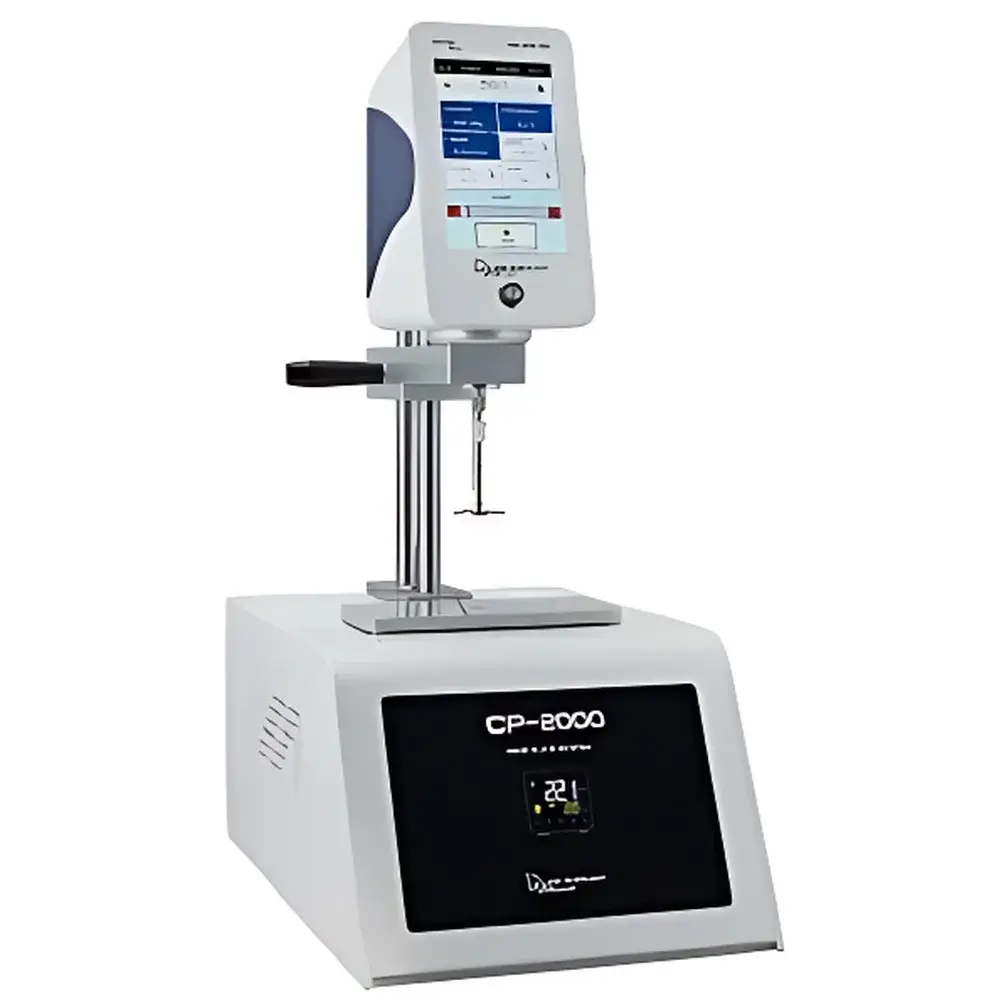
Lamy RM100+RT-3 High-Temperature Rotational Viscometer
| Brand | Lamy Rheology |
|---|---|
| Origin | France |
| Model | RM100 + RT-3 High-Temperature Furnace |
| Instrument Type | Benchtop Rotational Viscometer |
| Viscosity Range | 1–540,000,000 mPa·s |
| Rotational Speed | 0.3–1500 rpm |
| Torque Range (Standard) | 0.05–13 mN·m |
| Accuracy | ±1% of full scale |
| Repeatability | ±0.2% |
| Temperature Control (RT-3) | Ambient to 300 °C ±0.2 °C |
| Display | 7″ capacitive touchscreen |
| Interfaces | RS-232, USB, 4–20 mA analog output |
| Security | User authentication with 4-digit password |
| Power Supply | 90–240 VAC, 50/60 Hz |
| Compliance | CE, RoHS |
| Sample Compatibility | Disposable cups MB-B/C/D, coaxial cylinder systems |
| Software Integration | RHEOMATIP-compatible |
| Data Management | On-device method programming, real-time data logging, USB backup |
Overview
The Lamy RM100+RT-3 is a high-precision benchtop rotational viscometer engineered for demanding high-temperature rheological characterization in regulated industrial and research environments. Based on Couette flow principles, it measures dynamic viscosity by quantifying the torque required to rotate a spindle (or coaxial cylinder) at controlled angular velocity within a thermally stabilized sample. The system integrates the RM100 viscometer base unit—featuring a brushless DC motor, digital torque transducer, and embedded Pt100 temperature sensing—with the RT-3 high-temperature furnace module, enabling stable thermal control from ambient up to 300 °C with ±0.2 °C accuracy. This architecture eliminates external oil baths and supports rapid thermal equilibration, making it particularly suitable for temperature-dependent studies of thermosetting resins, polymer melts, pharmaceutical suspensions, and high-melting-point food matrices where thermal history critically influences structural development.
Key Features
- Integrated 7″ capacitive touchscreen interface with intuitive icon-driven navigation, supporting multilingual operation (English, French, German, Spanish) and on-device method programming—including ramped temperature profiles, multi-speed sequences, and time-sweep protocols.
- High-fidelity coaxial alignment mechanism in the RT-3 furnace ensures precise concentricity between spindle and cup, minimizing secondary flow artifacts and enhancing measurement reproducibility across extended temperature ranges.
- Dual-mode torque sensing: Standard configuration (0.05–13 mN·m) optimized for medium-to-high viscosity fluids; optional low-range (LR) variant (0.005–0.8 mN·m) available for delicate gels or dilute polymer solutions.
- Comprehensive connectivity suite: RS-232 and USB ports for bidirectional communication with Lamy’s RHEOMATIP software; USB host port for direct printer output or data export to flash storage; configurable 4–20 mA analog output for integration into PLC-controlled process monitoring systems.
- Robust security framework compliant with GLP audit requirements: User-specific login credentials with four-digit password protection, timestamped operator ID logging, and immutable method parameter locking to prevent unauthorized configuration changes.
- Modular sample handling: Designed for use with disposable aluminum or stainless-steel sample cups (MB-B, MB-C, MB-D), eliminating cross-contamination risks and reducing cleaning validation burden in GMP-regulated QC laboratories.
Sample Compatibility & Compliance
The RM100+RT-3 accommodates a wide range of sample geometries—including standard spindles (LV, RV, HA, HB), coaxial cylinders (CC series), and custom fixtures—enabling shear-rate-dependent analysis per ASTM D2196, ISO 2555, and USP . Its RT-3 furnace chamber accepts cup-based configurations up to Ø60 mm × H80 mm, supporting both Newtonian and non-Newtonian fluid evaluation under isothermal or programmed thermal conditions. All electronic subsystems meet CE marking requirements and conform to IEC 61000-6-3 (EMC) and IEC 61010-1 (safety). Firmware supports audit-trail generation per FDA 21 CFR Part 11 when used with validated RHEOMATIP software, including electronic signatures, version-controlled method storage, and tamper-evident raw data archiving.
Software & Data Management
RHEOMATIP software provides full remote control, real-time graphing, and advanced post-processing capabilities—including yield stress calculation via Casson/Bingham models, thixotropy index derivation from step-down recovery tests, and Arrhenius activation energy fitting. Data files are saved in vendor-neutral CSV format with embedded metadata (operator ID, timestamp, environmental conditions, calibration traceability). On-instrument data logging retains up to 10,000 measurement points with automatic timestamping, while USB backup preserves complete method definitions, calibration certificates, and historical datasets. All firmware updates are digitally signed and installed via secure USB transfer, maintaining integrity throughout the instrument lifecycle.
Applications
This system is routinely deployed in quality control and formulation development across sectors requiring high-temperature viscosity assurance: hot-melt adhesives (ISO 1133), molten chocolate and confectionery coatings (ISO 8587), silicone elastomer prepolymers, API suspension stability screening (ICH Q5C), catalyst slurries in petrochemical refining, and ceramic paste rheology for additive manufacturing. Its thermal stability and repeatability make it suitable for ISO/IEC 17025-accredited testing laboratories performing accredited viscosity determinations under scope clause 5.9.
FAQ
What temperature range does the RT-3 furnace support, and how is thermal uniformity verified?
The RT-3 furnace operates from ambient to 300 °C with ±0.2 °C setpoint accuracy, verified using NIST-traceable Pt100 sensors calibrated annually per ISO/IEC 17025 procedures.
Can the RM100+RT-3 perform yield stress measurements?
Yes—when paired with appropriate geometry (e.g., vane or cone-and-plate) and RHEOMATIP software, it supports controlled-stress ramp tests and Herschel-Bulkley model fitting per ASTM D7480.
Is the system compatible with automated sample changers?
While not natively integrated, the RS-232 and USB command protocol supports third-party automation via SCPI-like ASCII commands, enabling synchronization with XYZ robotic handlers in high-throughput labs.
Does the instrument meet regulatory requirements for pharmaceutical QC documentation?
When operated with validated RHEOMATIP software and documented calibration records, it satisfies data integrity requirements outlined in EU Annex 11 and FDA Guidance for Industry on Data Integrity and Compliance With CGMP.
What maintenance intervals are recommended for long-term accuracy?
Annual torque sensor recalibration and biannual verification of thermal gradient uniformity across the furnace zone are recommended; all procedures are detailed in the manufacturer’s Maintenance Manual Rev. 4.2.



