
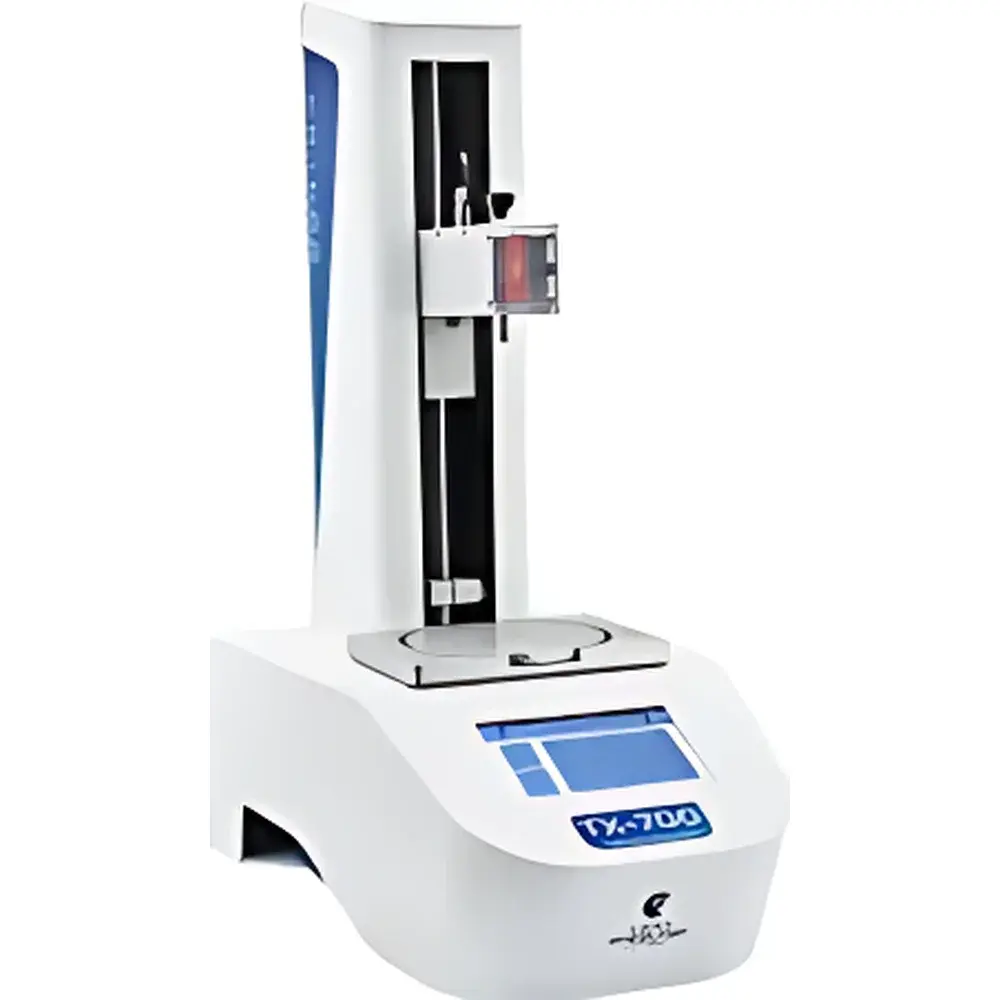
Lamy TX-700 Texture Analyzer
| Brand | Lamy Rheology |
|---|---|
| Origin | France |
| Model | TX-700 |
| Touchscreen Display | 7" Color LCD |
| Force Sensor Options | 10 N (1 kg), 20 N (2 kg), 50 N (5 kg), 250 N (20 kg), 500 N (50 kg) |
| Force Resolution | 0.001 N (0.1 g) up to 50 N |
| Force Accuracy | ±0.05 % FS |
| Speed Range | 0.1–10 mm/s (±0.2 %) |
| Maximum Travel Height | 240 mm |
| Displacement Resolution | 0.1 mm |
| Temperature Measurement | Integrated PT100 probe, range −50 °C to +300 °C |
| Sample Platform | Adjustable height, 160 mm diameter, insertable stage 120 × 220 mm |
| Operating Modes | Compression, Relaxation, Tension, TPA Cycle, Penetration, Relative Compression |
| Data Interface | RS232, USB, 4–20 mA analog output |
| Software Control | Optional external PC control via dedicated software |
| Data Export | USB backup and CSV export |
| Safety | Operator ID lock (4-digit numeric code) |
| Power Supply | 90–240 VAC, 50/60 Hz |
| Dimensions (L×W×H) | 610 × 340 × 650 mm |
| Weight | 22 kg |
| Language Support | English, French, Spanish, Russian |
| Compliance | Designed for GLP-compliant environments |
Overview
The Lamy TX-700 Texture Analyzer is a high-precision, motorized mechanical testing instrument engineered for objective measurement of mechanical properties—including hardness, fracturability, elasticity, adhesiveness, cohesiveness, chewiness, and springiness—across solid, semi-solid, and viscoelastic materials. Based on controlled uniaxial compression, tension, penetration, and cyclic deformation principles, the TX-700 applies calibrated force at defined speeds and displacements while continuously recording real-time load vs. distance, time, or temperature profiles. Its modular architecture integrates a precision stepper-driven actuator, interchangeable load cells (ranging from 10 N to 500 N), and an embedded PT100 temperature sensor—enabling simultaneous mechanical and thermal response characterization under ambient or conditioned conditions. Designed for both R&D laboratories and production-floor quality control environments, the TX-700 meets the functional and regulatory expectations of food science, pharmaceutical development, polymer engineering, construction materials testing, and academic research.
Key Features
- 7-inch full-color touchscreen interface with intuitive icon-based navigation—enabling direct method programming, real-time curve visualization (force/distance/time/temperature), and on-device data review without external hardware.
- Modular force sensing system with five selectable load cell options (10 N, 20 N, 50 N, 250 N, 500 N), each offering high-resolution force detection (0.001 N up to 50 N; 0.01 N above) and traceable accuracy of ±0.05 % full scale.
- Programmable crosshead speed from 0.1 to 10 mm/s (±0.2 % linearity), with 240 mm maximum travel height and 0.1 mm displacement resolution—supporting standardized texture profiling protocols including Texture Profile Analysis (TPA), puncture, extrusion, and shear tests.
- Integrated PT100 temperature probe with extended operational range (−50 °C to +300 °C), allowing synchronized thermal monitoring during mechanical testing—critical for evaluating temperature-dependent rheological transitions in fats, gels, polymers, and confectionery systems.
- Adjustable sample platform (160 mm Ø, insertable 120 × 220 mm stage) with vertical positioning capability—ensuring optimal alignment for diverse probe geometries and specimen configurations.
- Comprehensive safety and traceability controls: 4-digit operator ID authentication locks method parameters and prevents unauthorized modifications; all measurements include timestamp, user ID, and environmental metadata.
Sample Compatibility & Compliance
The TX-700 accommodates a broad spectrum of sample types—from soft dairy gels and baked goods to rigid composites, asphalt binders, and pharmaceutical tablets—via its extensive library of standardized and custom probes (cylindrical, spherical, blade, Kramer shear, Warner–Bratzler, and bespoke geometries). Probe material options include stainless steel (AISI 316), aluminum, PTFE-coated, and food-grade anodized variants. The instrument complies with key international test standards including ISO 11357-3 (plastics—DSC determination of crystallinity), ASTM D638 (tensile properties of plastics), EN ISO 12084 (food texture—penetration testing), and USP (mechanical testing of dosage forms). When paired with optional validated software, it supports 21 CFR Part 11–compliant electronic records, audit trails, and role-based access control for regulated environments.
Software & Data Management
Data acquisition and analysis are supported through both onboard firmware and optional PC-based software (LamySoft Pro). The embedded OS enables method storage (up to 100 preconfigured protocols), real-time graph overlay, peak detection, area-under-curve integration, and automatic parameter extraction (e.g., yield force, fracture energy, relaxation modulus). All datasets export in CSV format via USB flash drive. RS232 and USB ports allow bidirectional communication with laboratory information management systems (LIMS) or statistical process control (SPC) platforms. Analog 4–20 mA output supports integration into industrial PLC networks for inline QC feedback loops. Software modules offer advanced features including multi-cycle sequence scripting, statistical batch reporting, and GLP/GMP-compliant report generation with digital signatures.
Applications
- Food Science: Quantitative assessment of texture attributes in cheeses, meats, fruits, cereals, and plant-based alternatives—supporting shelf-life studies, formulation optimization, and sensory correlation modeling.
- Pharmaceuticals: Tablet hardness, capsule shell brittleness, gelatin bloom strength, and ointment extrudability testing per USP monographs and ICH Q5E guidelines.
- Construction Materials: Mechanical evaluation of asphalt binders, concrete admixtures, sealants, and thermal insulation foams under controlled thermal-mechanical loading.
- Academic Research: Teaching and investigation of viscoelastic behavior, fracture mechanics, and time–temperature superposition in polymer science, biomaterials, and soft matter physics.
- Quality Assurance: Routine release testing in manufacturing environments where rapid, operator-independent pass/fail decisions are required against predefined texture specifications.
FAQ
What load cell options are available for the TX-700, and how do I select the appropriate one?
The TX-700 supports five interchangeable load cells: 10 N, 20 N, 50 N, 250 N, and 500 N. Selection depends on expected peak force—e.g., 10–50 N for soft foods and gels; 250–500 N for construction materials or dense pharmaceutical compacts. Each cell maintains consistent resolution and accuracy across its range.
Can the TX-700 operate in temperature-controlled chambers?
Yes—the integrated PT100 probe functions independently of ambient conditions, and the instrument’s mechanical subsystem is rated for stable operation within environmental chambers. External temperature control must be managed separately; the TX-700 reports and logs temperature but does not regulate it.
Is method validation support available for regulated industries?
Lamy provides IQ/OQ documentation templates and offers on-site or remote installation qualification (IQ) and operational qualification (OQ) services. Full 21 CFR Part 11 compliance requires deployment of the optional LamySoft Pro with audit trail and electronic signature modules.
How is data integrity ensured during transfer from instrument to PC?
All USB exports generate timestamped, immutable CSV files containing raw sensor data, metadata (operator ID, method name, date/time, temperature), and calibration identifiers—enabling full traceability and alignment with ALCOA+ data governance principles.
Does the TX-700 support automated test sequences across multiple samples?
Yes—using LamySoft Pro, users can define multi-step programs with auto-positioning, sequential probe changes (via optional auto-turret), and pass/fail logic based on configurable thresholds—reducing manual intervention and inter-operator variability.



