
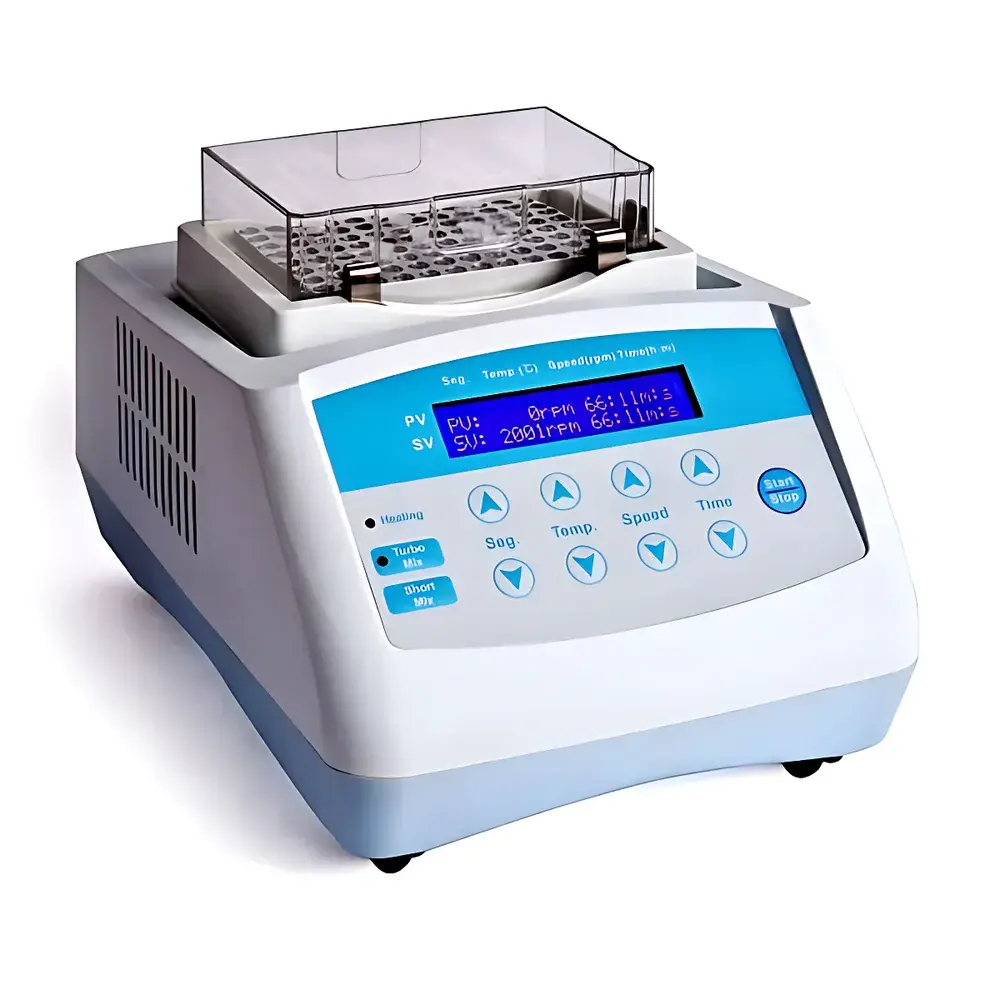
Langbo MK-1 Precision Metal Block Heater
| Brand | Langbo |
|---|---|
| Model | MK-1 |
| Temperature Range | RT + 5°C to 150°C |
| Temperature Stability | ±0.5°C (40–100°C), ±1.0°C (100–150°C) |
| Uniformity Across Block | ≤ ±0.5°C |
| Max ΔT Within Block at 40°C | 0.3°C |
| Display Resolution | 0.1°C |
| Timer Range | 1 min to 99 h 59 min |
| Heating Time | ≤30 min (20°C → 150°C) |
| Block Dimensions | 96 × 96 × 49 mm |
| Compliance | CE-marked, RoHS-compliant, GLP-ready design |
Overview
The Langbo MK-1 Precision Metal Block Heater is a microprocessor-controlled dry bath instrument engineered for stable, uniform, and repeatable thermal incubation of samples in tubes, vials, and microcentrifuge containers. Unlike water baths, it employs solid aluminum heating blocks with high thermal mass and optimized heat distribution pathways—enabling rapid heating, minimal evaporation risk, and precise temperature maintenance across all sample positions. Its operation is grounded in conductive heat transfer principles, where thermal energy is delivered directly from the heated metal surface to the vessel wall, minimizing ambient air interference and ensuring high reproducibility in applications requiring strict thermal consistency—such as enzyme reactions, DNA denaturation/annealing, cell lysis, reagent pre-warming, and standard curve preparation in clinical and research laboratories.
Key Features
- Microprocessor-based PID temperature control with digital LCD interface displaying real-time setpoint, actual block temperature, and countdown timer
- Calibration offset function allows user-adjustable correction of thermal sensor drift (±9.9°C range), supporting traceable accuracy verification per ISO/IEC 17025 requirements
- Self-diagnostic system continuously monitors heater circuit integrity, sensor continuity, and thermal runaway conditions; triggers audible alarm and automatic shutdown upon fault detection
- Programmable timer with 1-minute to 99-hour 59-minute range; auto-shutdown with audible alert upon completion ensures protocol compliance and energy efficiency
- Intuitive Chinese-language UI (configurable firmware option available for English localization) with status icons indicating heating mode, standby, alarm, and calibration state
- Rugged anodized aluminum block construction with corrosion-resistant surface finish; compatible with standard laboratory cleaning agents and alcohol wipes
Sample Compatibility & Compliance
The MK-1 accommodates a comprehensive range of tube formats via interchangeable, precision-machined aluminum modules—each manufactured to ±0.05 mm dimensional tolerance. Standard configurations support 0.2 mL PCR strips (96-well), 0.5 mL, 1.5 mL, and 2.0 mL microcentrifuge tubes, as well as round-bottom culture tubes (6–40 mm diameter). Custom module geometries can be ordered to match proprietary container footprints. All modules share identical footprint (96 × 96 × 49 mm) for seamless swapping without recalibration. The device meets CE safety directives (2014/35/EU Low Voltage Directive and 2014/30/EU EMC Directive), complies with RoHS 2011/65/EU restrictions on hazardous substances, and supports Good Laboratory Practice (GLP) workflows through its audit-trail-capable timer logging and calibration history retention (when used with optional data export firmware).
Software & Data Management
While the MK-1 operates as a standalone benchtop unit, its embedded firmware architecture supports future firmware upgrades via USB port (optional accessory kit). Current functionality includes non-volatile memory storage of last-used setpoint, timer value, and calibration offset—retained after power cycle. For regulated environments, the instrument’s deterministic thermal response, documented temperature stability profiles, and user-accessible calibration adjustment align with FDA 21 CFR Part 11 expectations when integrated into validated SOPs. Optional RS-232 or USB-to-serial adapters enable connection to LIMS or ELN systems for automated run logging, provided third-party drivers are implemented per site-specific validation protocols.
Applications
- Thermal activation of restriction enzymes and ligases in molecular biology workflows
- Controlled denaturation of nucleic acids prior to hybridization or sequencing library prep
- Consistent pre-heating of reagents (e.g., agarose solutions, staining buffers, antibody diluents)
- Cell suspension warming to physiological temperatures (37°C) prior to transfection or assay initiation
- Stability testing of pharmaceutical intermediates under accelerated thermal conditions (40–80°C)
- Standardized incubation of QC reference materials in clinical chemistry and microbiology labs
- Supporting ASTM D5293 (cold cranking simulator viscosity) and ISO 3104 (petroleum products kinematic viscosity) sample conditioning steps
FAQ
What is the maximum operating temperature of the MK-1?
The MK-1 achieves a maximum setpoint of 150°C, with thermal stability maintained within ±1.0°C across the full block surface at temperatures between 100°C and 150°C.
Can I use multiple modules simultaneously?
No—the MK-1 accepts only one module at a time due to fixed block geometry and thermal coupling design; however, modules are hot-swappable without cooling delay.
Is the temperature sensor calibrated at the factory?
Yes—each unit ships with NIST-traceable calibration certificate covering three points (40°C, 75°C, 100°C); users may perform field recalibration using the built-in offset function.
Does the MK-1 meet GLP or GMP requirements?
It supports GLP/GMP practices through deterministic performance, calibration traceability, and configurable audit-log readiness—but formal qualification (IQ/OQ/PQ) must be conducted by the end user per internal SOPs.
How often should I verify temperature uniformity?
We recommend quarterly verification using a calibrated thermocouple probe array per ISO/IEC 17025 Annex A.3 guidelines, especially before critical validation runs or after mechanical impact.
Related Products



