
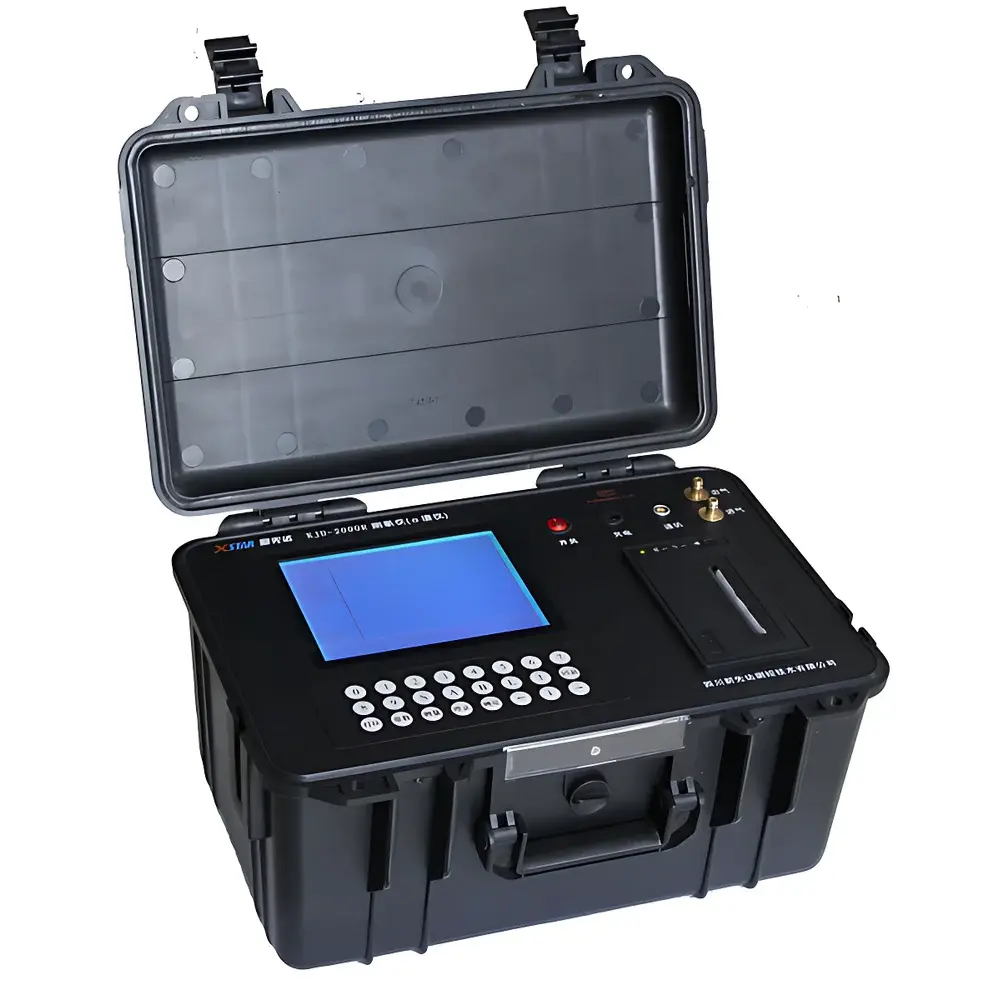
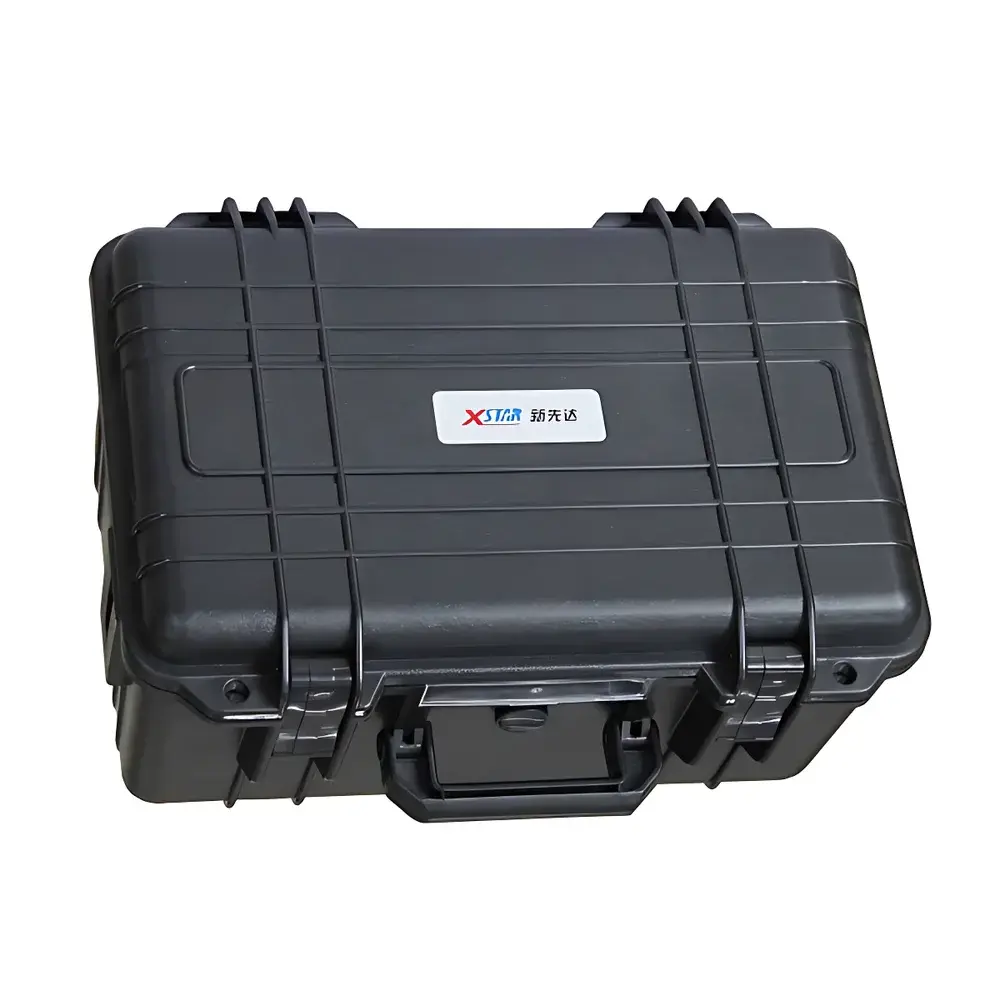
Xinxianda KJD-2000R Radon Detector
| Brand | Xinxianda |
|---|---|
| Model | KJD-2000R |
| Detection Principle | Electrostatic Collection + Alpha Spectrometry |
| Radionuclides | ²²²Rn and ²²⁰Rn |
| Measurement Range | 3.7–925,000 Bq/m³ (0.1–25,000 pCi/L) |
| Detection Sensitivity | 0.2 CPM/pCi/L |
| Pump Flow Rate | 1 L/min |
| Measurement Duration | 10 min (soil), 60 min (air or water) |
| Uncertainty | ≤10% (k=2) |
| Data Storage | 1,000 alpha spectra |
| Power Supply | 12 V/7 Ah rechargeable battery (≥10 h operation) or AC 220 V |
| Operating Environment | 0–50 °C, ≤95% RH |
| Dimensions | 300 × 200 × 180 mm |
| Weight | 5 kg |
| Detector Type | Passivated implanted planar silicon (PIPS) alpha spectrometer with gold-silicon surface barrier configuration |
| Calibration Sources | Certified radon chamber or liquid ²²⁶Ra standard |
Overview
The Xinxianda KJD-2000R Radon Detector is a field-deployable, continuous alpha-spectrometric instrument engineered for quantitative measurement of radon isotopes (222Rn and 220Rn) in air, soil gas, and aqueous samples. It operates on the principle of electrostatic precipitation of radon progeny—primarily 218Po and 214Po for 222Rn, and 212Po for 220Rn—onto a passivated implanted planar silicon (PIPS) alpha detector. The resulting alpha energy spectrum is resolved in real time, enabling isotope-specific discrimination and concentration calculation without cross-interference. As a compliant implementation of ISO 11665-2:2019 (Measurement of radioactivity — Radon-222 — Part 2: Integrated measurement method for determining average activity concentration), the KJD-2000R supports both short-term screening and long-term monitoring protocols required by environmental health and regulatory laboratories.
Key Features
- Real-time alpha spectrometry with simultaneous 222Rn and 220Rn identification via distinct alpha peak resolution (6.00 MeV and 6.29 MeV, respectively)
- Electrostatic collection chamber optimized for >95% progeny deposition efficiency under variable humidity and flow conditions
- Low-background PIPS detector with gold-silicon surface barrier architecture, insensitive to mechanical vibration and electromagnetic noise
- Integrated 1 L/min diaphragm pump with flow stabilization circuitry and automatic pressure compensation
- Onboard microcontroller (8-bit MCU) with 128 KB non-volatile RAM for secure storage of 1,000 full alpha spectra, including timestamp, temperature, humidity, and spectral metadata
- Graphical 128×64 dot-matrix LCD with Chinese/English bilingual interface and real-time curve plotting of count rate vs. time
- Dual power architecture: AC 220 V mains or 12 V/7 Ah sealed lead-acid battery supporting ≥10 hours of continuous operation
- RS-232 serial interface compliant with EIA/TIA-232-F standards for data export and remote control
Sample Compatibility & Compliance
The KJD-2000R accommodates three primary sampling matrices through standardized accessories: ambient air (via integrated inlet filter and desiccant tube), soil gas (using stainless-steel probe, moisture trap, and vacuum-assisted extraction manifold), and water (via radon-extraction membrane module and degassing chamber). All configurations maintain traceability to national radon calibration facilities per CNAS-CL01:2018 (equivalent to ISO/IEC 17025). The instrument satisfies performance criteria outlined in EPA Protocol for Radon and Radon Decay Product Measurements (EPA 402-R-92-002), ASTM D6911-22 (Standard Guide for Soil Gas Sampling), and IAEA Technical Reports Series No. 437 (Radon Measurement Techniques). Its measurement uncertainty of ≤10% (k = 2) meets GLP requirements for environmental monitoring programs subject to regulatory audit.
Software & Data Management
The included Windows-based desktop application (v3.2+) provides spectral deconvolution, peak fitting using Gaussian-Lorentzian hybrid algorithms, and automated background subtraction based on Poisson-weighted moving average. Raw spectra are stored in vendor-neutral .SPE format (following ORTEC/Canberra conventions), enabling interoperability with third-party analysis tools such as Genie 2000 or GammaVision. Audit trails record all user actions—including calibration updates, parameter changes, and data exports—with timestamps and operator ID fields. The software supports 21 CFR Part 11-compliant electronic signatures when deployed in regulated environments (e.g., public health laboratories accredited under ISO/IEC 17025). Export options include CSV, PDF reports with embedded spectra, and XML metadata bundles compatible with LIMS integration.
Applications
- Indoor radon risk assessment in residential, educational, and healthcare buildings per WHO Handbook on Indoor Radon (2009) and EU Council Directive 2013/59/Euratom
- Geological surveying for uranium prospecting, fault-line mapping, and hydrogeological modeling via soil-gas radon profiling
- Drinking water compliance testing for 226Ra-derived radon in groundwater sources, aligned with WHO Guidelines for Drinking-water Quality (4th ed.) and EPA Maximum Contaminant Level (MCL) of 300 pCi/L
- Post-remediation verification of radon mitigation systems in basements and crawl spaces
- Research applications in earthquake precursor studies, volcanic monitoring, and radon exhalation rate quantification from building materials
- Academic instruction in nuclear instrumentation, environmental radiochemistry, and radiation protection principles
FAQ
What radon isotopes does the KJD-2000R detect, and how are they distinguished?
The instrument resolves 222Rn (via 6.00 MeV alpha from 218Po) and 220Rn (via 6.29 MeV alpha from 212Po) using high-resolution alpha spectrometry. Peak separation exceeds 20 keV FWHM at 6 MeV.
Is calibration traceable to national standards?
Yes—calibration is performed using NIST-traceable 226Ra liquid standards or certified radon reference chambers accredited by CNAS (China National Accreditation Service). Annual recalibration is recommended.
Can the instrument operate unattended for extended periods?
It supports scheduled autonomous measurements up to 72 hours with battery backup; however, for regulatory reporting, manual start/stop and spectral review are advised per ISO 11665-4.
Does the software support multi-instrument fleet management?
The desktop application allows batch import/export and project-level organization but lacks centralized server architecture; enterprise deployment requires third-party LIMS integration via API or flat-file exchange.
What maintenance is required for sustained accuracy?
Annual detector window cleaning, desiccant replacement (every 200 hours of humid sampling), and pump diaphragm inspection. No routine gas replenishment or vacuum maintenance is needed.
Related Products







