
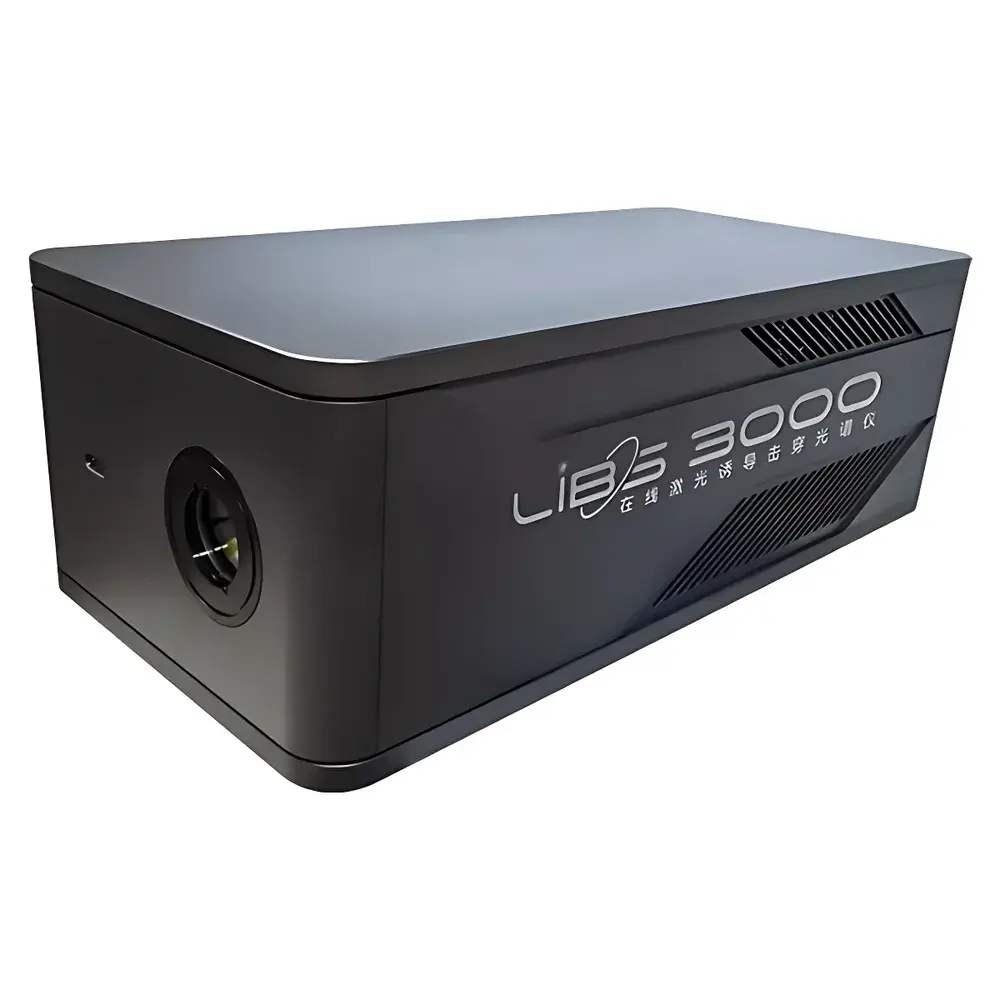
LANScientific LIBS 3000 Online Laser-Induced Breakdown Spectroscopy Analyzer
| Brand | LANScientific |
|---|---|
| Origin | Jiangsu, China |
| Manufacturer Type | Original Equipment Manufacturer (OEM) |
| Regional Classification | Domestic (PRC) |
| Model | LIBS 3000 |
| Instrument Type | Online |
| Pricing | Upon Request |
| Key | Value Format: None |
Overview
The LANScientific LIBS 3000 is an industrial-grade online Laser-Induced Breakdown Spectroscopy (LIBS) analyzer engineered for real-time elemental composition monitoring in continuous process environments. Operating on the fundamental principle of laser ablation plasma emission spectroscopy, the system delivers rapid, non-contact, and non-destructive elemental analysis by focusing a high-energy pulsed laser onto the sample surface to generate a transient microplasma. The emitted atomic and ionic line spectra—spanning UV–VIS–NIR wavelengths—are collected via fiber-coupled optics and resolved using a high-resolution echelle spectrometer with gated ICCD detection. Designed for integration into metallurgical, mining, and bulk materials processing lines, the LIBS 3000 enables millisecond-scale spectral acquisition (<1 ms per shot), facilitating high-frequency compositional feedback for closed-loop process control without interrupting production flow.
Key Features
- Integrated ruggedized probe cabinet with IP65-rated enclosure, dust and fume mitigation systems, and active thermal stabilization for stable operation in harsh industrial ambient conditions (−10 °C to +50 °C).
- Automated standoff distance regulation via integrated time-of-flight or triangulation-based positioning feedback, ensuring consistent laser fluence across variable sample topographies.
- Class 4 pulsed Nd:YAG laser source (1064 nm, ≤10 ns pulse width, ≥10 Hz repetition rate) compliant with IEC 60825-1:2014 safety standards; equipped with interlocked beam path and visible alignment laser for operational safety.
- Real-time spectral acquisition and onboard preprocessing (background subtraction, peak normalization, spectral calibration drift correction) executed via embedded ARM Cortex-A9 processor running Linux RTOS.
- Local HMI touchscreen interface with dual-mode operation: standalone mode for on-site diagnostics and remote supervisory control via Modbus TCP, OPC UA, or Ethernet/IP protocols.
Sample Compatibility & Compliance
The LIBS 3000 supports direct analysis of heterogeneous solid surfaces (e.g., hot metal slabs, sintered ore pellets, coal lumps), loose powders (e.g., cement raw meal, fly ash), and semi-molten streams (e.g., ladle slag skimming zones) without grinding, pressing, or chemical digestion. It complies with ISO/IEC 17025:2017 general requirements for competence of testing and calibration laboratories, and its data handling architecture aligns with FDA 21 CFR Part 11 for electronic records and signatures where deployed in GMP-regulated metallurgical QA/QC environments. Traceability of spectral acquisition timestamps, laser energy logs, and environmental sensor readings (temperature, humidity, pressure) is maintained for GLP audit readiness.
Software & Data Management
The proprietary LANScientific LIBS Suite v4.2 provides quantitative multielement calibration using matrix-matched reference standards and partial least squares (PLS) regression models. Spectral libraries include >80 elements (Z ≥ 11) with certified NIST SRM cross-validation. All raw spectra, processed quantitation results, and system health logs are timestamped and stored locally on encrypted SSD storage. Cloud synchronization (AWS IoT Core or private server option) enables centralized dashboard visualization, automated report generation (PDF/CSV), and configurable alarm triggers based on elemental concentration thresholds. Audit trails record user login events, method changes, calibration updates, and data export actions—fully traceable for regulatory review.
Applications
- Primary and secondary steelmaking: Real-time monitoring of alloying elements (Cr, Ni, Mo, Mn, Si) in molten bath and solidified slab surfaces to optimize charge composition and minimize rework.
- Mining and mineral processing: On-belt elemental assay of iron ore, bauxite, and phosphate rock for grade control and blending optimization prior to beneficiation.
- Coal quality assurance: Rapid determination of ash content, sulfur, chlorine, alkali metals (Na, K), and trace heavy metals (As, Pb, Hg) in pulverized coal feed streams.
- Environmental compliance: In-situ detection of hazardous elements (Cd, Cr⁶⁺ surrogates, Pb) in fly ash and slag residues from waste-to-energy plants.
- Geoscientific field deployment: Mobile LIBS cart integration for rapid lithological classification and rare-earth element (REE) screening in core logging operations.
FAQ
What is the typical detection limit for major and trace elements under standard operating conditions?
Detection limits range from 10–100 ppm for most metallic elements (e.g., Fe, Al, Ca, Mg) and 50–500 ppm for light elements (e.g., C, O, N, Li), depending on matrix effects, laser stability, and integration time.
Can the system operate continuously for 24/7 industrial shifts?
Yes—the LIBS 3000 is rated for uninterrupted operation up to 8,760 hours/year, supported by redundant cooling fans, self-diagnostic firmware, and predictive maintenance alerts triggered by laser energy decay or spectrometer signal-to-noise degradation.
Is spectral calibration required between analyses?
No—built-in internal reference lamp (Hg/Ar) and automated wavelength recalibration before each measurement sequence ensure long-term spectral fidelity without manual intervention.
How is data integrity ensured during network transmission?
All transmitted data packets are signed using SHA-256 HMAC authentication; TLS 1.2 encryption secures cloud uploads, and local database writes follow ACID-compliant transaction protocols.
Does the system support custom calibration models for proprietary alloys or ores?
Yes—users may import their own certified reference materials (CRMs) and develop application-specific PLS or neural network models using the offline Calibration Builder module.




