
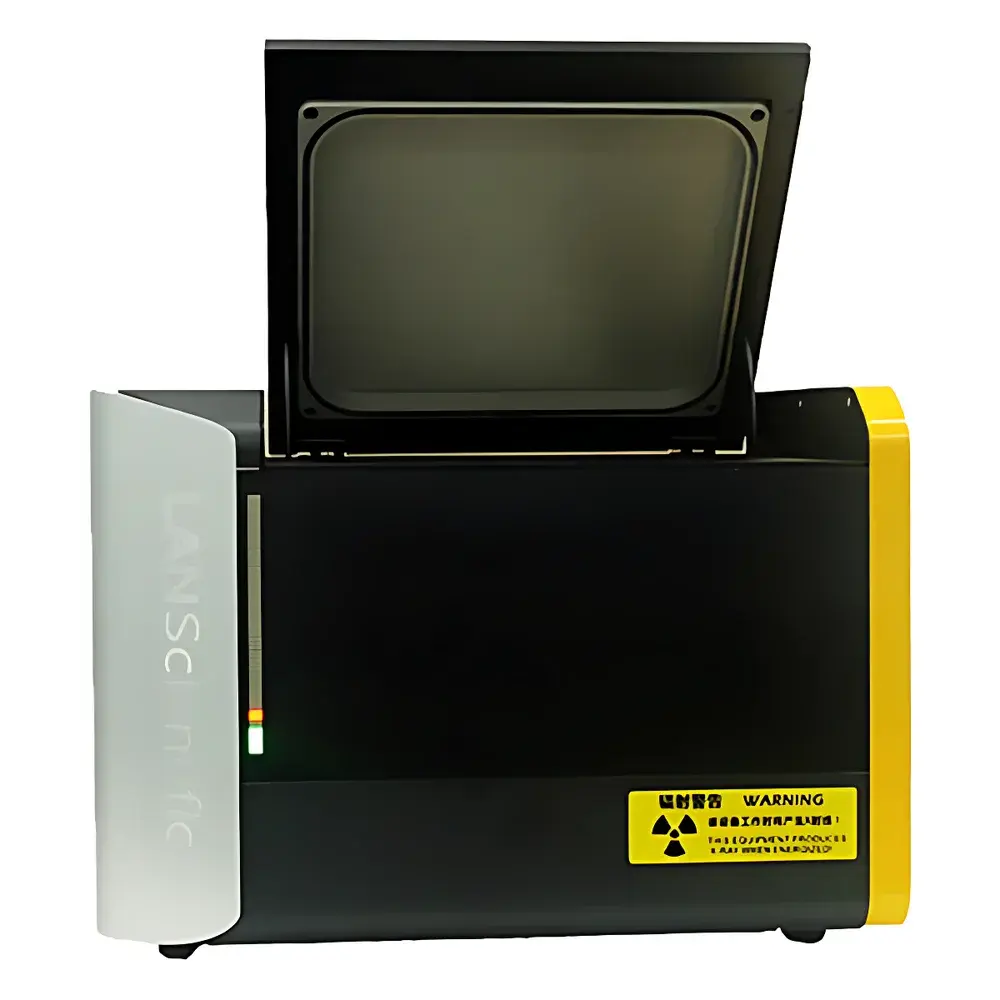
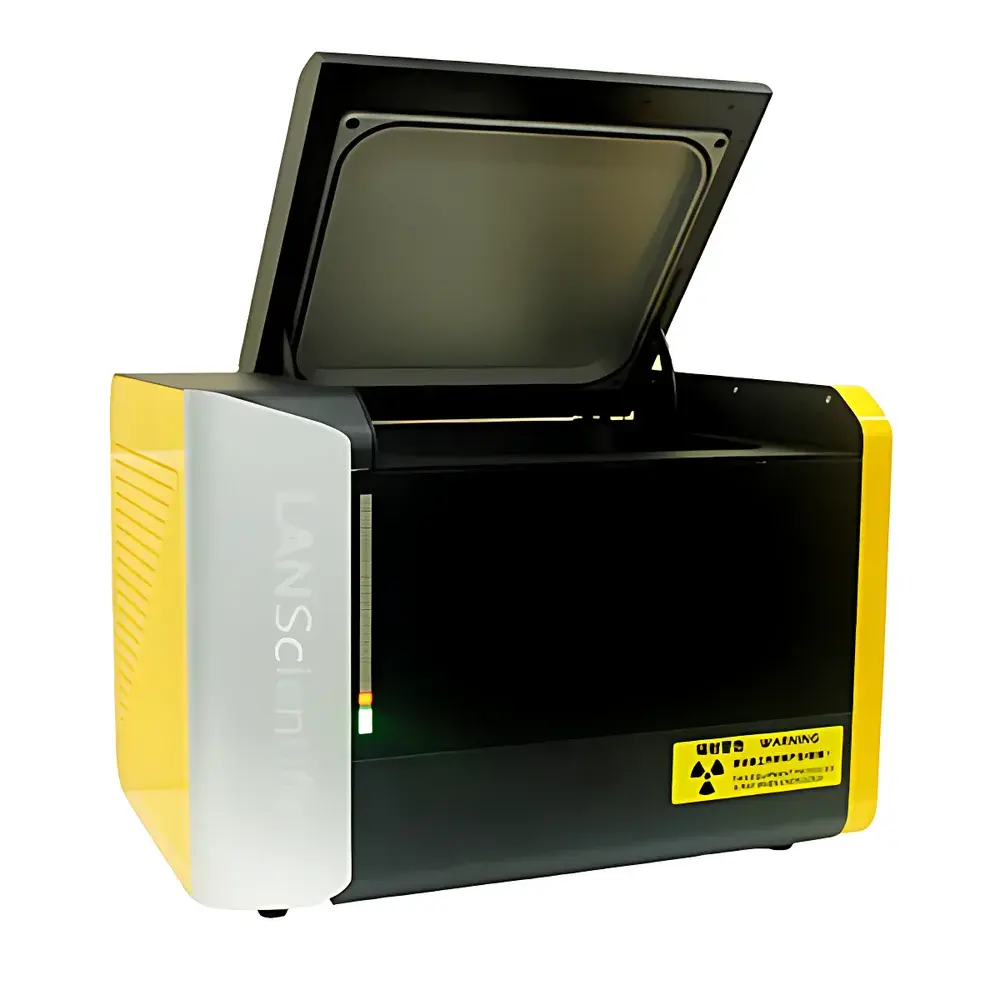
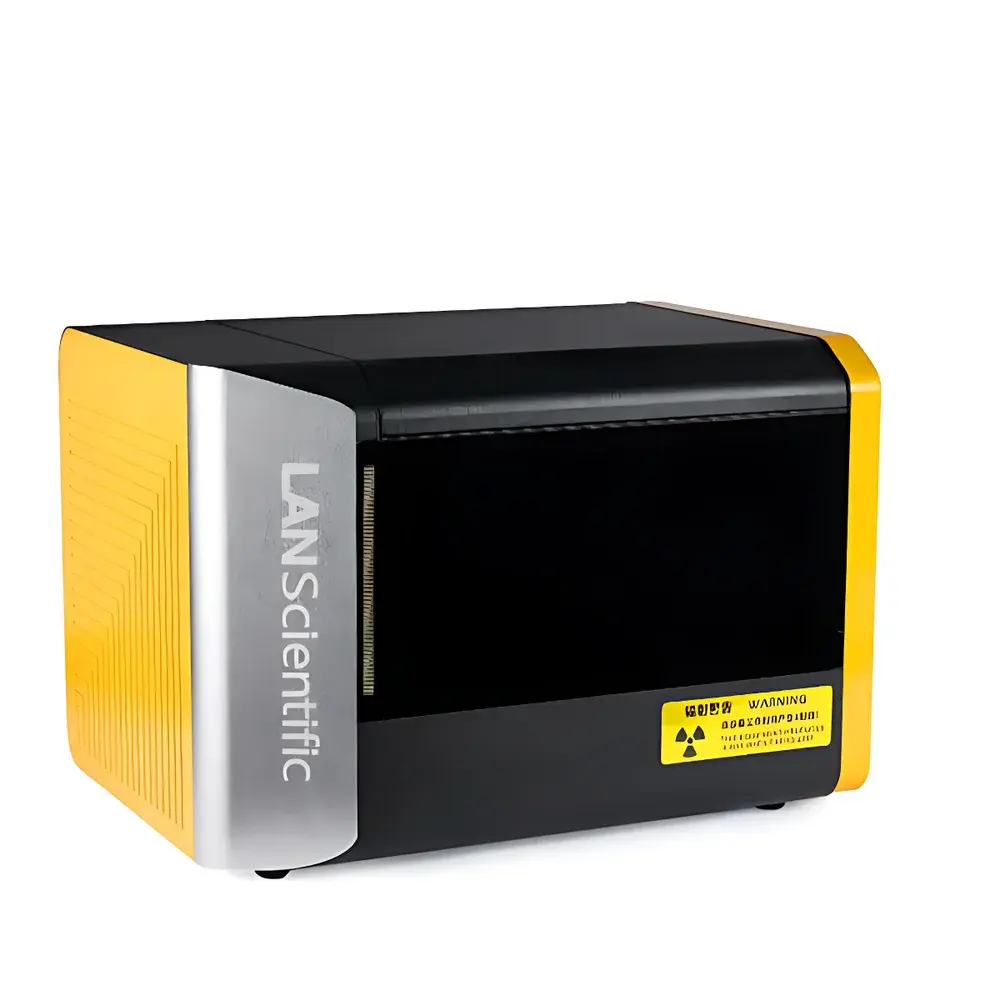
LANScientific ScopeX Desktop Energy Dispersive X-Ray Fluorescence Spectrometer for Cement CaO Analysis
| Brand | LANScientific |
|---|---|
| Origin | Jiangsu, China |
| Manufacturer Type | Direct Manufacturer |
| Origin Category | Domestic |
| Model | ScopeX Cement CaO Analyzer |
| Form Factor | Benchtop |
| Instrument Type | Conventional ED-XRF |
| Industry-Specific Design | Non-Ferrous Metals & Construction Materials |
| Elemental Range | Na (11) to U (92) |
| Detection Limit | ppm-level |
| Sample Compatibility | Solid, Powder, Pellet, Liquid, Thin Film |
| Regulatory Compliance | GB18871-2002, GBZ115-2002 |
Overview
The LANScientific ScopeX Desktop Energy Dispersive X-Ray Fluorescence (ED-XRF) Spectrometer is an industrial-grade analytical instrument engineered for rapid, non-destructive elemental quantification—specifically optimized for calcium oxide (CaO) determination in cement raw materials, clinker, and finished products. Based on fundamental X-ray fluorescence physics, the instrument irradiates a sample with primary X-rays, inducing inner-shell electron ejection from constituent atoms. As outer-shell electrons transition to fill vacancies, characteristic secondary X-ray photons are emitted—each element producing a unique energy signature (e.g., Ca Kα at 3.69 keV). The intensity of these peaks is directly proportional to elemental concentration, enabling quantitative analysis without chemical dissolution or sample digestion. Unlike wavelength-dispersive systems, the ScopeX employs a high-resolution silicon drift detector (SDD) with Peltier cooling, delivering high count-rate capability and excellent light-element sensitivity—critical for accurate CaO, SiO₂, Al₂O₃, Fe₂O₃, and MgO profiling in cement matrices per ASTM C114 and ISO 29581-2.
Key Features
- Optimized benchtop architecture with expanded sample chamber (Ø100 mm × H70 mm), accommodating irregularly shaped cement briquettes, fused beads, powders in cups, and liquid slurries.
- Low-energy X-ray excitation source coupled with intelligent vacuum control—enabling reliable detection of light elements down to sodium (Na), including critical cement constituents: Si, P, S, Al, Mg, and Ca.
- Motorized collimator turret with four fixed apertures (5.0 mm, 3.0 mm, 1.0 mm, and 0.5 mm) and programmable filter wheel—automatically selected via software to maximize peak-to-background ratio for specific analytes.
- Peltier-cooled SDD detector operating at –20 °C, eliminating liquid nitrogen dependency while maintaining <135 eV Mn Kα resolution and long-term spectral stability.
- Integrated safety interlock system: fully shielded steel enclosure, beam shutter with hardware-based dead-man switch, and real-time radiation monitoring compliant with GB18871-2002 (equivalent to IAEA Safety Standards Series No. GSR Part 3) and GBZ115-2002.
Sample Compatibility & Compliance
The ScopeX supports heterogeneous sample forms common in cement QA/QC workflows—including pressed pellets (10–15 ton pressure), fused borate glasses, loose powders in polypropylene cups, and slurry suspensions in quartz cells. Its open-sample design permits direct analysis of large-format clinker nodules or cut mortar sections without size-reduction preprocessing. Method validation aligns with ISO/IEC 17025 requirements for testing laboratories; spectral data acquisition meets traceability criteria for GLP environments. While not FDA 21 CFR Part 11–certified out-of-the-box, audit trails, user access controls, and electronic signature support can be enabled through optional firmware modules for regulated manufacturing settings.
Software & Data Management
The proprietary QuantScan™ software provides full spectrum acquisition, peak deconvolution (based on fundamental parameter + empirical calibration hybrid algorithms), and matrix correction using Lucas-Tooth or influence coefficient methods. Users may build custom calibrations for Portland cement, slag-blended cements, or limestone-dolomite admixtures using NIST SRM 2709a (San Joaquin Soil) and BAM reference materials. Reports export natively to Excel (.xlsx) and PDF formats—with configurable templates embedding company logos, spectral overlays, uncertainty estimates (k=2), and compliance statements. Data transfer options include USB 3.0 host interface, IEEE 802.11n Wi-Fi, and Bluetooth 5.0—enabling seamless integration into LIMS or MES platforms via CSV/JSON API endpoints.
Applications
- Routine CaO content verification in limestone feedstock and raw meal homogenization silos.
- Real-time clinker phase composition estimation (C₃S/C₂S ratio inferred from Ca/Si/Al/Fe ratios).
- Quality control of gypsum addition (SO₃) and minor oxide impurities (K₂O, Na₂O, Cl⁻).
- Supplier verification of slag, fly ash, and pozzolan reactivity indices via elemental fingerprinting.
- Research-grade analysis of alkali-silica reaction (ASR) potential through Na/K ratio mapping in aggregates.
FAQ
Does the ScopeX require daily calibration with standards?
No—factory-installed fundamental parameters and drift correction algorithms enable stable operation for up to 72 hours between recalibration; however, daily verification using a certified cement CRM (e.g., NIST 8435) is recommended for ISO 9001 compliance.
Can it analyze chloride (Cl) in cement?
Yes—the vacuum mode enables reliable Cl Kα (2.62 keV) detection at ≥100 ppm levels in powdered samples with <5% RSD precision (n=10, 1σ).
Is method transfer possible between different ScopeX units?
Yes—QuantScan™ supports cross-instrument method portability via encrypted .qsm files, provided identical collimator/filter configurations and detector gain settings are maintained.
What maintenance does the Peltier cooling system require?
None beyond periodic dust filter cleaning every 6 months; the solid-state cooler has no moving parts or consumables and is rated for >50,000 hours MTBF.
How is measurement uncertainty estimated?
Uncertainty budgets follow EURACHEM/CITAC Guide CG4, incorporating counting statistics, calibration curve fit residuals, sample heterogeneity (via duplicate pellet analysis), and matrix effect propagation—reported automatically in final certificates.





