
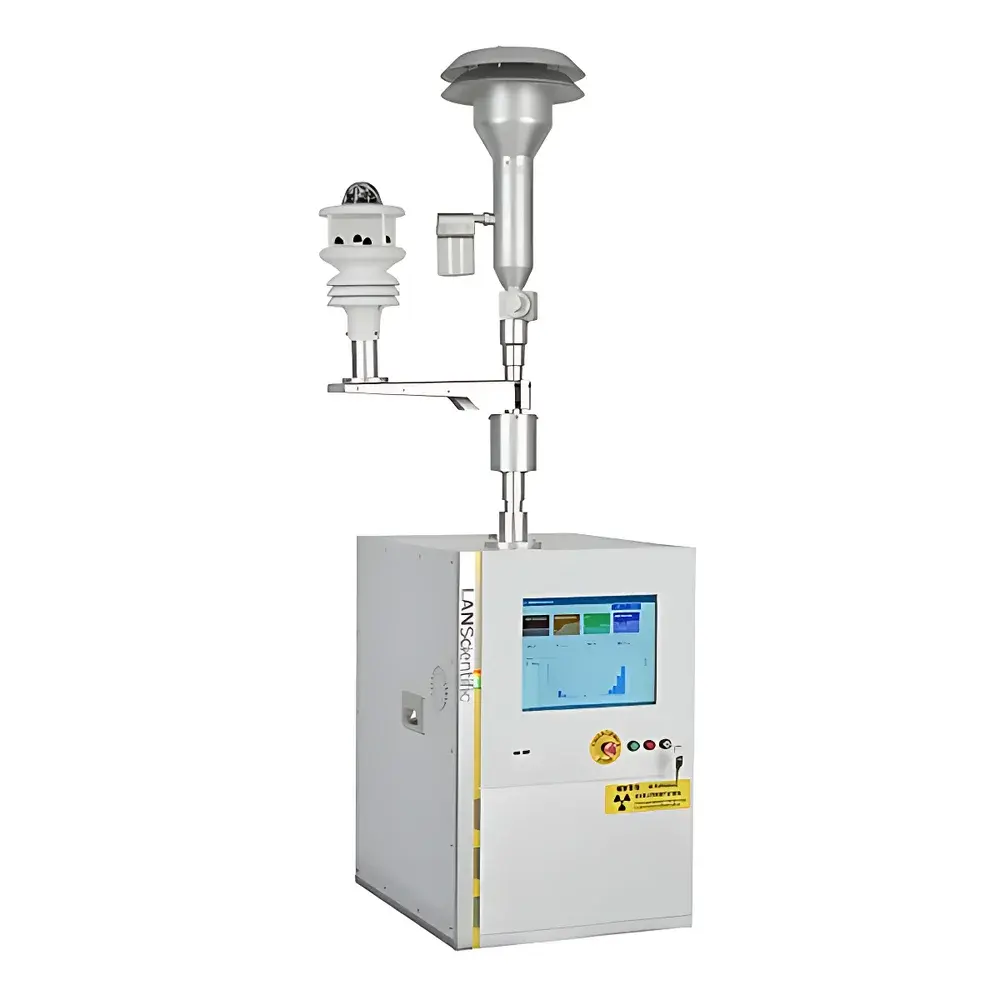
Brookfield LANScientific AOA Series Atmospheric Heavy Metal Online Analyzer
| Brand | LANScientific |
|---|---|
| Origin | Jiangsu, China |
| Manufacturer Type | Manufacturer |
| Regional Category | Domestic |
| Model | AOA Series |
| Pricing | Upon Request |
Overview
The LANScientific AOA Series Atmospheric Heavy Metal Online Analyzer is an integrated, real-time environmental monitoring system engineered for continuous, unattended measurement of airborne particulate matter (PM) mass concentration and elemental composition. It combines three complementary analytical technologies: energy-dispersive X-ray fluorescence (EDXRF) spectroscopy for multi-element quantification, beta-ray absorption (β-ray) attenuation for precise PM mass determination, and automated air-sampling with time-resolved particle enrichment on a rotating filter tape. This hybrid architecture enables simultaneous, co-located analysis of PM2.5/PM10 mass loading and trace-level heavy metal content—including Pb, Cd, Cr, As, Ni, Zn, Cu, Mn, and Sb—in ambient or stack emissions. The instrument complies with U.S. EPA Method IO-3.3 (“Determination of Metals in Ambient Particulate Matter by X-Ray Fluorescence Spectrometry”) and supports data traceability required under ISO/IEC 17025-accredited environmental laboratories.
Key Features
- Multi-Parameter Synchronization: Simultaneous acquisition of PM mass concentration (via β-ray absorption) and elemental mass concentrations (via EDXRF), eliminating temporal misalignment between particulate load and metal composition.
- Low Detection Limits: Achieves sub-ng/m³ detection limits for key toxic metals (e.g., Pb < 0.5 ng/m³, Cd < 0.2 ng/m³) over 1-hour integration, enabled by high-efficiency X-ray optics, low-noise silicon drift detector (SDD), and optimized vacuum path design.
- Automated Calibration & QC: Integrated radioactive calibration sources (e.g., 55Fe, 109Cd) enable periodic spectral energy and intensity calibration; built-in internal reference standards support daily drift correction and automatic quality control flagging.
- Radiation-Safe Architecture: Fully shielded X-ray tube housing, interlocked access doors, and real-time radiation monitoring ensure zero detectable leakage (<0.1 µSv/h at 5 cm), meeting IEC 61000-6-4 and national regulatory requirements for unattended field deployment.
- Flexible Deployment: Standard 19-inch rack-mount chassis (4U height) compatible with mobile monitoring vehicles, fixed air quality stations, and industrial fence-line monitoring enclosures; operating temperature range: −20 °C to +50 °C.
Sample Compatibility & Compliance
The AOA Series accepts standard 47-mm quartz fiber or Teflon-coated glass fiber filter tapes, compatible with EPA TO-13A, EN 14902, and GB/T 15432-1995 sampling protocols. All quantitative results are traceable to NIST SRM 2783 (Air Particulate on Filter Media) and certified reference materials (CRMs) for aerosol metal analysis. Data output formats comply with ISO 14001 environmental management systems and support audit-ready reporting for GLP/GMP-aligned environmental monitoring programs. Instrument firmware and data logs meet basic requirements for electronic record integrity per FDA 21 CFR Part 11 when configured with user authentication and audit trail activation.
Software & Data Management
The embedded Linux-based control software provides local touchscreen operation, scheduled measurement cycles (1–24 hr intervals), and real-time spectral visualization. Remote access is supported via secure HTTPS web interface or Modbus TCP protocol. Data export includes CSV, XML, and NetCDF formats with embedded metadata (sampling flow rate, temperature, pressure, humidity, filter ID, calibration status). All raw spectra and processed results are timestamped and stored with immutable file attributes. Optional cloud integration enables centralized dashboarding, anomaly detection alerts, and cross-site trend analysis—fully compatible with existing EPA AirNow, EEA Air Quality e-Reporting, or China’s CNEMC data platforms.
Applications
- Continuous fence-line monitoring at non-ferrous smelters, steel mills, and battery recycling facilities
- Mobile source characterization: real-time tracking of brake wear (Cu, Sb), tire wear (Zn), and exhaust-derived metals (Pb, Cr) along urban corridors
- Source apportionment studies using receptor modeling (e.g., PMF, CMB) requiring speciated metal time-series
- Early-warning systems for industrial emission events, supported by configurable threshold alarms and SMS/email notifications
- Regulatory compliance verification for national ambient air quality standards (e.g., China’s GB 3095-2012, EU Directive 2004/107/EC)
FAQ
Does the AOA Series require external laboratory support for calibration verification?
No. Internal reference sources and automated spectral recalibration routines eliminate routine reliance on external CRMs; however, annual verification using NIST-traceable aerosol filters is recommended for accreditation purposes.
Can the instrument operate reliably in high-humidity or dusty environments?
Yes. The sampling inlet incorporates heated impactor stages and optional Nafion dryer modules; the analyzer enclosure meets IP54 rating, and all optical components are sealed under positive-pressure dry air purge.
Is method validation documentation available for regulatory submissions?
Yes. Full IO-3.3 validation reports—including precision, accuracy, interference testing, and field comparison data against ICP-MS reference methods—are provided with each unit and updated annually per QA/QC protocol.
Related Products







