
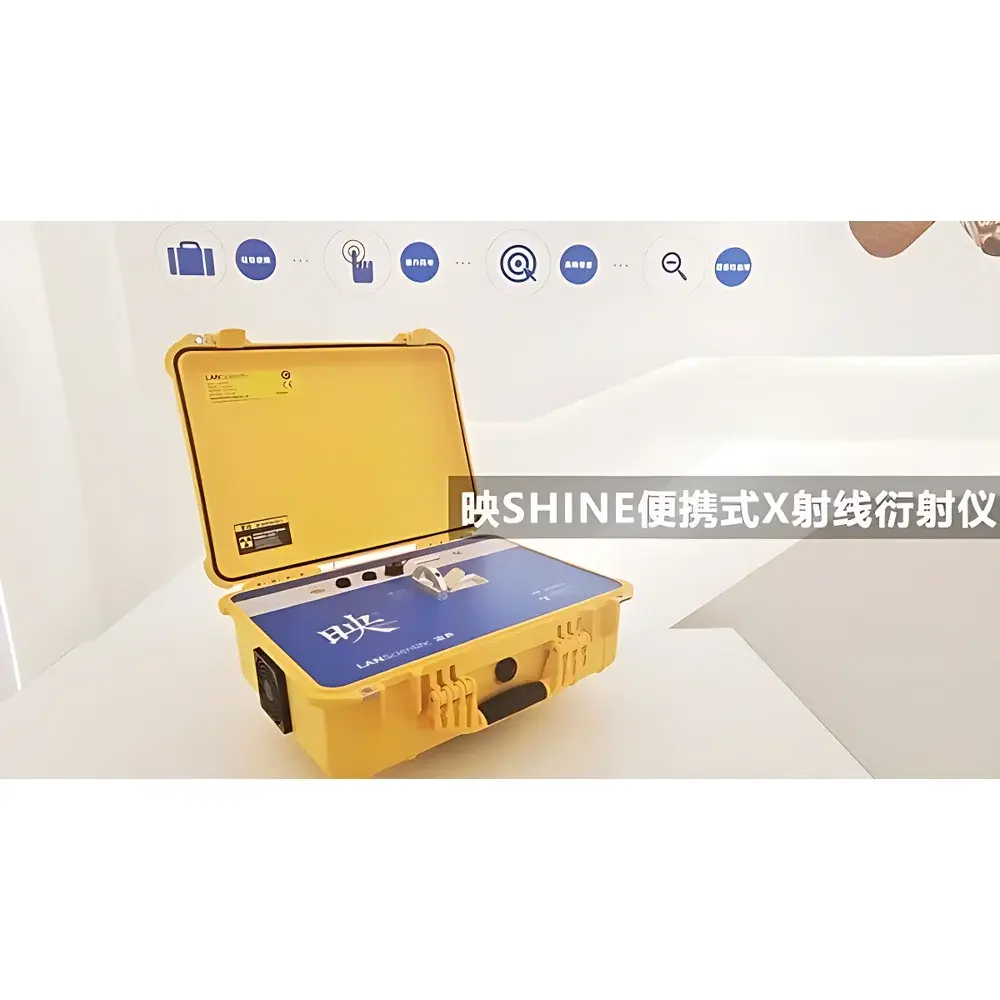
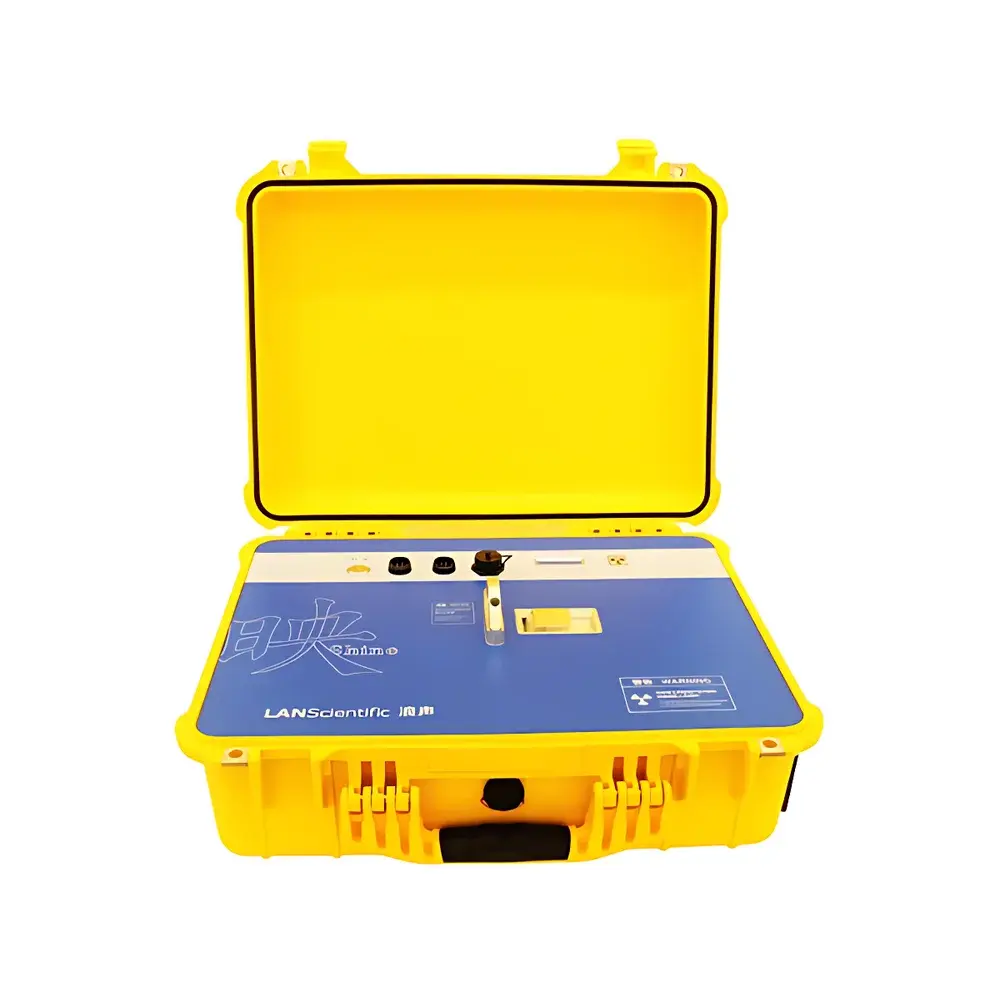
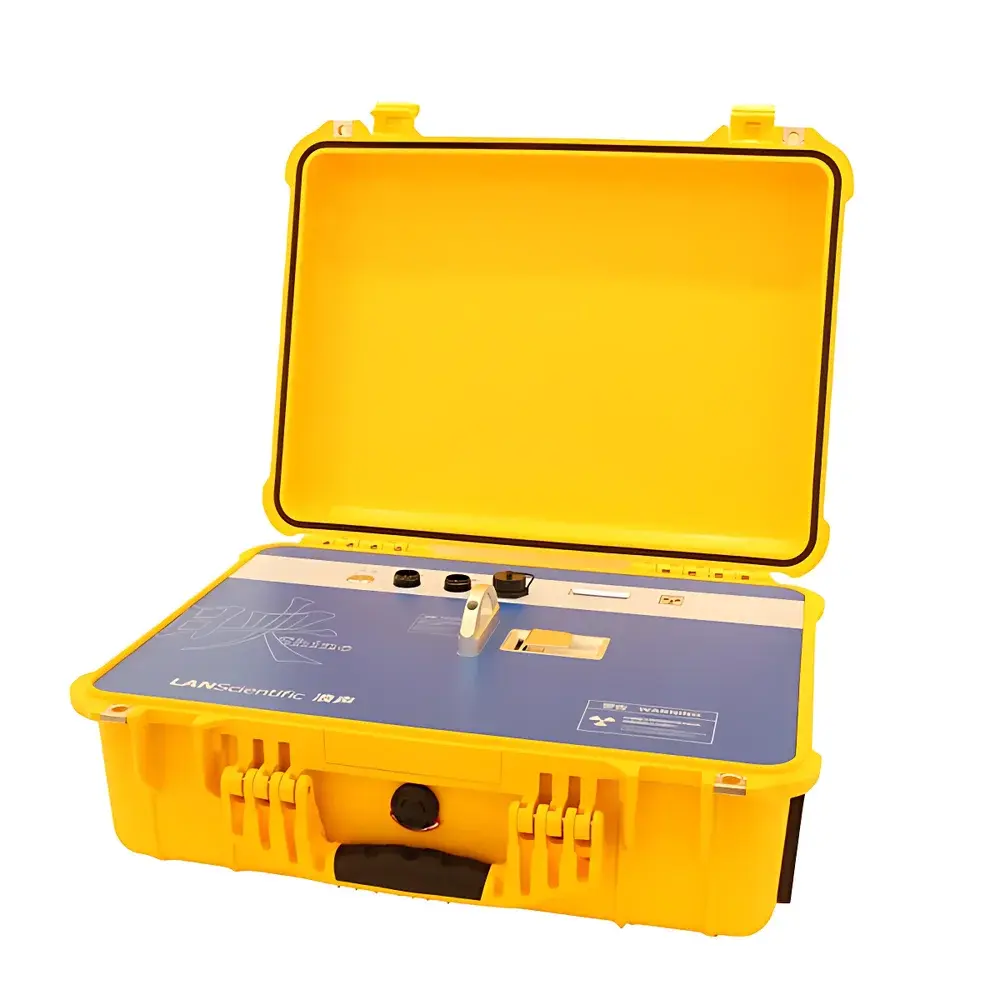
LANScientific SHINE Portable X-ray Diffractometer (Soil Edition)
| Brand | LANScientific |
|---|---|
| Origin | Jiangsu, China |
| Manufacturer Type | Direct Manufacturer |
| Regional Classification | Domestic |
| Model | SHINE Soil Edition |
| Instrument Type | Powder X-ray Diffractometer |
| Power Supply | As specified in technical documentation |
| Anode Target Options | Cu or Co |
| Detector | CCD-based 2D X-ray detector |
| Sample Requirement | ~20 mg per analysis |
| Connectivity | USB, Bluetooth, Wi-Fi |
Overview
The LANScientific SHINE Portable X-ray Diffractometer (Soil Edition) is a field-deployable powder X-ray diffractometer engineered for rapid, on-site identification and quantitative phase analysis of clay minerals in soil and sediment samples. It operates on the fundamental principle of Bragg diffraction: when monochromatic X-rays impinge upon a crystalline material, constructive interference occurs at specific angles governed by the lattice spacing (d-spacing) and incident wavelength (λ), satisfying the Bragg equation nλ = 2d sinθ. The resulting diffraction pattern—intensity versus 2θ angle—is a fingerprint of the sample’s crystallographic structure. Unlike conventional benchtop XRD systems requiring goniometric motion and precise alignment, the SHINE Soil Edition employs a fixed-geometry design with no moving mechanical parts, enabling robust operation under variable environmental conditions while maintaining high angular reproducibility across repeated measurements.
Key Features
- True Field Portability: Housed in an IP65-rated, shock-resistant, dust- and water-resistant enclosure; total system mass < 12 kg including battery, optimized for backpack or vehicle-mounted deployment.
- Zero-Calibration Workflow: Factory-aligned optical path and pre-characterized detector response eliminate routine angular calibration; instrument initialization requires only power-on and sample loading.
- Real-Time Full-Spectrum Acquisition: Simultaneous collection of full 2θ range (5°–70° typical, configurable) with CCD-based 2D detection, enabling immediate visualization of diffraction rings and assessment of particle statistics or preferred orientation artifacts.
- Minimal Sample Preparation: Requires only ~20 mg of air-dried, homogenized soil; eliminates grinding, pressing, or mounting—reducing bias from texture-induced preferred orientation.
- Dual-Anode Flexibility: Interchangeable Cu or Co X-ray tubes allow optimization for Fe-rich matrices (Co Kα minimizes fluorescence interference) or standard mineral identification (Cu Kα for higher intensity and resolution).
- Integrated Data Pipeline: On-device spectral processing coupled with cloud-synced database matching against ICDD PDF-4+ and custom clay-mineral reference libraries.
Sample Compatibility & Compliance
The SHINE Soil Edition is validated for direct analysis of unprocessed or minimally processed (<2 mm sieved) soil, sediment, weathered rock powders, and agricultural substrates. Its low-power X-ray source (≤50 kV, ≤1 mA) complies with IEC 61010-1 safety standards for portable radiation-emitting equipment. Software supports audit-trail generation and user-access logging, aligning with GLP principles for environmental monitoring programs. While not certified for FDA 21 CFR Part 11 compliance out-of-the-box, raw data export (XYE, CIF, CSV) enables integration into validated laboratory information management systems (LIMS) meeting ISO/IEC 17025 requirements.
Software & Data Management
The proprietary SHINE Analysis Suite provides real-time spectrum display, automatic peak search, Rietveld-refined quantitative phase analysis (QPA), and semi-quantitative clay mineral classification using reference intensity ratio (RIR) methodology. All processing steps—including background subtraction, peak deconvolution, and crystallite size estimation via Scherrer analysis—are traceable and parameter-adjustable. Data synchronization occurs over Wi-Fi or Bluetooth to Windows/macOS clients; USB-C connection enables direct firmware updates and bulk spectral archiving. Raw diffraction images and processed reports are timestamped, geotagged (when GPS-enabled tablet used), and exportable in formats compatible with third-party crystallographic software (e.g., TOPAS, GSAS-II).
Applications
- Agricultural Soil Health Assessment: Discrimination among kaolinite, illite, smectite, chlorite, and mixed-layer I/S phases to inform cation exchange capacity (CEC), nutrient retention, and swelling potential modeling.
- Contaminated Site Characterization: Identification of clay-bound heavy metal hosts (e.g., smectite interlayers, vermiculite edge sites) and redox-sensitive phases (e.g., green rust, ferrihydrite) in remediation planning.
- Environmental Forensics & Provenance Studies: Clay mineral assemblage fingerprinting for sediment source tracing in watershed studies and paleoenvironmental reconstruction.
- Geotechnical Screening: Rapid field classification of expansive clay content prior to foundation engineering assessments.
- Regulatory Monitoring: Support for ASTM D4319 (clay mineral identification in soils) and ISO 14688-1 (geotechnical investigation—identification and classification of soils).
FAQ
Is the SHINE Soil Edition suitable for regulatory reporting?
Yes—when operated within defined SOPs and paired with validated reference standards, its QPA results meet data quality objectives outlined in EPA Method 6020B and ISO 18567 for solid-phase mineralogical characterization.
Does it require external cooling or vacuum pumping?
No—the X-ray tube uses passive thermal management and operates in ambient air; no vacuum chamber or chiller is needed.
Can it distinguish between different smectite subtypes (e.g., montmorillonite vs. beidellite)?
Yes—through precise d-spacing refinement of the (001) reflection and hydration-state-dependent peak shifts, supported by layered silicate-specific reference patterns in the embedded library.
What is the minimum detectable concentration for a minor clay phase?
Under optimal sample preparation and acquisition settings, detection limits for well-crystallized clay phases are typically 1–2 wt%, depending on structural similarity to dominant phases and signal-to-noise ratio.
How is instrument performance verified in the field?
A certified NIST SRM 676a (corundum) check sample is included for periodic angular accuracy verification; integrated intensity stability monitoring logs tube output drift over time.
Related Products





