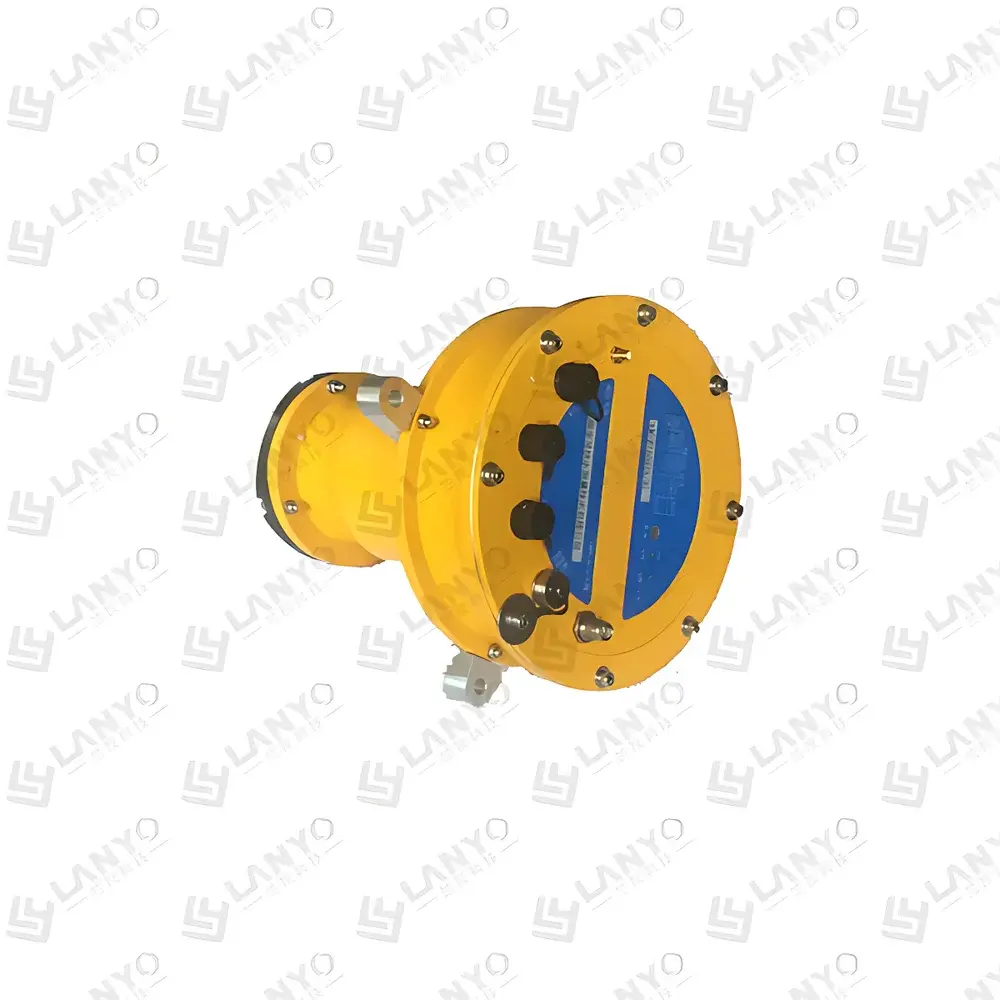
LANYO LY-P2000 Series Shipborne Acoustic Doppler Current Profiler (ADCP)
| Brand | LANYO |
|---|---|
| Origin | Beijing, China |
| Model | LY-P2000 |
| Frequency | Dual-frequency (0.5 MHz & 0.6 MHz), auto-switching |
| Beam Configuration | 8-beam, dual-pair configuration |
| Central Depth Sounder | 1-beam, 0.6 MHz |
| Max Measurable Depth | 120 m |
| Blind Zone | 0.1 m |
| Operating Mode | Intelligent frequency-adaptive mode |
| Depth Tracking | Bottom-track and water-column profiling with real-time signal strength display and auto-gain adjustment |
| Mounting Options | Vessel-mounted (trimaran or unmanned surface vehicle), optional seabed mooring or buoy integration |
| Power & Communication | Compatible with underwater battery packs and acoustic telemetry modules |
Overview
The LANYO LY-P2000 Series Shipborne Acoustic Doppler Current Profiler (ADCP) is an engineered solution for high-accuracy, real-time velocity profiling and discharge computation in open-channel and estuarine environments. Based on the physical principle of acoustic Doppler shift, the system transmits pulsed ultrasonic signals into the water column and analyzes the frequency shift of backscattered echoes from suspended particles to determine three-dimensional water velocity components at discrete depth cells. Unlike fixed-station ADCPs, the LY-P2000 is designed for mobile deployment—typically integrated onto trimaran vessels or autonomous surface vehicles—enabling rapid, non-intrusive cross-sectional surveys without flow disturbance. Its dual-frequency architecture (0.5 MHz and 0.6 MHz) supports adaptive operation across variable turbidity, sediment load, and depth conditions, making it suitable for rivers with high suspended solids, tidal estuaries, irrigation canals, and floodplain channels where traditional electromagnetic or mechanical flowmeters fail due to fouling or hydraulic constraints.
Key Features
- Intelligent dual-frequency operation: Automatically selects optimal transmit frequency (0.5 MHz for deeper, clearer water; 0.6 MHz for shallow, high-turbidity conditions) based on real-time echo amplitude and signal-to-noise ratio.
- 8-beam velocity profiling: Two orthogonal beam pairs (4 beams per pair) provide redundant, vector-averaged horizontal and vertical velocity components, enhancing measurement robustness and minimizing heading-induced errors.
- Integrated single-beam 0.6 MHz depth sounder: Delivers concurrent bathymetric data with ≤0.1 m blind zone—critical for accurate discharge integration near the bed and for low-flow condition analysis.
- Zero-blind-zone flow measurement: Achieves usable velocity data starting at 0.1 m below transducer face, eliminating extrapolation assumptions in shallow or low-velocity zones.
- Adaptive sampling logic: Dynamically adjusts ping rate, cell size, and number of ensembles according to local water depth and mean velocity—ensuring consistent velocity resolution (±0.5% of measured value, typical) and statistical confidence across heterogeneous flow regimes.
- Real-time signal diagnostics: Onboard display of bottom-track lock status, echo intensity profiles, and gain compensation metrics enables field verification of data quality prior to post-processing.
Sample Compatibility & Compliance
The LY-P2000 operates reliably in natural and engineered water bodies characterized by suspended sediment concentrations up to 10 g/L, turbidity levels exceeding 3000 NTU, and salinity gradients ranging from freshwater (<0.5 ppt) to brackish (≤25 ppt). It complies with ISO 748:2022 (Measurement of liquid flow in open channels — Velocity-area method) for discharge determination and supports traceable calibration against NIST-traceable acoustic velocity standards. The system’s firmware architecture adheres to IEC 61508 functional safety principles for embedded instrumentation, and its data logging structure conforms to CF Standard Format (CF-1.7) metadata conventions for long-term archival and inter-laboratory interoperability. While not certified for Class I Div 1 hazardous locations, it meets IP68 ingress protection for continuous submersion at depths up to 10 m during vessel transit.
Software & Data Management
The LY-P2000 is operated via LANYO HydroSurvey Suite—a Windows-based application supporting real-time navigation-integrated acquisition, GPS-synchronized ensemble logging, and automated cross-section alignment. Raw velocity, depth, and position data are stored in HDF5 format with embedded georeferencing (WGS84), time stamps (UTC with millisecond precision), and instrument configuration metadata. Post-processing includes automatic side-lobe correction, pitch/roll compensation using integrated IMU data, and discharge computation per ISO 748 Annex B methodologies. Export options include CSV (for Excel or MATLAB), GeoJSON (for GIS integration), and XML-based CUAHSI HIS WaterML 2.0 compliant files. Audit trails—including operator ID, session start/stop times, and parameter modification history—are retained for GLP-aligned workflows. The software supports FDA 21 CFR Part 11-compliant electronic signatures when deployed with domain-authenticated Windows accounts and encrypted local storage.
Applications
- River discharge monitoring for hydrometric networks and flood forecasting systems
- Environmental flow assessment in regulated rivers and ecological restoration projects
- Validation of 2D/3D hydrodynamic models (e.g., HEC-RAS, Delft3D, TELEMAC)
- Performance evaluation of weirs, sluice gates, and intake structures
- Estuarine salt-wedge and residual circulation studies
- Infrastructure impact assessments (e.g., bridge pier scour, dredging operations)
- Climate-resilient water resource planning under variable sediment transport regimes
FAQ
What mounting platforms are supported for the LY-P2000?
The system is optimized for trimaran hulls and unmanned surface vehicles (USVs) with GNSS/IMU integration. Optional seabed-mounting kits and moored-buoy configurations are available for stationary profiling applications.
Does the LY-P2000 support bottom-tracking in highly silty or muddy riverbeds?
Yes—the adaptive bottom-track algorithm continuously monitors echo spectral width and amplitude variance, enabling stable tracking even in acoustically attenuating substrates such as fine clay or organic-rich sediments.
Can velocity data be exported directly to hydraulic modeling software?
Yes—native export to HEC-RAS 6.x (via RAS Mapper import), Delft3D-FLOW (ASCII grid and boundary condition formats), and QGIS-compatible GeoPackage layers is fully implemented.
Is remote firmware update capability available?
Firmware updates are performed via secure USB transfer or Ethernet-connected host PC; over-the-air (OTA) updates are not supported to maintain deterministic timing control and regulatory compliance.
How is measurement uncertainty quantified in discharge reports?
Uncertainty estimation follows ISO/IEC Guide 98-3 (GUM) methodology, incorporating contributions from velocity precision, depth measurement error, cross-section geometry interpolation, and alignment uncertainty—reported as expanded uncertainty (k=2) in final discharge certificates.