
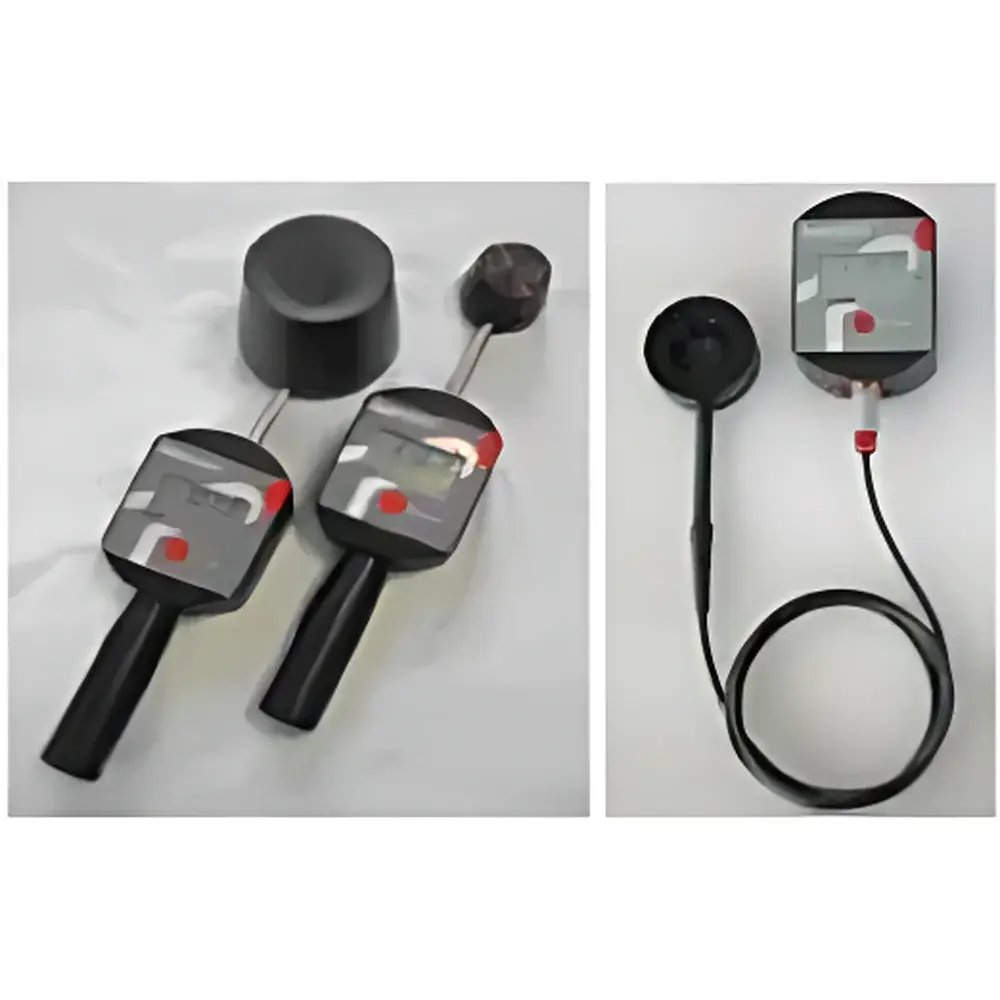
LaserPoint Cronos & Fit Series Laser Power Probes
| Brand | LaserPoint |
|---|---|
| Origin | Italy |
| Model | Cronos / Fit |
| Power Range (Cronos) | 1.5 W – 10 kW |
| Power Range (Fit) | 0.5 W – 500 W |
| Measurement Principle | Thermopile-based real-time thermal dynamics analysis |
| Display | Integrated LCD showing power, wavelength setting (CO₂, Nd:YAG, Diode), battery status |
| Measurement Time | 10 s (Cronos), 4 s (Fit) |
| Accuracy | ±4% (Cronos), ±3% (Fit) |
| Repeatability | ±2% (Cronos), ±1% (Fit) |
| Calibration | User-performable via built-in calibration routine |
| Operating Wavelengths | 10.6 µm (CO₂), 1.064 µm (Nd:YAG), 0.4–1.1 µm (Diode) |
| Resolution | Full-scale dependent (e.g., 1 W at 10 kW range) |
| Power Supply | Internal rechargeable battery |
| Compliance | CE, RoHS, ISO/IEC 17025 traceable calibration support |
Overview
The LaserPoint Cronos and Fit Series Laser Power Probes are thermopile-based optical measurement instruments engineered for direct, real-time quantification of continuous-wave (CW) and quasi-CW laser output power. Unlike photodiode-based sensors limited to low-power or narrow-spectral applications, these probes operate on calibrated thermoelectric conversion—absorbing incident laser radiation across broad spectral bands and converting thermal gradients into proportional electrical signals. The embedded microprocessor continuously monitors temperature dynamics in the absorber substrate, dynamically optimizing integration time to ensure stable, drift-compensated readings without active cooling or external chillers. This architecture enables reliable operation from milliwatt-level diode lasers to multi-kilowatt industrial CO₂ systems—making the Cronos and Fit platforms suitable for R&D labs, laser manufacturing QA/QC lines, and OEM integration where reproducibility, spectral versatility, and operational autonomy are critical.
Key Features
- Intelligent thermal dynamics algorithm: Automatically determines optimal measurement duration (4 s for Fit, 10 s for Cronos) based on real-time heat dissipation profiles—eliminating manual dwell-time selection and minimizing thermal lag error.
- Dual-series architecture: Cronos optimized for high-power industrial lasers (1.5 W – 10 kW); Fit designed for precision low-to-mid power applications (0.5 W – 500 W), with correspondingly refined resolution and faster response.
- Onboard LCD interface: Displays instantaneous power value, selected wavelength band (CO₂, Nd:YAG, or broadband diode), measurement mode, and battery voltage—enabling fully standalone operation without PC or external meter.
- User-accessible calibration: Field calibration routines support traceable adjustment using NIST-traceable reference sources, aligning with ISO/IEC 17025 laboratory requirements and facilitating internal audit readiness.
- Spectrally agnostic design: Validated performance across key industrial laser wavelengths—10.6 µm (CO₂), 1.064 µm (Nd:YAG), and 400–1100 nm (diode and fiber lasers)—without requiring interchangeable heads or filters.
- Robust mechanical construction: Anodized aluminum housing with integrated heat-sink geometry ensures long-term stability under repeated thermal cycling and ambient temperature fluctuations (15–35 °C operating range).
Sample Compatibility & Compliance
These probes accommodate free-space beam delivery configurations typical in laser material processing, optical alignment verification, and medical laser system validation. Beam diameters from 2 mm up to full aperture coverage (Ø25 mm for Fit, Ø50 mm for Cronos) are supported without vignetting or edge-loss artifacts. All units comply with CE marking directives (2014/30/EU EMC, 2014/35/EU LVD) and RoHS 2011/65/EU restrictions on hazardous substances. While not certified as medical devices per IEC 60601-1, they meet functional safety expectations for Class 4 laser environment monitoring under IEC 60825-1:2014. Calibration certificates include uncertainty budgets referenced to national metrology institutes (NMI), supporting GLP/GMP documentation workflows and FDA 21 CFR Part 11–aligned electronic record retention when paired with LaserPoint’s optional data logging software.
Software & Data Management
Though fully functional as stand-alone instruments, both series interface via USB-C (Cronos) or micro-USB (Fit) with LaserPoint’s proprietary LPControl Suite—Windows-compatible software enabling automated data capture, statistical trend analysis (min/max/avg/std dev), batch report generation (PDF/CSV), and timestamped audit logs. The software enforces role-based access control and supports digital signature workflows compliant with FDA 21 CFR Part 11 Annex 11 requirements. Raw sensor output is logged at 10 Hz sampling rate, permitting post-acquisition evaluation of transient power behavior—critical for validating pulsed-CW hybrid sources or detecting mode instability in DPSS lasers.
Applications
- Laser source qualification during production: Verifying output stability and power linearity across multiple duty cycles in diode-pumped solid-state (DPSS), fiber, and CO₂ laser modules.
- Optical component testing: Measuring transmission loss of lenses, mirrors, and beam splitters under realistic irradiance conditions.
- Medical laser system commissioning: Validating delivered power at handpiece output per ANSI Z136.3 and IEC 60601-2-22 standards.
- OEM integration: Embedding calibrated power feedback into closed-loop laser control systems via analog (0–5 V) or digital (RS-485) outputs available on Cronos models.
- Academic and metrology lab use: Serving as transfer standards in inter-laboratory comparisons and supporting student training in radiometric measurement principles.
FAQ
Do these probes require water or air cooling during operation?
No—both Cronos and Fit series utilize passive thermal management and dynamic integration algorithms, eliminating the need for external cooling even at maximum rated power.
Can I switch between CO₂ and Nd:YAG measurements without hardware changes?
Yes—the wavelength setting is selected digitally via front-panel menu; absorber coating and thermopile design are optimized for simultaneous accuracy across all supported bands.
Is recalibration required after field adjustment?
User-performed calibration updates the instrument’s gain coefficient but does not replace periodic third-party accredited calibration recommended annually or per ISO/IEC 17025 quality system requirements.
What is the maximum permissible beam irradiance for each model?
Cronos: ≤10 kW/cm² (for short-duration exposure); Fit: ≤500 W/cm²—exceeding these may cause localized absorber damage and permanent calibration drift.
Are firmware updates available, and how are they applied?
Yes—LaserPoint releases verified firmware patches quarterly via secure download portal; updates are installed via USB connection using LPControl Suite with checksum validation and rollback capability.



