
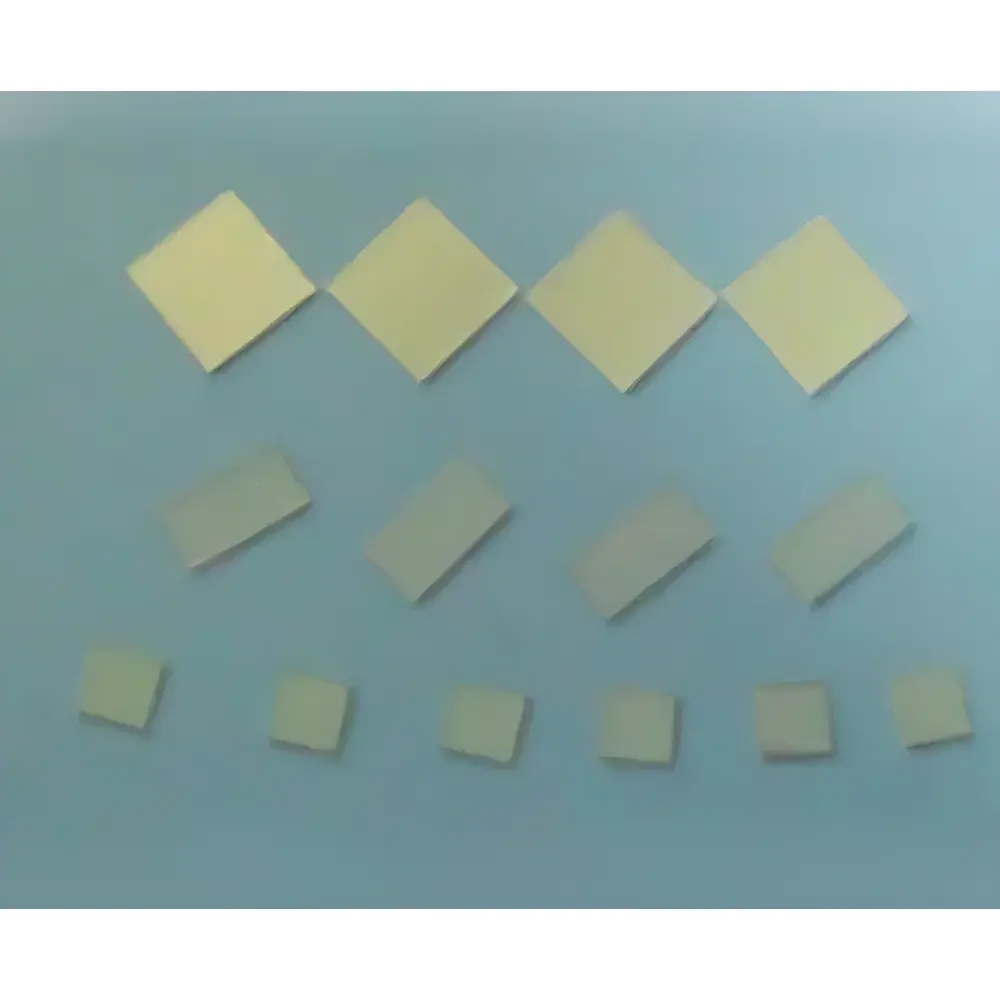
LaSrAlO4 Single Crystal Substrate (合肥科晶 | Model: LaSrAlO4)
| Brand | Hefei Kejing |
|---|---|
| Origin | Anhui, China |
| Manufacturer Type | Authorized Distributor |
| Country of Origin | PRC |
| Model | LaSrAlO4 |
| Crystal Structure | Tetragonal |
| Lattice Parameters | a = 3.756 Å, c = 12.636 Å |
| Melting Point | 1650 °C |
| Density | 5.92 g/cm³ |
| Dielectric Constant (εᵣ) | 16.8 |
| Growth Method | Czochralski (Cz) |
| Standard Orientations | <001>, <100> |
| Orientation Tolerance | ±0.5° |
| Typical Dimensions | 10 × 10 × 0.5 mm³, 10 × 5 × 0.5 mm³ |
| Surface Finish | Single- or Double-Polished, Ra < 0.5 nm |
| Packaging | Class 1000 Cleanroom / Class 100 Clean Bag |
Overview
LaSrAlO4 (Lanthanum Strontium Aluminum Oxide) is a high-purity, single-crystal perovskite-related oxide substrate engineered for epitaxial thin-film growth—particularly in high-temperature superconducting and complex oxide heterostructure research. Its tetragonal crystal structure (space group I4/mmm) exhibits exceptional thermal and structural stability across a wide temperature range—from melt temperature (1650 °C) down to cryogenic conditions—with no observed phase transitions or twinning. This intrinsic stability enables reproducible, high-fidelity film deposition under controlled atmospheres and ultra-high vacuum (UHV) environments. With a lattice mismatch of only 2.5–3.5% relative to YBa2Cu3O7−δ (YBCO) along the orientation, LaSrAlO4 serves as a structurally compatible, low-strain template for YBCO and related cuprate films. Its comparatively low coefficient of thermal expansion (CTE), when benchmarked against conventional perovskite substrates such as SrTiO3 or LaAlO3, mitigates interfacial stress during post-deposition cooling—thereby enhancing crystallinity, reducing defect density, and improving critical current density (Jc) in functional devices.
Key Features
- Tetragonal symmetry with precisely controlled lattice parameters (a = 3.756 Å, c = 12.636 Å) optimized for epitaxial registry with -oriented YBCO and other layered oxides
- High-density monocrystalline architecture (ρ = 5.92 g/cm³) ensuring mechanical robustness and minimal scattering in optical/electronic characterization
- Low dielectric constant (εr ≈ 16.8) suitable for RF and microwave applications where parasitic capacitance must be minimized
- Czochralski-grown with strict stoichiometric control; verified via X-ray diffraction (XRD), rocking curve FWHM < 0.1°, and surface atomic force microscopy (AFM)
- Surface roughness < 0.5 nm (Ra) after single- or double-side chemical-mechanical polishing (CMP), meeting stringent requirements for molecular beam epitaxy (MBE) and pulsed laser deposition (PLD)
- Available in standard orientations and , with angular tolerance ≤ ±0.5°—certified by high-resolution Laue back-reflection
Sample Compatibility & Compliance
LaSrAlO4 substrates are routinely employed in UHV-compatible deposition systems including MBE, PLD, and sputtering platforms. Their thermal stability supports in-situ annealing up to 800 °C without degradation. All wafers undergo rigorous pre-shipment inspection in ISO Class 5 (100) cleanroom conditions and are sealed in static-dissipative, particle-free packaging compliant with SEMI S2-0201 standards. While not certified to ISO 9001 at the distributor level, material traceability—including growth batch ID, orientation verification report, and surface metrology data—is provided upon request. The substrate meets common laboratory safety and handling protocols for oxide ceramics per OSHA 1910.1200 and IEC 61000-4-2 ESD guidelines.
Software & Data Management
As a passive crystalline substrate, LaSrAlO4 does not incorporate embedded electronics or firmware. However, it is fully compatible with industry-standard thin-film process documentation frameworks—including LabArchives ELN, Thermo Fisher SampleManager LIMS, and custom GLP/GMP-compliant audit trails. Batch-specific characterization reports (XRD θ–2θ scans, AFM topographs, and optical micrographs) are delivered in PDF and ASCII formats, enabling direct import into MATLAB, OriginPro, or Python-based analysis pipelines (e.g., using scikit-image or pyFAI). Traceability metadata follows ASTM E2500-17 conventions for materials used in regulated R&D environments.
Applications
- Epitaxial growth of high-Tc superconductors (YBCO, SmBCO, GdBaCuO) for Josephson junctions and SQUID sensors
- Heterostructures involving correlated electron systems (e.g., LaNiO3/LaSrMnO3, FeSe on oxide templates)
- Dielectric buffer layers in multiferroic and ferroelectric tunnel junctions
- Substrate reference material in synchrotron-based X-ray reflectivity (XRR) and grazing-incidence small-angle X-ray scattering (GISAXS) calibration
- Platform for strain-engineered oxide interfaces in emergent phenomena studies (e.g., interfacial superconductivity, orbital reconstruction)
FAQ
What is the typical surface finish specification for LaSrAlO4 substrates?
Standard substrates are either single- or double-polished to an average surface roughness (Ra) < 0.5 nm, verified by contact-mode AFM over 5 × 5 µm² areas.
Can custom orientations or dimensions be supplied?
Yes—custom cuts along , , or off-axis orientations (e.g., 0.5°–4° miscut) are available; minimum order quantity applies. Dimensional tolerances adhere to ISO 2768-mK.
Is this substrate compatible with oxygen plasma cleaning prior to deposition?
Yes—LaSrAlO4 withstands standard O2 plasma treatment (100–300 W, 30–120 s) without surface decomposition or Al segregation.
How is crystal orientation verified?
Each wafer undergoes Laue back-reflection diffraction; orientation certificate includes azimuthal scan data and deviation angle from nominal Miller indices.
Do you provide bulk material or only finished wafers?
We supply only polished, characterized wafers. Bulk crystals (>10 mm diameter) are available under separate quotation for in-house slicing and polishing.






