
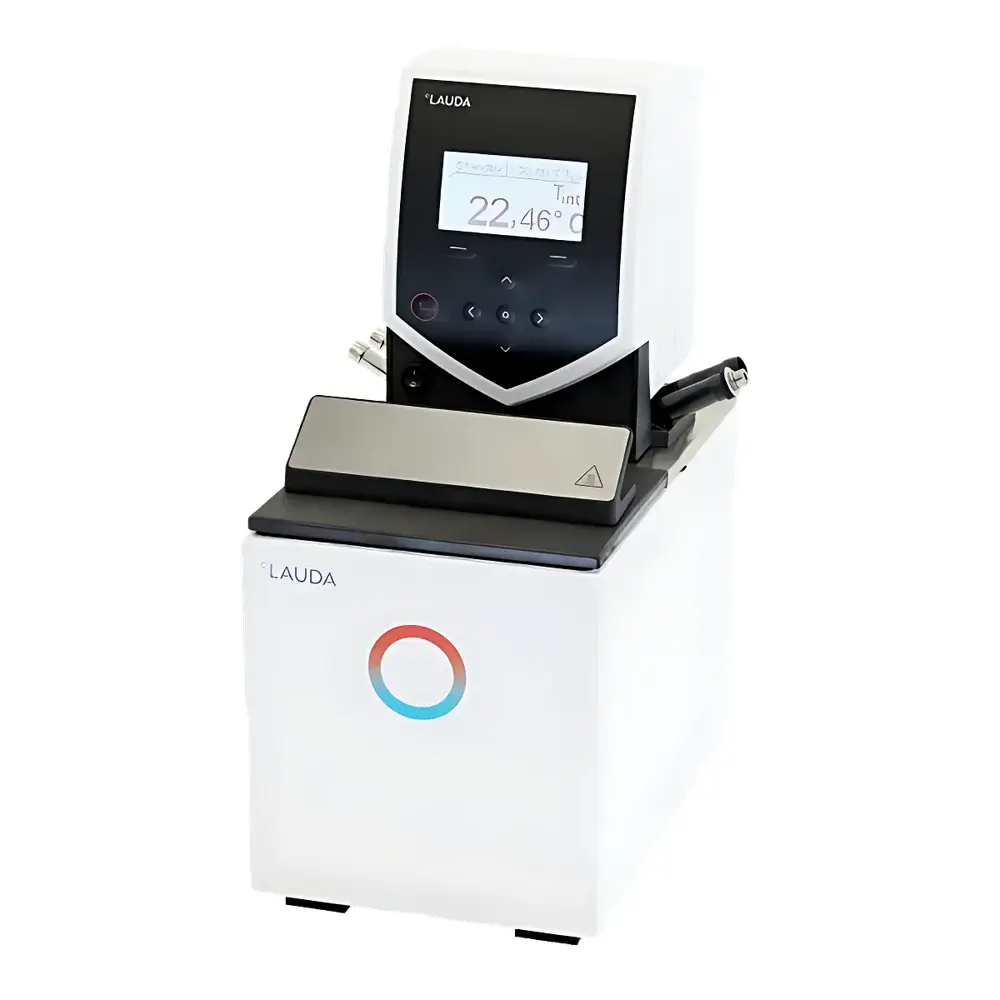
LAUDA ECO E 4 S High-Precision Wide-Temperature-Range Circulating Bath, 20–200 °C, ±0.01 °C Stability
| Brand | LAUDA |
|---|---|
| Origin | Germany |
| Model | ECO E 4 S |
| Instrument Type | Heating Circulating Bath |
| Circulation Mode | Internal & External |
| Temperature Control | Heating-Only |
| Bath Volume Range | 3.5–40 L |
| Temperature Range | 20–200 °C |
| Temperature Stability | ±0.01 °C |
| Heating Power | 2 kW |
| Max Power Consumption | 2.1 kW |
| Pump Flow Rate | up to 22 L/min |
| Dimensions (W×D×H) | 168 × 272 × 376 mm |
| Power Supply | 230 V, 50/60 Hz |
| Safety Class | III (for flammable & non-flammable liquids) |
| Standard Features | Stainless Steel Bath, Integrated Cooling Coil, Bath Lid, External Pump Interface, Drain Valve, ECO Silver LCD Controller, USB Port, 6-Step Adjustable Circulation Pump |
Overview
The LAUDA ECO E 4 S is a high-precision, wide-temperature-range circulating bath engineered for demanding laboratory applications requiring stable thermal control from 20 °C to 200 °C. Unlike conventional heating baths limited by material compatibility or thermal uniformity, the ECO E 4 S employs a robust stainless steel bath vessel and optimized heater geometry to ensure ±0.01 °C temperature stability across its full operating range—critical for kinetic studies, calibration traceability, viscometry, and polymer processing simulations. Its design follows fundamental principles of convective heat transfer and closed-loop PID control with Pt100 resistance temperature detection, enabling reproducible thermal environments under both static immersion and dynamic external circulation conditions. The unit complies with IEC 61010-1 for electrical safety and meets Class III requirements per DIN EN 61010, permitting safe operation with organic solvents, silicone oils (e.g., Therm 250), and other low-flashpoint media.
Key Features
- Stainless steel bath vessel rated for continuous operation up to 200 °C, resistant to corrosion and thermal fatigue
- Integrated cooling coil enables passive heat dissipation during extended high-temperature runs or rapid cooldown preparation
- ECO Silver controller with monochrome LCD interface—supports intuitive menu navigation, real-time setpoint/actual value display, and user-configurable overtemperature protection thresholds
- 6-stage adjustable circulation pump (0–22 L/min flow rate) with pressure-compensated output, compatible with external reactors, jacketed vessels, and analytical instrumentation
- Dual-mode circulation: seamless switching between internal recirculation (for bath homogeneity) and external loop mode (for process integration), controllable remotely via front-panel or digital interface
- Rear-mounted drain valve for safe, tool-free thermal fluid exchange—minimizes operator exposure and prevents spillage during maintenance
- Bath lid and dedicated pump connection port included as standard, reducing setup time for external applications
- USB port for firmware updates and optional interface module expansion (e.g., Libus, Pt100 analog input, Command controller integration)
Sample Compatibility & Compliance
The ECO E 4 S accommodates a broad spectrum of thermal transfer fluids—including water, ethylene glycol/water mixtures, silicone oils (e.g., Therm 250), and mineral oils—within its validated 20–200 °C range. Its Class III safety rating permits use with flammable liquids in accordance with local laboratory safety protocols. All wetted parts are constructed from electropolished 316 stainless steel and PTFE-sealed components, ensuring chemical inertness and long-term reliability. The device conforms to ISO/IEC 17025-relevant environmental conditioning requirements and supports GLP-compliant workflows through configurable audit trails (when paired with LAUDA Command or third-party SCADA systems). It is suitable for applications governed by ASTM D2857 (viscosity standards), USP (aseptic compounding support equipment), and ISO 13485 (medical device manufacturing thermal validation).
Software & Data Management
While the ECO Silver controller operates as a standalone unit, the integrated USB port allows for future-proofing via optional communication modules. The Libus interface enables Modbus RTU integration into centralized lab automation networks, supporting remote monitoring, parameter logging, and alarm forwarding. When connected to LAUDA’s Command controller, the E 4 S gains programmable ramp-soak profiles, multi-step temperature sequences, and independent dual-limit overtemperature protection (process + safety). All configuration changes—including pump speed, stability tolerance, and sensor offset—are timestamped and stored in non-volatile memory. For regulated environments, optional 21 CFR Part 11-compliant software packages provide electronic signatures, role-based access control, and immutable audit logs.
Applications
- Calibration of thermometers, RTDs, and thermocouples against NIST-traceable references
- Temperature-controlled rheometry and viscometry using external shear cells
- Thermal aging studies of polymers, composites, and adhesives per ISO 2578 and ASTM D3045
- Preconditioning of samples prior to mechanical testing (tensile, impact, hardness)
- Supporting HPLC column ovens, GC injectors, and spectroscopic sample compartments requiring precise thermal anchoring
- Reaction calorimetry and synthesis optimization in jacketed glass reactors (up to 40 L external volume)
- Material testing per ISO 62 (water absorption) and ASTM D570 where controlled humidity-temperature coupling is required
FAQ
What thermal fluids are compatible with the ECO E 4 S at 200 °C?
Thermally stable silicone oils such as LAUDA Therm 250 or equivalent high-viscosity, low-volatility heat transfer fluids are recommended. Water-based solutions are not suitable above 100 °C due to vapor pressure limitations.
Can the unit operate in external circulation mode only—without internal bath circulation?
Yes. The pump and flow path are fully configurable via the controller menu to disable internal recirculation while maintaining full external loop functionality.
Is the drain valve self-sealing and chemically resistant?
The rear-mounted drain valve features a PTFE-coated stainless steel plug and Viton O-ring, ensuring leak-tight sealing and compatibility with common organic solvents and thermal oils.
Does the USB port support data logging directly to a PC?
The USB interface is primarily for firmware updates and module configuration; real-time data streaming requires optional Libus or Command controller integration.
How is overtemperature protection implemented?
Two independent hardware-limited safeguards: a primary PID-controlled cut-off and a secondary mechanical safety thermostat, both user-adjustable within defined operational boundaries.



