
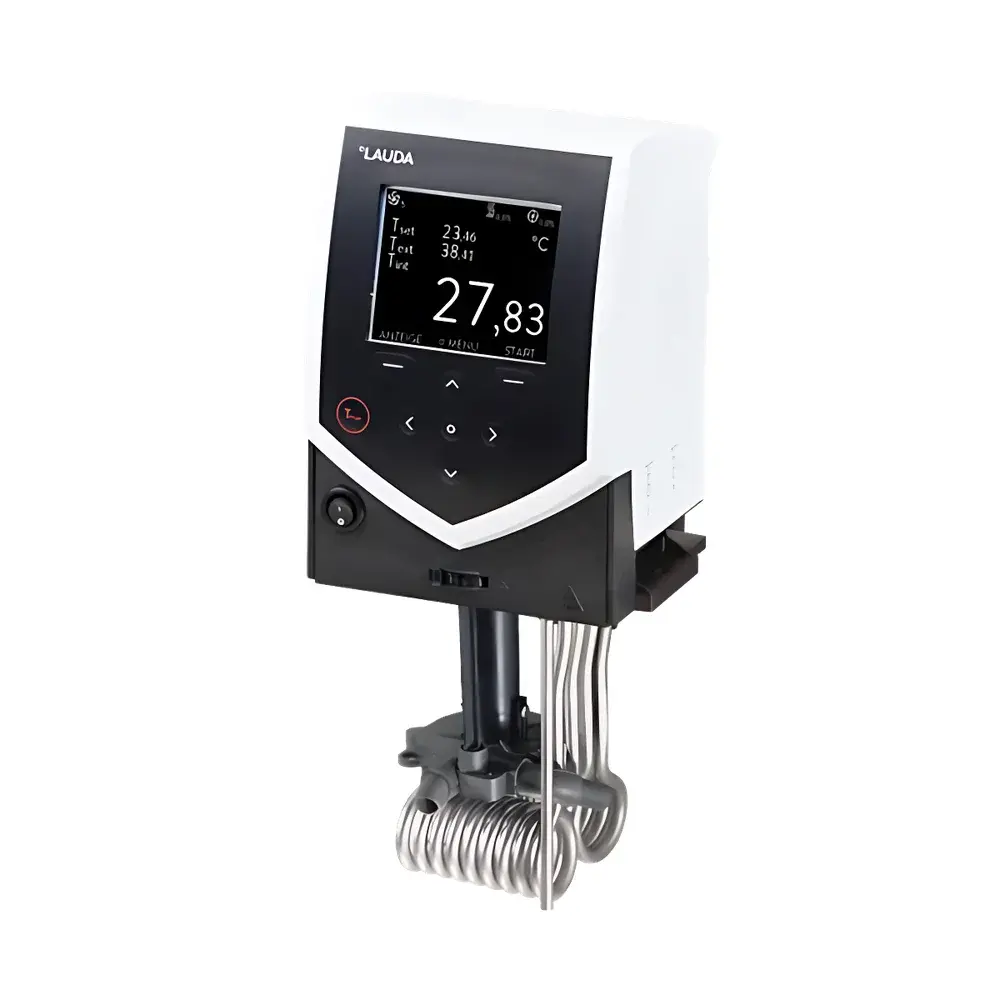
LAUDA ECO Gold Immersion Circulator Thermostat
| Brand | LAUDA |
|---|---|
| Origin | Germany |
| Model | ECO Gold |
| Temperature Range | 20–200 °C |
| Temperature Stability | ±0.01 °C |
| Heating Power | 2.6 kW |
| Max. Power Consumption | 2.7 kW |
| Current Draw | 12 A |
| Pump Flow Rate | 22 L/min |
| Dimensions (W×D×H) | 130 × 135 × 325 mm |
| Power Supply | 230 V, 50/60 Hz |
| Safety Class | III |
Overview
The LAUDA ECO Gold Immersion Circulator Thermostat is a precision-engineered temperature control system designed for demanding laboratory applications requiring stable, uniform thermal environments in open or closed liquid baths. Operating on the principle of forced convection via an integrated high-efficiency circulation pump, the ECO Gold maintains exceptional thermal stability—±0.01 °C—across its full operational range of 20 to 200 °C. Its compact, vertically oriented immersion design enables direct integration into standard glass or stainless-steel bath vessels without external reservoirs or complex plumbing. Engineered in Germany to stringent DIN and IEC safety standards, the unit complies with Safety Class III requirements, permitting safe operation with both flammable (e.g., ethanol, acetone) and non-flammable heat transfer fluids (e.g., silicone oils, water-glycol mixtures), making it suitable for chemistry, materials testing, and quality control laboratories operating under GLP or ISO/IEC 17025 frameworks.
Key Features
- High-resolution color TFT display showing real-time temperature, setpoint, and dynamic temperature trend curves for immediate process verification
- Intuitive menu navigation with cursor keys and soft-touch function buttons; dedicated Tmax key for rapid overtemperature threshold activation
- Full digital PID control architecture ensuring minimal overshoot, fast settling time, and long-term repeatability across repeated thermal cycles
- Six-stage adjustable circulation pump enabling precise flow-rate tuning—from gentle mixing to high-velocity heat transfer—without mechanical throttling
- Internal/external circulation mode switching via front-panel interface, supporting both bath-integrated and external jacketed reactor configurations
- 150-step programmable timer organized into five independent thermal profiles, supporting multi-segment ramp-hold-cool sequences for method-driven protocols
- Standard USB port for firmware updates and data logging; optional expansion modules (e.g., Pt100 input, LiBus communication interface) enable integration into automated lab networks
- Mechanically robust screw-clamp mounting system compatible with bath walls up to 25 mm thick and minimum immersion depth of 150 mm
- Electronic overtemperature protection fully configurable via menu—no hardware jumper changes required—supporting audit-ready parameter change logs when paired with compliant software
Sample Compatibility & Compliance
The ECO Gold is validated for use with a broad spectrum of laboratory heat transfer media, including deionized water, ethylene glycol/water blends, silicone oils (up to 200 °C), and low-flash-point solvents such as isopropanol (with appropriate ventilation and hazard controls). Its Class III electrical rating conforms to IEC 61010-1:2010 and EN 61010-1, certifying suitability for use in environments where operator contact with live parts is possible. The device supports traceable calibration workflows per ISO/IEC 17025 and meets essential requirements for inclusion in FDA-regulated processes when operated with documented procedures and version-controlled firmware (e.g., Part 11-compliant data capture via optional software interfaces).
Software & Data Management
While the ECO Gold operates autonomously via its embedded microprocessor, its USB interface provides direct access to device status, firmware revision, and real-time temperature logs. When equipped with the optional Pt100/LiBus module, the thermostat integrates seamlessly with LAUDA’s RCWin software or third-party SCADA platforms (e.g., LabVIEW, MATLAB, DeltaV) using standardized ASCII command protocols. All parameter modifications—including setpoints, ramp rates, and safety limits—are timestamped and stored in non-volatile memory. Remote control capability supports centralized monitoring in multi-instrument setups, and configuration backups can be exported for version control and regulatory review.
Applications
- Calibration of thermometers, RTDs, and thermocouples against NIST-traceable references
- Viscometry and rheological measurements requiring bath-stabilized sample temperature
- Accelerated stability testing of pharmaceutical formulations per ICH Q1A(R3)
- Controlled heating/cooling of reaction vessels in synthetic organic chemistry
- Material property testing—including coefficient of thermal expansion (CTE) and glass transition (Tg) analysis—using DSC or TMA sample stages
- Environmental simulation for electronics component aging studies (e.g., JEDEC JESD22-A108)
- Quality assurance in polymer processing labs for melt index and flow behavior validation
FAQ
What is the minimum required immersion depth for stable operation?
The ECO Gold requires a minimum immersion depth of 150 mm to ensure full coverage of the heating element and temperature sensor, preventing dry-run conditions and thermal drift.
Can the ECO Gold be used with flammable liquids?
Yes—its Safety Class III certification permits operation with flammable heat transfer media, provided local fire safety regulations (e.g., NFPA 30, DSEAR) are observed and ventilation meets solvent-specific ACGIH TLV requirements.
Is external temperature feedback supported?
Yes—via the optional Pt100/LiBus interface module, enabling external probe feedback for jacket or sample-core temperature control, improving accuracy in heterogeneous systems.
How is overtemperature protection configured?
The Tmax limit is user-definable through the main menu; activation triggers immediate heater shutdown and visual/audible alerts while preserving pump operation for residual heat dissipation.
Does the device support GLP-compliant data integrity?
When connected to validated software with electronic signature and audit trail functionality (e.g., LAUDA RCWin with 21 CFR Part 11 add-on), all critical parameters, setpoint changes, and error events are logged with user ID, timestamp, and reason code.



