
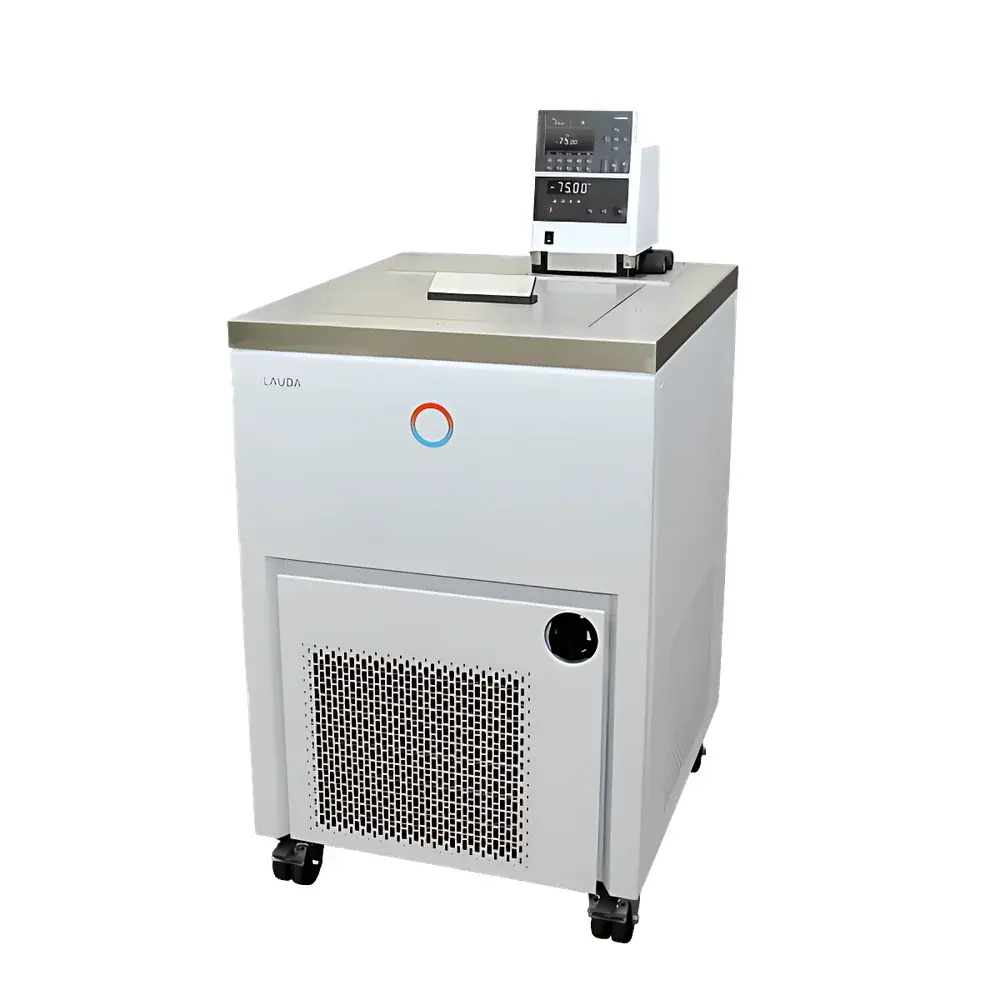
LAUDA Proline Kryomate RP 4050 CW Cryogenic & High-Temperature Circulating Bath
| Brand | LAUDA |
|---|---|
| Origin | Germany |
| Model | RP 4050 CW |
| Temperature Range | −90 °C to +200 °C |
| Temperature Stability | ±0.05 °C |
| Bath Volume | 32–44 L |
| Circulation Type | Internal & External |
| Cooling/Heating Mode | Dual-function |
| Refrigerant | R-449A (GWP 1397) |
| Pump Flow Rate | up to 90 L/min |
| Max. Pressure | 0.9 bar |
| Heating Power | 3.5 kW |
| Max. Power Consumption | 5 kW |
| Interface Options | RS-232/485, Ethernet/USB, Profibus (upgradable) |
| Programmable Steps | 150 segments across 5 programs |
| Remote Control Range | up to 50 m |
Overview
The LAUDA Proline Kryomate RP 4050 CW is a floor-standing, high-performance circulating bath engineered for demanding materials testing and process validation under extreme thermal conditions. Operating across an exceptionally wide temperature range of −90 °C to +200 °C, it integrates a dual-stage refrigeration system with intelligent digital cooling management (SmartCool™) and triple independent heating elements to ensure precise, stable, and reproducible thermal control. Unlike conventional baths limited by compressor restart constraints at elevated temperatures, the RP 4050 CW enables immediate refrigeration activation regardless of current bath temperature — a critical capability for dynamic thermal cycling in polymer characterization, metal embrittlement studies, and low-temperature rheology. Its robust stainless-steel bath construction, optimized flow dynamics via LAUDA Vario™ 4-stage pressure pump, and edge/bridge anti-condensation heating collectively eliminate thermal stratification and moisture-related operational failures during prolonged cryogenic operation.
Key Features
- Wide operational range (−90 °C to +200 °C) validated per IEC 61000-6-2/6-3 for electromagnetic compatibility in laboratory environments
- ±0.05 °C temperature stability over full range, achieved via full-electronic PID controller with adaptive tuning and PowerAdapt™ power optimization
- SmartCool™ digital refrigeration management reduces energy consumption by up to 75% versus legacy on/off compression cycles, extending compressor service life
- Triple redundant heating system: three independent 1.17 kW elements enable uninterrupted operation even if one fails — fault signaled without process interruption
- LAUDA Vario™ pump with four selectable flow stages (15–90 L/min), side/rear mounting options, and M30×1.5 threaded outlet for external circulation integration
- Integrated anti-condensation heating along bath rim and bridge prevents ice formation and corrosion during sub-zero operation in ambient humidity >40% RH
- Graphical backlit LCD with dual display modes: primary real-time temperature curve + secondary green LED Tmax safety indicator
- Comprehensive safety architecture: low-bath-level detection, overtemperature cutoff, non-flammable fluid protection, and automatic compressor shutdown upon sensor fault
Sample Compatibility & Compliance
The RP 4050 CW accommodates large-format test specimens — including ASTM E23 Charpy impact bars, ISO 6277 polymer tensile coupons, and API RP 14E flow loop components — within its 350 × 350 × 250 mm usable bath volume. Its open-top design and adjustable nozzle configuration support immersion of industrial-scale sensors, transducers, and mechanical test fixtures. The system complies with EU Regulation (EU) No 517/2014 on fluorinated greenhouse gases (F-gas), utilizing R-449A (GWP 1397) as primary refrigerant with certified charge containment and leak monitoring. It meets EN 61010-1:2010 for laboratory equipment safety and supports GLP/GMP audit requirements through full electronic logging of temperature setpoints, deviations, alarms, and maintenance events when paired with LAUDA LabView-compatible software.
Software & Data Management
Equipped with standard RS-232/485 optical isolation interface and optional Ethernet/USB or Profibus modules, the RP 4050 CW enables seamless integration into centralized lab data networks. Its onboard 150-segment programmable controller supports five independent thermal profiles with timer-triggered start/stop, standby mode entry, and automatic shutdown. All thermal events — including PID parameter changes, alarm triggers, and pump stage transitions — are timestamped and stored in non-volatile memory. When connected to LAUDA’s Thermostat Control Software (TCS), users gain FDA 21 CFR Part 11-compliant audit trails, electronic signatures, and automated report generation compliant with ISO/IEC 17025 calibration documentation standards. Remote operation up to 50 meters is supported via detachable Command control unit with identical UI functionality.
Applications
- Materials science: Low-temperature ductility testing of aerospace alloys (ASTM E8/E23), cryogenic aging of composites, and thermal shock evaluation per MIL-STD-810H Method 502.6
- Petroleum & lubricants: Pour point determination (ASTM D97, ISO 3016), viscosity index testing (ASTM D2550), and cold-cranking simulator validation
- Pharmaceutical development: Freeze-thaw stability assessment of biologics formulations and excipient crystallinity mapping
- Automotive R&D: EV battery thermal management system validation under simulated arctic/winter conditions (SAE J2380)
- Calibration labs: Reference bath for thermocouple, RTD, and infrared thermometer verification across extended ranges per ISO/IEC 17025 Clause 6.5.2
FAQ
What fluids are compatible with the RP 4050 CW at −90 °C?
Ethanol, ethylene glycol/water mixtures (≤60%), and specialized low-viscosity silicone oils meeting DIN 51587 Class H are approved. Pure water is prohibited below 0 °C.
Can the unit maintain stability at +200 °C while simultaneously circulating externally?
Yes — the dual-circuit design isolates internal bath regulation from external load fluctuations, ensuring ±0.05 °C stability even with 20 L/min external flow.
Is remote firmware update supported?
Firmware updates require local USB connection and LAUDA Service Tool; no over-the-air (OTA) capability is provided for security compliance with IEC 62443-3-3.
Does the system meet FDA 21 CFR Part 11 requirements out-of-the-box?
Electronic signature and audit trail functionality require TCS software licensing and configured user access roles — hardware supports all necessary technical controls (time stamping, event logging, secure storage).
What is the maximum allowable external backpressure for the circulation pump?
0.9 bar absolute pressure at the pump outlet; exceeding this may trigger flow fault detection and automatic stage reduction.



