
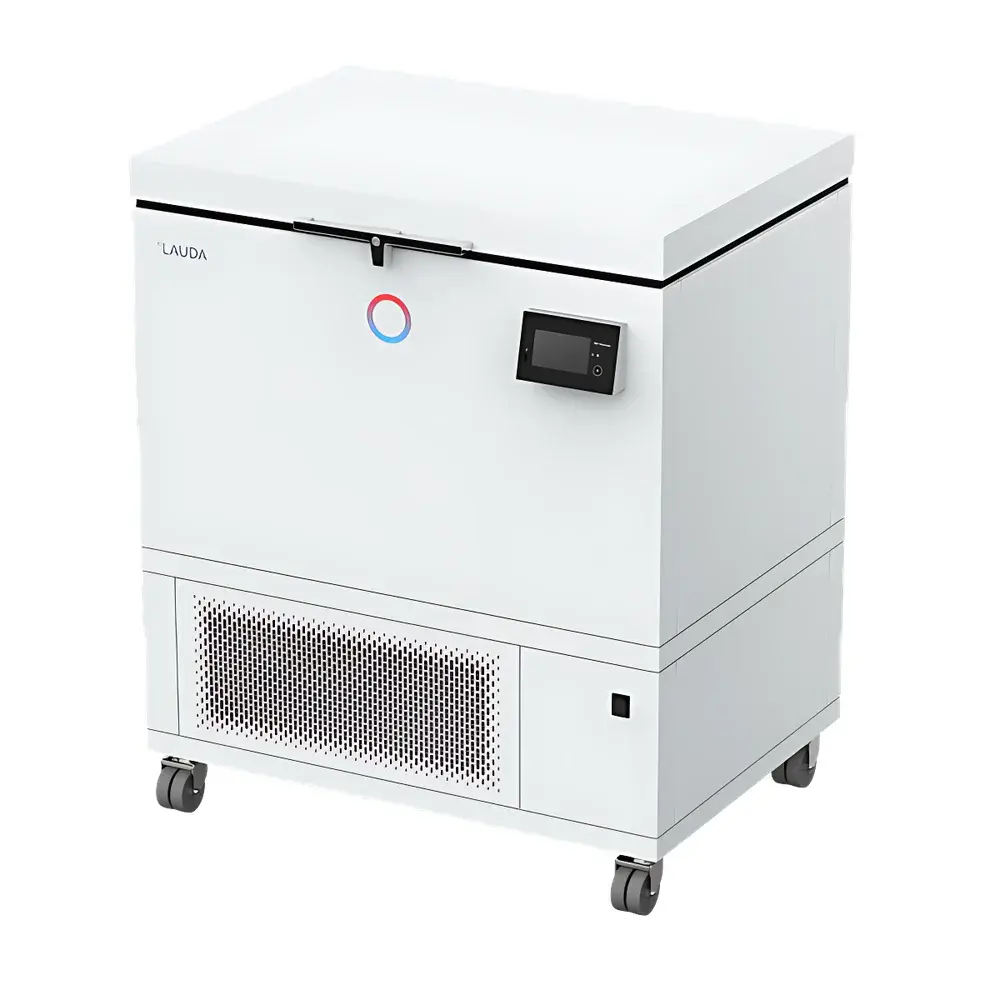
LAUDA Versafreeze VF 20085 C Ultra-Low Temperature Freezer
| Brand | LAUDA |
|---|---|
| Origin | Germany |
| Model | VF 20085 C |
| Configuration | Horizontal |
| Effective Volume | 205 L |
| Internal Dimensions (W×D×H) | 790 × 520 × 500 mm |
| External Dimensions (W×D×H) | 960 × 790 × 1130 mm |
| Power Supply | 230 V / 50 Hz |
| Energy Consumption | 11.2 kWh/d at −86 °C |
| Operating Temperature Range | −86 to −50 °C |
| Ambient Temperature Range | 15 to 28 °C |
| Cool-down Time (20 °C → −86 °C) | ≤3 h |
| Defrost Time (−86 °C → 0 °C) | 11 h |
| Refrigerants | R-290 (0.145 kg, GWP = 3) + R-170 (0.068 kg, GWP = 6) |
| Net Weight | 210 kg |
| Vacuum-Insulated Panels (VIPs) | Integrated |
Overview
The LAUDA Versafreeze VF 20085 C is a horizontally configured ultra-low temperature (ULT) freezer engineered for long-term, high-integrity storage of biologics, primary cell lines, cryopreserved tissues, and other thermolabile life science specimens at stable operating temperatures between −86 °C and −50 °C. Designed and manufactured in Germany, it employs a dual-refrigerant cascade system (R-290/R-170) — both natural hydrocarbons with negligible global warming potential (GWP < 10) — ensuring full compliance with EU F-Gas Regulation (EU No 517/2014) and future-proofing laboratory sustainability commitments. Its core thermal architecture integrates eight-layer insulation combined with vacuum-insulated panels (VIPs), delivering exceptional thermal resistance while maximizing internal usable volume relative to footprint. The unit achieves rapid stabilization: cooling from ambient (20 °C) to −86 °C in under three hours, with uniform temperature distribution maintained across the entire 205 L chamber via optimized airflow and four-directional cold delivery. This performance supports critical applications requiring strict adherence to ISO 13485, FDA 21 CFR Part 11 (when paired with validated software), and GLP/GMP-compliant sample integrity protocols.
Key Features
- Eight-layer composite insulation system with integrated vacuum-insulated panels (VIPs), enhancing thermal efficiency and increasing net storage capacity per unit floor area
- Patented water-cooled condenser design minimizes heat rejection into laboratory space, reducing ambient temperature fluctuation and acoustic emissions (typical noise level < 48 dB(A))
- Stainless steel interior chamber (AISI 304) with seamless welds and magnetic door sealing system to prevent frost lock and ensure long-term gasket integrity
- Intuitive capacitive touchscreen interface with real-time digital display; configurable high/low temperature alarms with user-defined thresholds and password-protected access control
- Battery-backed electronic alarm system retains operational status, temperature history, and alarm logs during power failure — up to six hours of hold time without sample thawing
- Dual 13 mm diameter pass-through ports pre-installed for external sensor integration (e.g., Pt100, thermocouples) and optional monitoring network expansion
- Energy-optimized closed-cycle refrigeration using R-290 (propane) and R-170 (ethane); total refrigerant charge < 0.22 kg, CO₂-equivalent impact ≈ 0 t per unit lifecycle
- Industrial-grade data logging with internal non-volatile memory and dual communication interfaces: 10/100 Mbps Ethernet (IIoT-ready, supports MQTT/HTTP APIs) and RS-485 Modbus RTU
Sample Compatibility & Compliance
The VF 20085 C accommodates diverse biospecimen formats including cryovials (1.0–2.0 mL), cryoboxes (10 × 10 configuration), microtiter plates (96-/384-well), deep-well plates, and tissue cassettes — all supported by optional drawer kits and configurable stainless steel shelving systems. Its uniform temperature stability (±1.5 °C maximum deviation across chamber volume at −86 °C, per IEC 60068-3-5) meets the validation requirements for storage of materials governed by USP , ISO 20387:2018 (biobanking), and CLSI GP44-A4. The unit is CE-marked under Directive 2014/30/EU (EMC) and 2014/68/EU (PED), and its firmware architecture supports audit-trail-enabled operation when integrated with compliant Laboratory Information Management Systems (LIMS).
Software & Data Management
Data integrity is ensured through embedded logging of temperature, alarm events, door openings, and system diagnostics at user-selectable intervals (1 min to 24 h). Logged data is exportable via USB or streamed in real time over Ethernet to centralized servers using standard protocols. Firmware supports TLS 1.2 encryption and role-based user authentication (admin/operator/guest), fulfilling ALCOA+ principles for electronic records. Optional LAUDA Connect Cloud service enables remote monitoring, predictive maintenance alerts, and automated report generation aligned with 21 CFR Part 11 Annex 11 requirements. RS-485 output allows seamless integration into existing BMS or SCADA infrastructures for facility-wide environmental oversight.
Applications
- Long-term archiving of stem cells, induced pluripotent stem cells (iPSCs), and primary human tissues under controlled cryogenic conditions
- Storage of mRNA, CRISPR reagents, viral vectors, and other nucleic acid-based therapeutics sensitive to thermal degradation
- Biobank infrastructure supporting population-scale genomics initiatives requiring ISO 20387-certified cold chain continuity
- QC/QA laboratories maintaining reference standards, certified reference materials (CRMs), and calibration samples at traceable −86 °C setpoints
- Academic and pharmaceutical research labs requiring GLP-compliant cold storage for preclinical study specimens and compound libraries
FAQ
What is the minimum ambient temperature required for stable operation at −86 °C?
The unit is rated for continuous operation within an ambient range of 15–28 °C. Below 15 °C, compressor oil viscosity increases may affect startup reliability; above 28 °C, cooling capacity degrades and energy consumption rises significantly.
Can this freezer be connected to a building’s central chilled water system?
Yes — the water-cooled condenser accepts standard industrial coolant (e.g., 10–25 °C glycol/water mix) at 2–4 bar pressure. An optional outdoor chiller package is available for facilities lacking centralized cooling infrastructure.
Is liquid nitrogen backup integration supported out-of-the-box?
The VF 20085 C includes dedicated mounting points and electrical interlocks for third-party LN₂ or CO₂ emergency backup systems; full integration requires site-specific engineering and validation per ICH Q5C.
How frequently should the VIP insulation integrity be verified?
Vacuum panel performance is monitored continuously via internal pressure sensors; any detected loss triggers a maintenance alert. No routine manual verification is required — VIPs are sealed for life and carry a 10-year functional warranty.
Does the unit comply with FDA 21 CFR Part 11 for electronic records?
The hardware and firmware support Part 11 requirements (audit trails, electronic signatures, secure login) when deployed with validated software configurations and documented change control procedures.



