
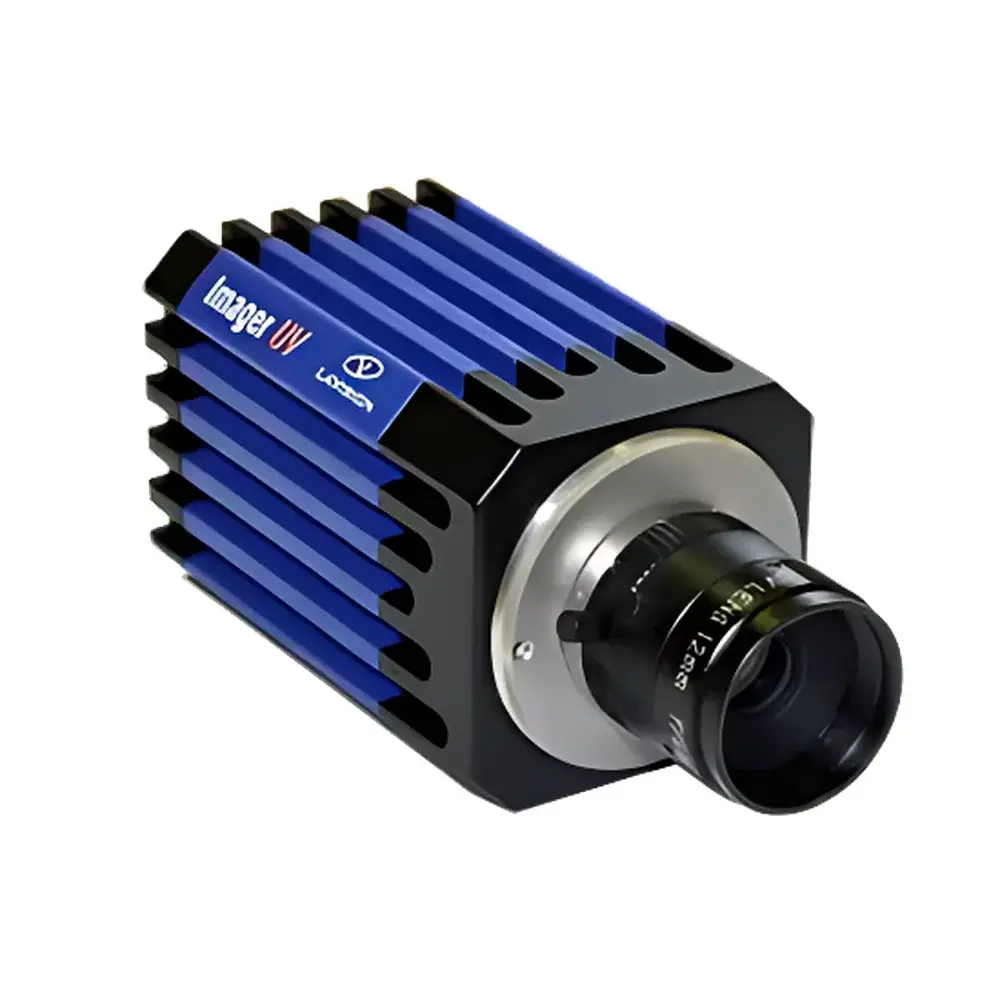
LaVision Imager UV High-Dynamic-Range CCD Camera
| Brand | LaVision GmbH |
|---|---|
| Origin | Germany |
| Model | Imager UV |
| Spectral Range | Optimized for UV (180–400 nm) |
| Minimum Exposure Time | 1 µs |
| Quantum Efficiency | >50% at 254 nm, >30% at 200 nm |
| Sensor Type | Back-illuminated, UV-enhanced CCD |
| Dynamic Range | ≥70 dB (typical, full-well capacity >100 ke⁻) |
| Interface | Camera Link or GigE Vision (configurable) |
| Cooling | Thermoelectric (−10 °C to −20 °C stabilized) |
| Compliance | CE, RoHS, ISO 9001 manufacturing environment |
Overview
The LaVision Imager UV is a scientific-grade, back-illuminated CCD camera engineered specifically for high-fidelity imaging in the ultraviolet spectral region (180–400 nm). Unlike standard silicon-based CCDs—whose quantum efficiency (QE) drops sharply below 350 nm—the Imager UV integrates a proprietary UV-enhanced photocathode and anti-reflective coating optimized for deep-UV photon detection. It operates on the principle of photoelectron generation in a thinned, passivated CCD architecture, where incident UV photons are converted directly into charge carriers with minimal absorption loss in the gate structure. This design enables quantitative, low-noise imaging in demanding applications such as laser-induced fluorescence (LIF) of OH radicals, UV Raman spectroscopy, plasma diagnostics, and synchrotron beamline monitoring—where spectral sensitivity, temporal resolution, and radiometric stability are non-negotiable.
Key Features
- UV-optimized quantum efficiency: >50% at 254 nm and >30% at 200 nm—significantly exceeding conventional front-illuminated CCDs (typically <5% at 200 nm)
- Ultrafast gating capability: Minimum exposure time of 1 µs with sub-microsecond shutter precision, enabling time-resolved UV imaging synchronized to pulsed lasers or discharge events
- High dynamic range performance: ≥70 dB (measured at 16-bit digitization), achieved via large full-well capacity (>100,000 electrons) and low read noise (<15 e⁻ RMS at 1 MHz pixel rate)
- Thermoelectric cooling system: Stabilized sensor temperature between −10 °C and −20 °C reduces dark current to <0.005 e⁻/pixel/s, critical for long-exposure UV luminescence studies
- Flexible interface options: Factory-configurable Camera Link (Base/Medium) or GigE Vision output, supporting integration into both legacy and modern machine vision or DAQ platforms
- Robust mechanical housing: Aluminum alloy chassis with magnetic-shielded enclosure and NIST-traceable calibration port for radiometric validation
Sample Compatibility & Compliance
The Imager UV is compatible with standard C-mount and F-mount optical interfaces, and supports optional UV-transmissive lens adapters (e.g., quartz or CaF₂ relay optics) to preserve spectral throughput. It meets EU regulatory requirements under CE marking directives (2014/30/EU EMC, 2014/35/EU LVD) and complies with RoHS 2011/65/EU restrictions on hazardous substances. Manufacturing adheres to ISO 9001:2015 quality management protocols. While not intrinsically rated for hazardous environments, the camera may be deployed in Class 100 cleanrooms or vacuum-compatible enclosures (with optional feedthrough variants) per customer specification. Its calibrated linearity and uniformity data support traceable measurements compliant with ASTM E1548 (Standard Guide for Characterizing Optical Imaging Systems) and ISO 15739 (Photography — Electronic still picture imaging — Noise measurements).
Software & Data Management
The Imager UV is fully supported by LaVision’s DaVis software suite (v10.2+), which provides hardware-synchronized acquisition, real-time flat-field correction, non-uniformity compensation, and photon-counting mode operation. All raw frames retain 16-bit linear intensity values with embedded metadata (exposure timestamp, sensor temperature, gain setting, lens ID). Data export formats include HDF5 (with hierarchical metadata tagging), TIFF (16-bit unsigned), and binary sequences compatible with MATLAB, Python (via NumPy/PIL), and LabVIEW. Audit trails—including parameter changes, user login sessions, and firmware version logs—are maintained in accordance with GLP/GMP-aligned workflows and satisfy basic FDA 21 CFR Part 11 requirements when used with validated DaVis configurations and network-authenticated user accounts.
Applications
- Laser-induced fluorescence thermometry (LIF-T) of reactive species (OH, CH, NO) in combustion chambers and gas-phase reaction kinetics
- UV shadowgraphy and Schlieren imaging for high-speed flow visualization in hypersonic wind tunnels
- Time-resolved UV microscopy of semiconductor photomasks and lithographic resist exposure profiles
- In-line UV inspection of pharmaceutical tablet coatings and polymer degradation under accelerated UV aging
- Synchrotron-based X-ray excited optical luminescence (XEOL) mapping with sub-10 µm spatial resolution
- Calibration reference source for UV radiometers and spectroradiometers across NIST-traceable irradiance levels
FAQ
Is the Imager UV suitable for vacuum chamber integration?
Yes—optional vacuum-compatible variants feature CF-40 flange mounting, bakeable cables, and outgassing-certified materials (per ASTM E595). Standard units require external viewport coupling.
Can it operate without active cooling?
It can acquire short-exposure images uncooled, but dark current increases exponentially above −5 °C; thermoelectric cooling is recommended for quantitative work requiring SNR >50:1.
Does it support external trigger synchronization with nanosecond jitter?
Yes—hardware-level TTL/RS-422 triggering with ≤5 ns jitter (measured RMS) and programmable delay (0–10 s, 10 ns resolution) is available via the Camera Link interface.
What UV-transmissive optics are recommended?
CaF₂ objectives (e.g., Mitutoyo UV M Plan Apo series) or fused silica lenses with MgF₂ anti-reflection coatings (180–250 nm optimized) are strongly advised to maintain system-level QE.
Is factory recalibration available?
Yes—LaVision offers biannual radiometric recalibration services traceable to PTB (Physikalisch-Technische Bundesanstalt) standards, including spatial uniformity, QE curve, and linearity verification reports.




