
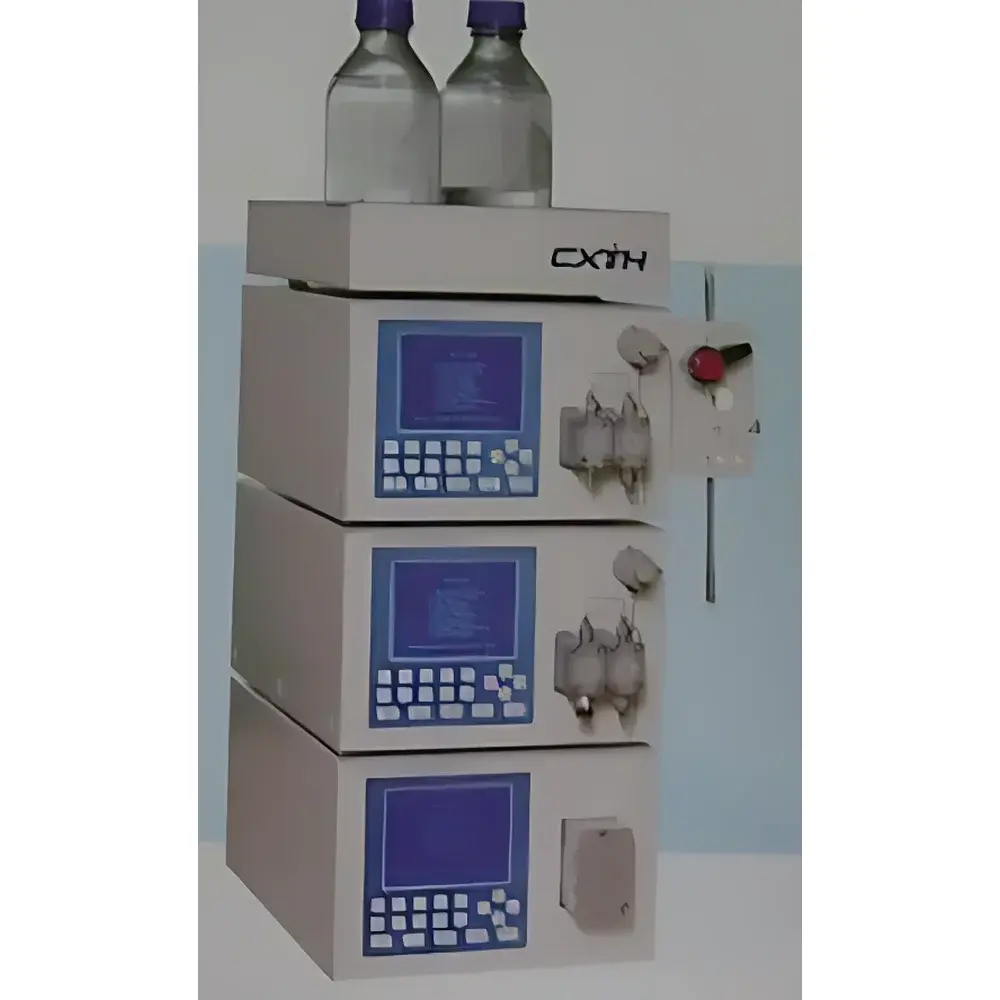
LC3050 Semi-Preparative High-Performance Liquid Chromatography System (Dual-Pump Gradient High-Pressure HPLC System)
| Origin | Shanghai, China |
|---|---|
| Manufacturer Type | Authorized Distributor |
| Origin Category | Domestic (PRC) |
| Model | LC3050 |
| Price | USD 13,800 (FOB Shanghai) |
| Flow Range | 0.1–49.9 mL/min (per pump) |
| Max Pressure | 30 MPa |
| UV Detection Range | 190–700 nm |
| Wavelength Accuracy | ±2 nm |
| Baseline Noise | ≤2 × 10⁻⁵ AU/h (254 nm, 1 mL/min, MeOH/H₂O 80:20) |
| Gradient Mixing | Binary high-pressure dynamic mixing |
| Column Dimensions | 250 × 30 mm, 10 µm C18 spherical silica |
| Software Compliance | GLP-compliant audit trail, electronic signatures, method validation support |
Overview
The LC3050 Semi-Preparative High-Performance Liquid Chromatography System is an engineered solution for scalable purification and isolation of target compounds from complex mixtures at the milligram-to-gram level. Built upon dual high-pressure reciprocating piston pumps operating in gradient mode, the system delivers precise, reproducible solvent delivery across a wide flow range (0.1–49.9 mL/min per pump) with maximum pressure capability of 30 MPa—enabling robust separation on semi-preparative columns packed with 10 µm spherical C18 silica. The system employs high-pressure binary mixing architecture, eliminating low-pressure dwell volume artifacts and ensuring accurate gradient formation critical for method transfer from analytical to semi-preparative scale. Its modular design supports seamless integration of UV/VIS detection (190–700 nm), manual loop injection (2 mL / 5 mL selectable), and dynamic flow-path configuration—making it suitable for natural product isolation, pharmaceutical intermediate purification, synthetic compound cleanup, and reference standard preparation under regulated laboratory environments.
Key Features
- Dual P3050 high-pressure reciprocating pumps with adjustable pressure limits (min/max), soft-start/stop functionality, and automatic parameter retention upon power cycle
- UV3000 UV/VIS detector featuring deuterium lamp (standard) and optional tungsten lamp, programmable wavelength scanning, and seven selectable time constants (0.1–10 s) for optimized signal-to-noise response
- 3725i-038 semi-preparative manual injection valve with dual定量 loops (2 mL and 5 mL), stainless-steel construction, and low-dead-volume flow path
- Integrated high-pressure dynamic mixer enabling real-time binary gradient composition control without post-mixing delay or band broadening
- Full-system reverse control via dedicated chromatography workstation with GLP-compliant features: user access levels, electronic signatures, audit trail logging, and method/version history tracking
- Pre-configured semi-preparative column (250 × 30 mm, 10 µm C18 spherical silica) and start-up toolkit including spare tubing, ferrules, and solvent reservoir tray
Sample Compatibility & Compliance
The LC3050 accommodates a broad range of sample matrices—including small organic molecules, peptides, natural extracts, and synthetic intermediates—provided they exhibit adequate solubility in common reversed-phase mobile phases (e.g., water/acetonitrile or water/methanol gradients). Its 30 MPa pressure rating and 30 mm internal diameter column compatibility support efficient loading and resolution of moderately polar to non-polar analytes. From a regulatory standpoint, the system’s software architecture complies with Good Laboratory Practice (GLP) requirements as defined by OECD Principles and aligns with data integrity expectations outlined in FDA 21 CFR Part 11 for electronic records and signatures. All method parameters, acquisition logs, and event timestamps are immutably recorded with user attribution and time-stamped audit trails—facilitating inspection readiness for QA/QC laboratories engaged in pharmaceutical development, contract research, or academic core facility operations.
Software & Data Management
The embedded chromatography workstation provides a fully localized English interface (with optional multilingual support) for instrument control, method development, peak integration, and report generation. It supports ICH Q2(R2)-aligned validation protocols—including specificity, linearity, accuracy, precision, and robustness testing—and exports raw data in open formats (e.g., .cdf, .csv) compatible with third-party analysis tools such as Chromeleon, Empower, or OpenChrom. All system events—including pump priming, gradient initiation, detector lamp status, and valve actuation—are logged with millisecond-resolution timestamps. Electronic signature workflows enforce role-based access control (administrator, analyst, reviewer), while password policies and session timeout settings meet ISO/IEC 27001-aligned information security practices. Data backups can be scheduled to network drives or external media with SHA-256 hash verification to ensure integrity.
Applications
- Purification of synthetic reaction mixtures prior to NMR or MS characterization
- Isolation of bioactive constituents from plant extracts or fermentation broths
- Preparative-scale fractionation for structure–activity relationship (SAR) studies
- Production of certified reference materials (CRMs) under ISO 17034 guidelines
- Method scouting and scalability assessment between analytical HPLC and preparative systems
- QC release testing of intermediate batches in API manufacturing (when operated within validated SOPs)
FAQ
What is the maximum flow rate and pressure supported by each pump?
Each P3050 pump operates from 0.1 to 49.9 mL/min with a maximum pressure rating of 30 MPa.
Can the system perform gradient elution with two different solvents?
Yes—the integrated high-pressure binary mixer enables precise, real-time gradient programming using two independent solvent channels.
Is the UV3000 detector compatible with both deuterium and tungsten lamps?
Yes—the detector ships with a deuterium lamp as standard; the tungsten lamp is field-replaceable and supports extended visible-range detection up to 700 nm.
Does the software support 21 CFR Part 11 compliance?
The workstation implements core Part 11 requirements including audit trails, electronic signatures, and role-based access control—but final validation remains the responsibility of the end-user laboratory.
What column dimensions and packing material are included in the base configuration?
One 250 × 30 mm semi-preparative column packed with 10 µm spherical C18 silica is supplied as standard equipment.
Is remote monitoring or network connectivity available?
The system supports Ethernet-based communication and can be integrated into local area networks for centralized monitoring via secure HTTP or OPC UA protocols (configuration requires IT department coordination).





