
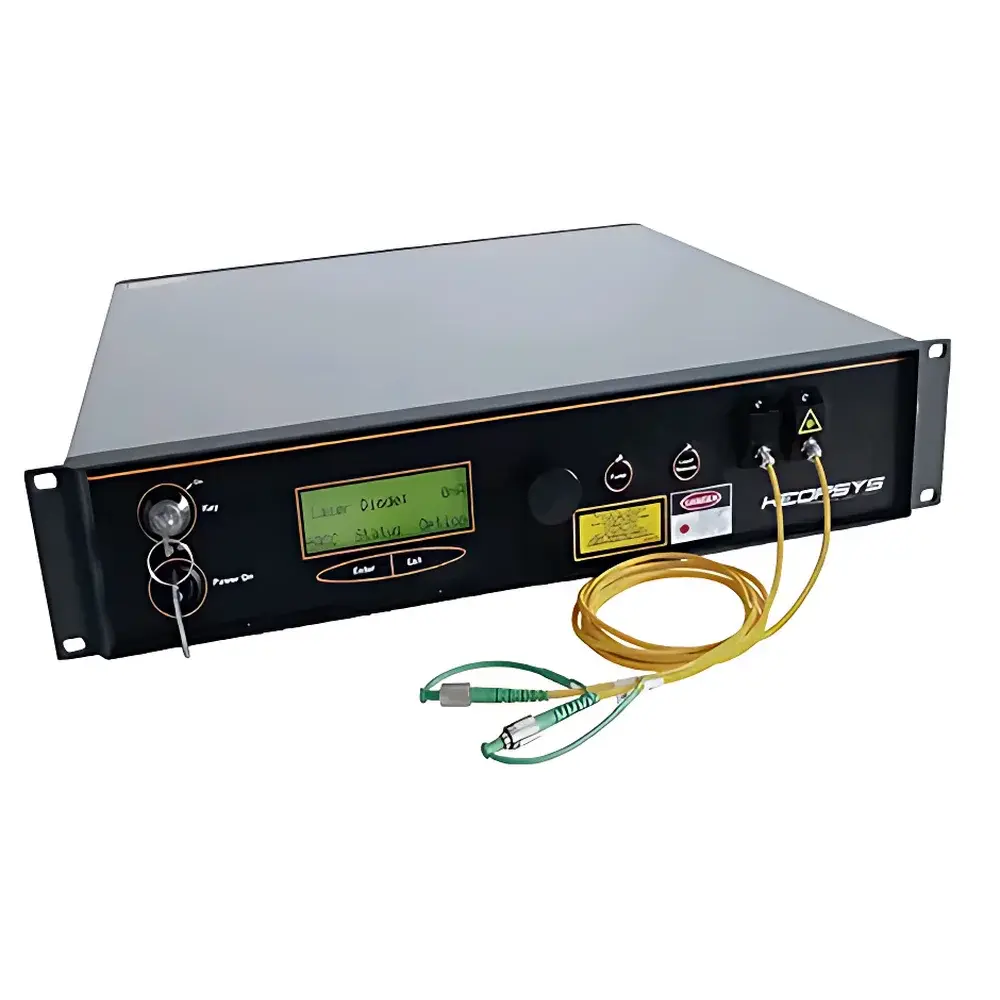
Keopsys CEFA-PB-HP Series High-Power Continuous-Wave Fiber Amplifier
| Brand | Keopsys |
|---|---|
| Origin | France |
| Model | CEFA-PB-HP Series |
| Output Power Range | +25 dBm to +42 dBm |
| Noise Figure | < 5.5 dB |
| Operating Wavelength | C-band (1535–1565 nm), L-band optional |
| Input Power Range | −20 dBm to +5 dBm |
| Control Modes | APC (Automatic Power Control) and ACC (Automatic Current Control) |
| Polarization-Maintaining Output | Optional |
| Application Domain | Optical communications, free-space optical links, tunable laser power boosting, pre-amplification, in-line amplification, Telcordia-compliant component testing |
Overview
The Keopsys CEFA-PB-HP Series is a high-performance, continuous-wave (CW) erbium-doped fiber amplifier (EDFA) engineered for demanding applications requiring stable, high-output optical power with exceptional signal fidelity. Based on dual-stage, co-propagating pump architecture and optimized gain fiber design, the CEFA-PB-HP delivers broadband amplification across the C-band (1535–1565 nm), with optional L-band variants available upon request. Its core function is to amplify weak optical signals while preserving signal-to-noise ratio (SNR) and spectral integrity—critical for coherent transmission systems, quantum optics experiments, and high-dynamic-range photonic test benches. Unlike pulsed or gain-switched amplifiers, the CEFA-PB-HP operates exclusively in CW mode, eliminating temporal jitter and enabling precise power stabilization essential for metrology-grade setups and long-haul analog optical links.
Key Features
- Output power scalable from +25 dBm (316 mW) up to +42 dBm (15.8 W), supporting both single-channel and multi-channel amplification configurations
- Noise figure consistently below 5.5 dB across full operating range—achieved via low-noise pre-amplifier stage and optimized pump wavelength management (980 nm + 1480 nm dual-pump configuration)
- Integrated APC and ACC control loops enable stable output under varying input conditions; APC ensures constant output power despite input fluctuations, while ACC maintains fixed pump diode current for reproducible gain calibration
- Polarization-maintaining (PM) output fiber option available with extinction ratio >20 dB, suitable for interferometric sensing, polarization-sensitive spectroscopy, and coherent detection systems
- Ruggedized OEM module design compliant with IEC 61300-2-1 (vibration) and IEC 60068-2-64 (shock); operating temperature range: 0 °C to +50 °C with forced-air cooling
- Front-panel analog voltage interface (0–5 V) and RS-232/RS-485 digital communication for remote monitoring of gain, output power, pump current, and case temperature
Sample Compatibility & Compliance
The CEFA-PB-HP accepts standard single-mode fiber (SMF-28 or equivalent) inputs with FC/APC or SC/APC connectors. It is compatible with narrow-linewidth (<100 kHz) DFB lasers, external cavity tunable lasers (e.g., Santec TSL-570), and fiber-coupled semiconductor optical amplifiers (SOAs) used as seed sources. The amplifier meets Telcordia GR-1312-CORE reliability requirements for telecom-grade components, including 2000-hour burn-in and accelerated life testing at elevated temperature/humidity. All units undergo full spectral characterization (gain flatness ±0.5 dB over C-band), polarization-dependent loss (PDL) measurement (45 dB). For regulated environments, firmware supports audit-trail logging and user-access-level configuration locking aligned with GLP/GMP documentation workflows.
Software & Data Management
Keopsys provides the KEOPSYS Control Suite—a Windows-based application enabling real-time parameter visualization, automated gain sweep routines, and CSV export of time-stamped operational logs (output power, pump current, TEC status). The software implements configurable alarm thresholds (e.g., pump current deviation >±5%, case temperature >45 °C) with email/SNMP alerting capability. Firmware adheres to IEEE 1621-compliant thermal management protocols and supports optional integration into LabVIEW™ via IVI drivers or Python-based PyVISA interfaces. All configuration changes are timestamped and stored in non-volatile memory with version-controlled firmware updates traceable to Keopsys release notes (e.g., v3.2.1, certified per ISO/IEC 17025 calibration procedures).
Applications
- High-power seeding of optical parametric oscillators (OPOs) and difference-frequency generation (DFG) sources in mid-IR spectroscopy
- Boosting output of narrow-linewidth lasers for gravitational wave detector interferometer arms (e.g., LIGO-style Michelson configurations)
- In-line amplification in free-space optical (FSO) communication testbeds operating under atmospheric turbulence simulation
- Telcordia GR-468 qualification testing of isolators, circulators, and WDM filters under high-power stress conditions
- Pre-amplification stage in ultra-low-noise coherent receivers for deep-space optical communications (DSOC) emulation
- Power scaling of frequency combs for absolute distance metrology and optical clock distribution networks
FAQ
What is the maximum allowable input power before saturation or nonlinear effects occur?
Saturation onset is defined at −3 dB gain compression; for the +42 dBm model, this occurs at input powers above +3 dBm. Operation beyond this point risks stimulated Brillouin scattering (SBS) in standard SMF—Keopsys recommends using large-mode-area (LMA) delivery fiber for inputs >0 dBm.
Is the CEFA-PB-HP series qualified for spaceborne deployment?
While radiation-hardened variants are not standard, the base platform has passed ESA ECSS-Q-ST-70-08C screening for total ionizing dose (TID) up to 10 krad(Si) and single-event latch-up (SEL) immunity per MIL-STD-883H Method 1019. Custom space-qualified versions require early engagement with Keopsys engineering.
Can the amplifier be operated in constant-gain mode?
No—the CEFA-PB-HP supports only APC and ACC modes. Constant-gain operation requires external feedback from an integrated photodiode and custom PID loop implementation, which is not embedded in factory firmware.
Does the unit include built-in optical monitoring (e.g., tap couplers with photodiodes)?
Yes—each unit integrates 1% output taps with calibrated InGaAs photodiodes for real-time output power monitoring; calibration certificates are provided with NIST-traceable uncertainty budgets.
What cooling method is required for sustained +42 dBm operation?
For continuous operation at rated maximum output, forced-air cooling with ≥40 CFM airflow directed across the heatsink fins is mandatory. Passive convection is sufficient only up to +33 dBm under ambient ≤30 °C.




