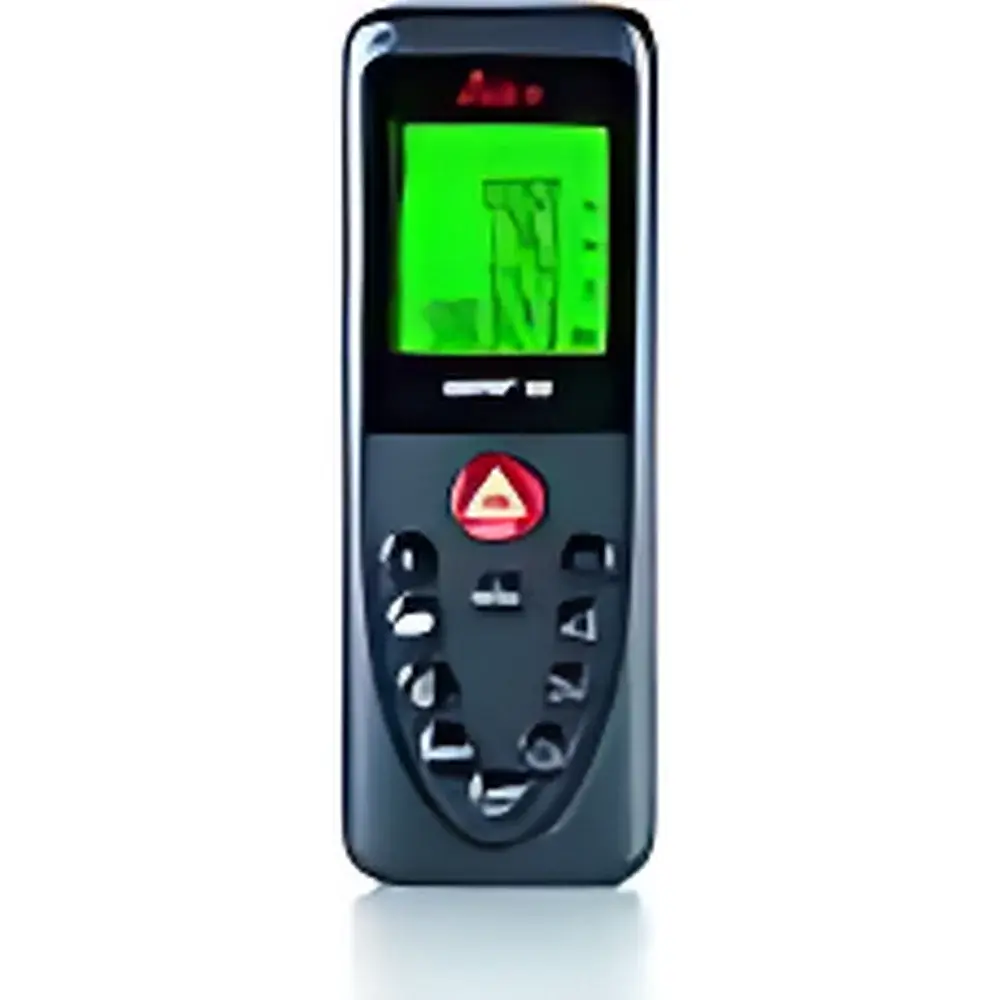
Leica D3 Handheld Laser Distance Meter
| Brand | Leica |
|---|---|
| Origin | Switzerland |
| Instrument Type | Handheld Laser Distance Meter |
| Measurement Principle | Time-of-Flight Laser Ranging |
| Measurement Range | 0.05 m – 100 m |
| Accuracy | ±1.0 mm |
| Tilt Sensor Accuracy | ±0.3° |
| Display Resolution | 0.1 mm |
| Operating Temperature | −10 °C to +50 °C |
| IP Rating | IP54 |
| Battery Life | Up to 5,000 measurements per set of 2 x AAA batteries |
| Compliance | CE, RoHS, FDA Class I Laser Product (IEC 60825-1) |
Overview
The Leica D3 Handheld Laser Distance Meter is an engineered solution for high-accuracy, single-point distance acquisition in indoor construction, facility management, and architectural surveying environments. Based on time-of-flight (ToF) laser ranging technology, the device emits a Class I invisible infrared laser pulse (wavelength: 635 nm) and calculates distance by precisely measuring the round-trip time between emission and reflection detection. Its compact ergonomic form factor, integrated tilt sensor, and intelligent ambient light sensing system enable reliable operation under variable lighting conditions—from dimly lit basements to sunlit atriums—without manual display adjustment. Designed for metrological integrity in field-deployed workflows, the D3 delivers traceable distance data with ±1.0 mm accuracy across its full 0.05–100 m range, meeting the repeatability and resolution requirements of ISO 17123-4 for electronic distance meters used in building measurement applications.
Key Features
- Integrated dual-axis tilt sensor (±0.3° accuracy) enabling indirect height/width determination via Pythagorean theorem and slope-compensated horizontal distance calculation
- Auto-illuminating OLED display and keypad activated by ambient light sensor—no manual backlight toggling required
- Folding base with automatic orientation detection for stable edge-to-edge or corner-to-corner measurements without repositioning
- On-device calculation suite: wall length summation, floor/ceiling area derivation, room angle computation (using three sequential distance inputs), and equal/unequal offset marking
- Rugged housing rated IP54 for protection against dust ingress and water splashes during daily site use
- Energy-efficient design supporting up to 5,000 measurements per pair of standard AAA alkaline cells
Sample Compatibility & Compliance
The Leica D3 is optimized for reflective and semi-diffuse surfaces typical of interior built environments—including drywall, painted concrete, ceramic tile, and wood finishes. It does not require retroreflective targets for standard operation but benefits from optional Leica target plates (e.g., Leica Target Plate TP1) when measuring low-reflectivity surfaces or at extended ranges (>70 m). The instrument complies with European CE marking directives, RoHS 2011/65/EU for hazardous substance restriction, and IEC 60825-1:2014 as a Class I laser product—ensuring eye safety under all normal operating conditions. While not certified for GLP/GMP-regulated metrology labs, its measurement stability and documented uncertainty budget support use in ISO 9001-certified quality systems where dimensional verification of installed equipment, partition layouts, or MEP clearances is required.
Software & Data Management
The D3 operates as a standalone field instrument with no proprietary software dependency. All measurement data—including timestamps, tilt values, and derived results—are displayed and stored locally in non-volatile memory (up to 30 recent readings). Export functionality is not embedded; however, users may manually transcribe values into external documentation systems compliant with ISO/IEC 17025 record-keeping protocols. For integration into digital workflow platforms (e.g., Autodesk BIM 360, PlanGrid), field personnel typically capture screen images or log entries directly into project management tools. Firmware updates are not field-upgradable; calibration verification and periodic adjustment must be performed by authorized Leica service centers adhering to manufacturer-recommended intervals (typically every 12–24 months depending on usage intensity).
Applications
- Architectural space verification: validation of as-built dimensions against CAD drawings prior to fit-out
- Facility maintenance planning: clearance checks for HVAC ductwork, fire suppression piping, and ceiling-mounted fixtures
- Interior fit-out coordination: precise layout marking for partition walls, suspended ceilings, and electrical outlet placements
- Real estate documentation: generation of accurate floor plans for leasing, valuation, or insurance assessments
- Education and vocational training: hands-on instruction in geometric metrology principles, error propagation analysis, and indirect measurement methodology
FAQ
What is the maximum measurable distance on non-reflective surfaces?
Under typical indoor lighting and surface reflectivity (e.g., matte-painted drywall), the practical limit remains within the specified 100 m range. However, for surfaces with reflectance <10% (e.g., black rubber flooring), performance degrades above ~40 m; use of Leica TP1 target plate restores full-range capability.
Can the D3 perform continuous measurement mode?
No—the D3 supports only single-shot distance acquisition. It does not offer real-time tracking or scan-mode functionality found in higher-tier models such as the Leica DISTO S910.
Is calibration traceable to national standards?
Yes—factory calibration is performed against Leica’s internal reference standards, which are periodically verified against NIST-traceable artifacts maintained at Leica Geosystems’ calibration laboratory in Heerbrugg, Switzerland.
Does the tilt sensor require user recalibration?
No—sensor zero-point stability is maintained through mechanical design and temperature compensation algorithms; no field recalibration procedure is provided or supported.
How is measurement uncertainty reported for QA documentation?
Per Leica’s technical specification sheet, expanded uncertainty (k = 2) for distance measurement is ±(1.0 mm + 0.02 mm/m), incorporating contributions from laser timing resolution, temperature drift, and tilt sensor cross-axis coupling effects.