
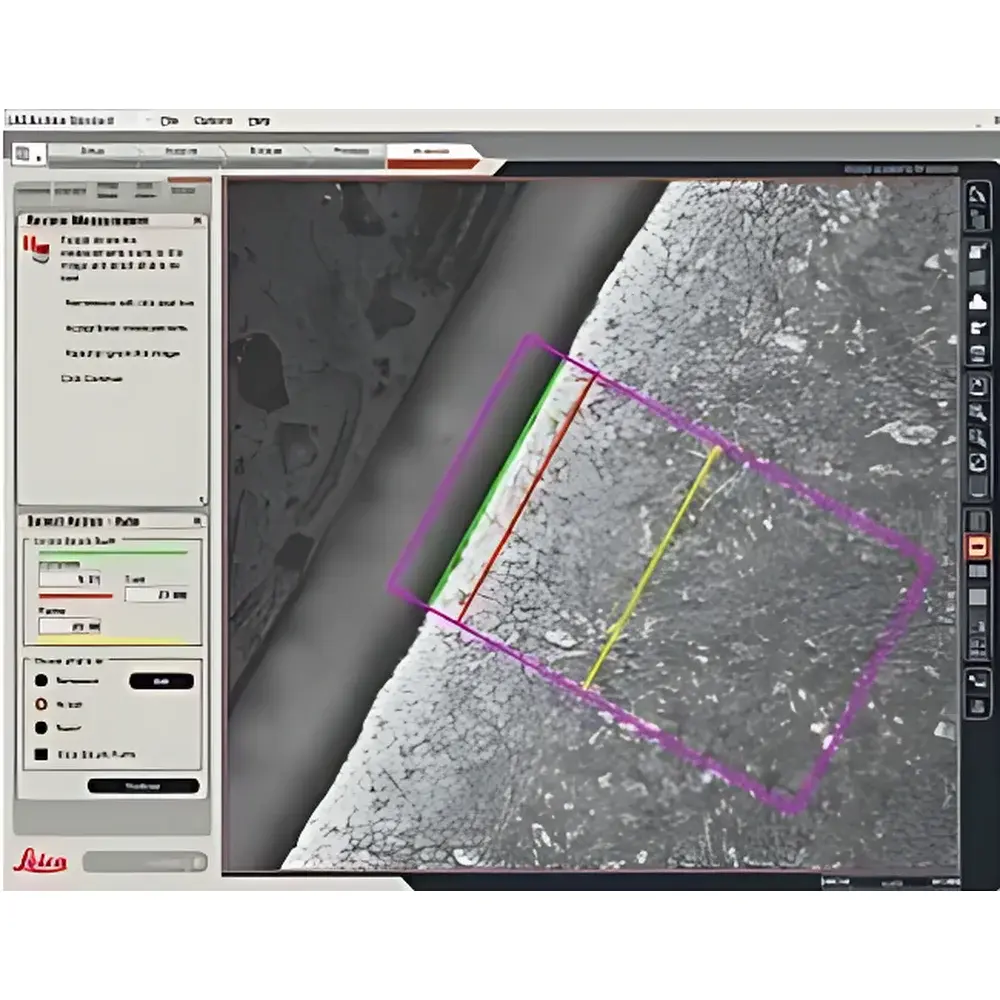
Leica Decarburisation Expert Metallurgical Microscope
| Brand | Leica |
|---|---|
| Origin | Germany |
| Configuration | Upright |
| Total Magnification | 1000× |
| Eyepiece | 10× |
| Objective | 100× |
| Compliance | ASTM E1077, ISO 3887, JIS G 0551 |
| Software Platform | Leica Application Suite (LAS) X |
| Reporting | Excel-integrated customizable templates |
| Image Analysis | Automated decarburization depth quantification (total, partial, and full decarburization zones) |
| System Architecture | Motorized stage, LED illumination, high-resolution monochrome camera (optional color), GLP-compliant audit trail |
Overview
The Leica Decarburisation Expert is a purpose-engineered upright metallurgical microscope system designed for standardized, quantitative assessment of surface decarburization in ferrous alloys—particularly carbon and alloy steels subjected to heat treatment, forging, or hot-rolling processes. It operates on the fundamental metallurgical principle that decarburization manifests as a gradient reduction in pearlite volume fraction near the surface, resulting from carbon diffusion out of the austenite phase during elevated-temperature exposure. The system combines high-fidelity optical imaging with algorithm-driven digital image analysis to objectively determine total decarburization depth (TDD), partial decarburization depth (PDD), and full decarburization zone (FDZ) boundaries in accordance with internationally recognized test methods. Unlike conventional manual measurement techniques prone to inter-operator variability, the Decarburisation Expert delivers traceable, repeatable results through calibrated pixel-to-micron mapping, automated contrast-based phase segmentation, and geometric thresholding aligned with ASTM E1077–22 (“Standard Test Methods for Determining Decarburization in Steel”), ISO 3887:2017 (“Steels — Determination of Depth of Decarburization”), and JIS G 0551:2019 (“Method of Testing Decarburization Depth of Steel”).
Key Features
- Upright optical architecture optimized for polished, etched metallographic specimens—compatible with standard 25 mm and 30 mm diameter sample mounts.
- High-NA 100× oil-immersion objective lens (numerical aperture ≥0.85) enabling diffraction-limited resolution at 1000× total magnification with 10× wide-field eyepieces.
- Integrated motorized XY stage with programmable coordinate recall for multi-field acquisition across large-area samples (e.g., bar cross-sections, strip edges).
- LED-based Köhler illumination system providing stable, flicker-free, color-temperature-controlled lighting essential for consistent grayscale intensity profiling in ferrite/pearlite discrimination.
- Monochrome scientific CMOS camera (≥5 MP, 12-bit dynamic range) synchronized with LAS X software for noise-reduced image capture under controlled exposure and gain settings.
- Pre-configured, standards-aligned analysis modules: automatic pearlite fraction calculation, edge-detection-based depth profiling, and ISO-compliant smoothing filters applied prior to boundary interpolation.
Sample Compatibility & Compliance
The Decarburisation Expert accepts conventionally prepared metallographic specimens—ground, polished, and etched using standard reagents such as 2% nital or picral—to reveal microstructural contrast between ferrite and pearlite phases. Specimen thickness is unrestricted; clamping fixtures accommodate samples up to 40 mm in height and 100 mm in width. All analytical workflows comply with Good Laboratory Practice (GLP) requirements: audit trails record operator ID, timestamp, image acquisition parameters, software version, and every modification made during analysis. Data integrity is preserved via write-protected result exports and optional 21 CFR Part 11–compliant electronic signature integration when deployed in regulated QA/QC environments.
Software & Data Management
Leica Application Suite (LAS) X serves as the central analytical engine, offering a validated, modular interface for decarburization-specific workflows. Its image processing pipeline includes adaptive histogram equalization, non-uniform illumination correction, and trainable classifiers for distinguishing decarburized ferrite-rich regions from unaffected bulk microstructure. Measurement data—including depth profiles, pearlite area fraction vs. distance curves, and statistical summaries (mean, SD, max/min)—are exported directly to Microsoft Excel via OLE automation. Custom report templates support laboratory-defined formatting, header/footer metadata (sample ID, analyst, date, equipment ID), and embedded annotated images with scale bars and region-of-interest overlays. Raw images and processed datasets are stored in vendor-neutral TIFF or HDF5 formats, ensuring long-term archival compatibility.
Applications
This system is routinely deployed in steel manufacturing quality control labs, third-party testing facilities, and R&D centers focused on thermal process validation. Typical use cases include: verification of decarburization limits per ASTM A29/A29M (carbon steel bars); evaluation of surface degradation in bearing steels (e.g., AISI 52100) after annealing; correlation studies between furnace atmosphere dew point and subsurface carbon loss; root-cause analysis of premature fatigue failure linked to undetected decarburized layers; and technical documentation for ASME Section II material certifications. Its reproducibility supports trend analysis across production batches and enables statistical process control (SPC) charting of decarburization depth distributions.
FAQ
Does the Decarburisation Expert require specialized sample preparation beyond standard metallography?
No—specimens must be ground, polished, and chemically etched using established protocols; no additional coating or conductive treatment is necessary.
Can the system analyze non-ferrous alloys or stainless steels?
It is specifically validated for carbon and low-alloy steels where pearlite/ferrite contrast is resolvable; austenitic stainless steels or aluminum alloys fall outside its intended scope.
Is calibration traceable to national metrology institutes?
Yes—stage calibration uses NIST-traceable stage micrometers; software pixel-size calibration is performed during initial setup and verified semi-annually per internal SOPs.
How is measurement uncertainty reported?
LAS X calculates combined standard uncertainty based on optical resolution, stage repeatability (±0.5 µm), and image segmentation confidence intervals—displayed alongside each depth value in the final report.
Can multiple operators share analysis configurations securely?
Yes—LAS X supports role-based user accounts, encrypted configuration libraries, and centralized template management via Leica’s LAS X Server module.





