
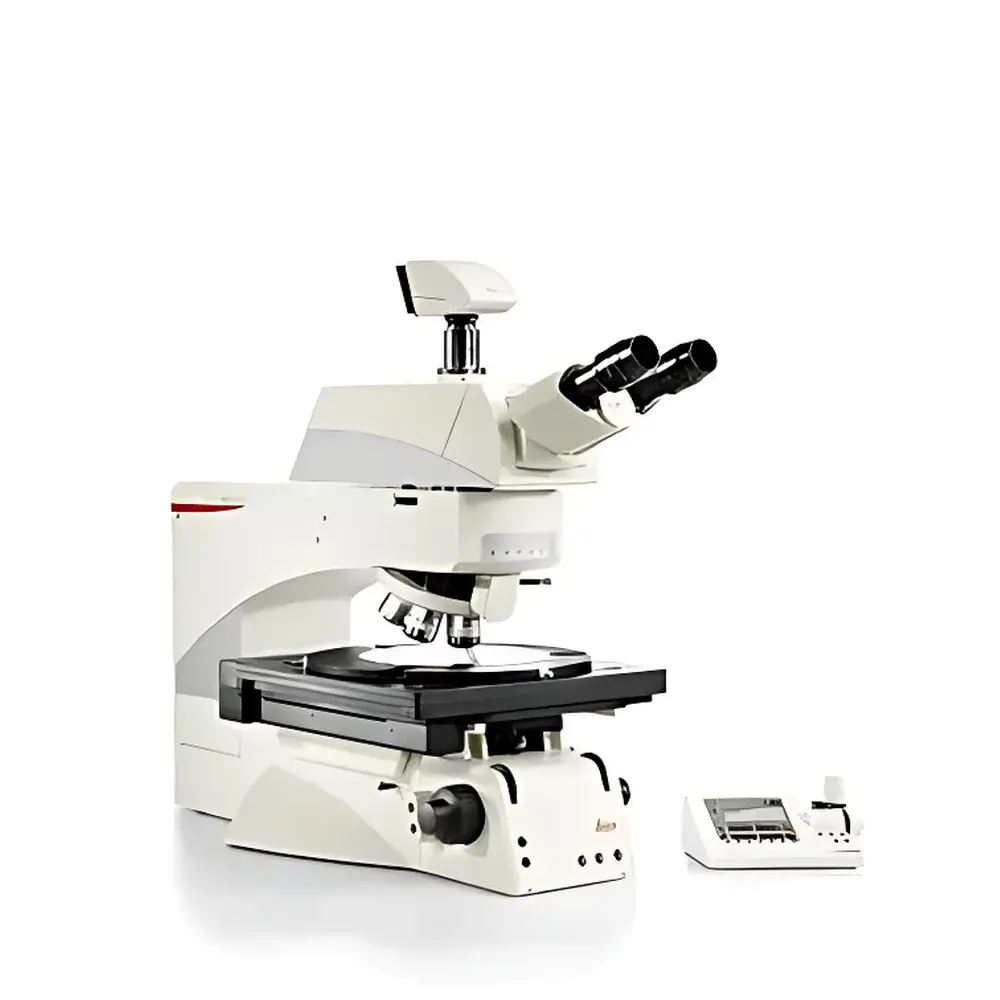
Leica DM12000 M Upright Metallurgical Microscope
| Brand | Leica |
|---|---|
| Origin | Germany |
| Model | DM12000 M |
| Configuration | Upright |
| Total Magnification | 1000× |
| Eyepiece | 10× |
| Objective | 100× |
| Image Analysis System | Integrated |
| Field of View (Macro) | 36 mm |
| Maximum Specimen Height | 42 mm |
| Illumination | LED-based Reflected-Light (Brightfield, Darkfield, Polarization, DIC, Fluorescence, UV, OUV, Oblique) |
| Optical Path | Achromatic-Corrected, 25 mm Field Number |
| Objective Turret | Motorized 6-Position, Encoded |
| Stage | 12 × 12 inch (305 × 305 mm), Wafer-Compatible |
| Focus | Motorized and Manual Coaxial |
| UV Source | High-Power LED (254 nm / 365 nm), OUV-capable |
| Compliance | ISO 9001, ISO/IEC 17025 (when used in accredited labs), SEMI S2/S8,洁净室-compatible (ESD-safe housing, laminar flow-optimized chassis) |
Overview
The Leica DM12000 M is a research-grade upright metallurgical microscope engineered for high-precision microstructural analysis of solid-state materials in industrial quality control and advanced R&D environments. It operates on reflected-light optical principles—primarily brightfield, darkfield, polarization, differential interference contrast (DIC), fluorescence, and ultraviolet (UV)/optical ultraviolet (OUV) illumination—to resolve surface topography, phase distribution, grain boundaries, inclusion morphology, and defect signatures without sample sectioning or coating. Its modular, encoded optical architecture supports seamless transitions between observation modes while maintaining calibration integrity across magnifications. Designed for semiconductor wafer inspection, metallography, ceramic characterization, and electronic component failure analysis, the DM12000 M integrates rigorous optical performance with ergonomic automation to sustain operator accuracy during extended visual assessment cycles.
Key Features
- Motorized 6-position encoded objective turret with automatic scale-bar recall—ensures traceable magnification metadata for every image captured.
- 25 mm field-number optical path with apochromatically corrected optics, delivering uniform resolution and color fidelity across the full FOV.
- Dual-mode UV/OUV LED illumination (254 nm and 365 nm) enabling sub-micron lateral resolution enhancement and improved axial sectioning capability—critical for detecting sub-surface contamination and thin-film delamination.
- 0.7× macro objective providing a 36 mm field of view for rapid wafer-level defect screening and macrostructure localization prior to high-magnification interrogation.
- ESD-safe conductive housing and sealed motorized components compliant with ISO Class 5 cleanroom requirements (SEMI S2/S8 certified); laminar airflow-optimized mechanical design minimizes particle disturbance.
- Coaxial motorized/manual focusing system with programmable Z-step precision, supporting repeatable focal plane mapping and depth profiling workflows.
- Integrated dual-LED illumination engine (reflected-light only) with thermal-neutral output—eliminates sample heating artifacts and ensures photometric stability over multi-hour sessions.
Sample Compatibility & Compliance
The DM12000 M accommodates specimens up to 42 mm in height via optional material-stage incident-light axis configuration. Its 305 × 305 mm motorized stage enables direct 300 mm (12-inch) wafer inspection without repositioning. Sample types include polished metallographic mounts, sintered ceramics, coated semiconductors, polymer composites, and particulate-laden filters. The system complies with ASTM E3–22 (Standard Guide for Preparation of Metallographic Specimens), ISO 643:2019 (Steel—Micrographic Determination of Ferrite Content), and USP (Analytical Instrument Qualification) when deployed in regulated QC laboratories. All encoded functions—including illumination mode, aperture diaphragm position, condenser height, and objective selection—are logged with timestamps and user IDs to support GLP/GMP audit trails per FDA 21 CFR Part 11.
Software & Data Management
Leica Application Suite X (LAS X) is the native platform, offering validated modules for grain size quantification (ASTM E112), phase fraction analysis (ISO 16700), inclusion rating (ASTM E45), decarburization depth measurement (ISO 3887), and cleanliness assessment (ISO 14630). Image acquisition supports TIFF, JPEG2000, and proprietary LEICA LIF formats with embedded EXIF metadata—including objective ID, illumination type, exposure time, and calibration coefficients. LAS X includes role-based access control, electronic signature capability, and automated report generation compliant with ISO/IEC 17025 documentation standards. Data export is compatible with LIMS integration via OPC UA and HL7 protocols.
Applications
- Semiconductor manufacturing: Defect review on bare and patterned wafers; lithography residue detection; CMP scratch and particle analysis.
- Metallography labs: Quantitative evaluation of ferrite/pearlite ratios, austenite grain size, intergranular corrosion susceptibility, and weld heat-affected zone (HAZ) microstructures.
- Failure analysis: Identification of fatigue striations, brittle cleavage facets, ductile dimples, and environmental cracking mechanisms in aerospace alloys and powertrain components.
- Advanced materials R&D: Characterization of additive-manufactured microstructures, thermal barrier coating porosity, and composite fiber-matrix interfacial integrity.
- Quality assurance: Routine verification of surface finish, plating thickness uniformity, and solder joint wetting behavior per IPC-A-610 and J-STD-001.
FAQ
Does the DM12000 M support transmitted-light observation?
No—the DM12000 M is configured exclusively for reflected-light metallurgical imaging. For combined transmission/reflection capability, the Leica DM6000 M or DM2700 M platforms are recommended.
Is UV illumination integrated or optional?
UV/OUV LED illumination is factory-integrated and fully aligned within the optical path; no external lamp housings or alignment procedures are required.
Can the system interface with automated wafer handling equipment?
Yes—via RS-232, Ethernet/IP, and Leica’s standardized API, the DM12000 M synchronizes focus, illumination, and image capture with third-party wafer probers and load ports.
What is the warranty coverage and service support structure?
Leica Microsystems provides a 24-month parts-and-labor warranty, extendable to 5 years with Leica ServicePlus contracts; on-site calibration and preventive maintenance are available globally through ISO/IEC 17025-accredited service centers.
Are software updates included post-purchase?
Yes—LAS X major and minor version upgrades, including regulatory-compliant patches and new analysis modules, are delivered free of charge for the duration of active support subscription.




