
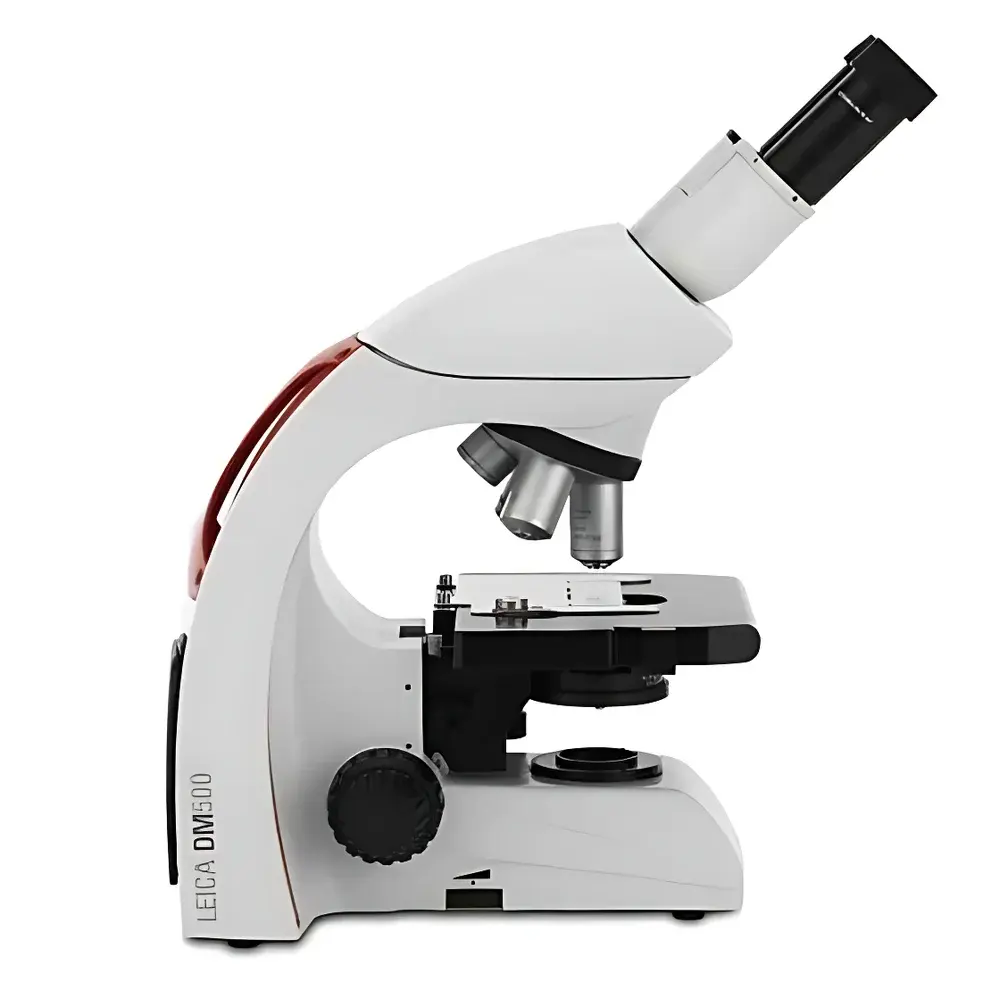
Leica DM500 Biological Microscope
| Origin | Germany |
|---|---|
| Manufacturer Type | Authorized Distributor |
| Origin Category | Imported |
| Model | DM500 |
| Pricing | Upon Request |
Overview
The Leica DM500 Biological Microscope is a robust, education- and routine-laboratory–optimized upright microscope engineered for high optical fidelity, ergonomic safety, and long-term operational reliability. Built on Leica Microsystems’ proven optical platform—shared with higher-tier research-grade instruments—the DM500 delivers consistent Köhler illumination, chromatic aberration-corrected Plan Achromat objectives, and diffraction-limited resolution across its full magnification range (40× to 1000×). Its optical design adheres to DIN-standard mechanical tube length (160 mm) and finite-conjugate optics, ensuring compatibility with standardized accessories and calibration protocols used in academic teaching labs, clinical training environments, and quality-controlled biological screening workflows. Unlike modular research systems, the DM500 integrates core functionality into a fixed, pre-aligned architecture—eliminating alignment drift and reducing maintenance overhead while maintaining ISO 10934-1 compliance for optical performance verification.
Key Features
- EZStore™ Ergonomic Transport System: Integrated vertical handle and front-mounted grip grooves enable two-handed, stable lifting and shelf placement—reducing strain and minimizing risk of mechanical misalignment during relocation.
- EZLite™ Long-Life LED Illumination: Cold-white 3000 K LED source provides uniform field illumination without heat-induced specimen drying or thermal lens drift; rated for >50,000 hours (≥15 years at 8 h/day), eliminating bulb replacement cycles and associated calibration recalibration.
- SafeTStage™ Self-Supporting Mechanical Stage: Fully enclosed, rounded-corner stage frame prevents accidental contact injury and eliminates protruding support arms that may snag gloves or damage adjacent equipment during benchtop storage.
- AgTreat™ Antimicrobial Surface Treatment: All frequently contacted surfaces—including focus knobs, stage controls, and eyepiece barrels—are impregnated with silver-ion-based biocidal additives compliant with ISO 22196, inhibiting >99% of common Gram-positive and Gram-negative bacteria (e.g., Staphylococcus aureus, Escherichia coli) over 24-hour contact periods.
- EZTube™ Integrated Binocular Head: Fixed 30° inclination, pre-set diopter compensation (±5 dpt), and snap-fit eyepiece retention prevent ocular loss or misalignment; compatible with optional phase contrast and darkfield slider modules via dedicated condenser slot.
- Oil-Free 100× Dry Objective (NA 0.8): Proprietary high-NA dry objective eliminates immersion oil handling, cross-contamination, and cleaning downtime—while delivering resolution comparable to conventional 100× oil objectives (≈0.55 µm lateral resolution at 550 nm).
Sample Compatibility & Compliance
The DM500 accommodates standard 1″ × 3″ (25 × 76 mm) glass slides and 0.13–0.17 mm coverslips. Its Abbe condenser (NA 1.25) supports brightfield, phase contrast (via optional 4-position slider), and darkfield observation. The system conforms to IEC 61000-6-3 (EMC emissions), IEC 61000-6-1 (immunity), and EN 61010-1:2013 (safety requirements for laboratory electrical equipment). All optical components meet ISO 8578 (microscope labeling) and ISO 10934-1 (optical performance testing) standards. AgTreat™ surface treatment is validated per ISO 22196:2011 and JIS Z 2801:2010.
Software & Data Management
While the DM500 is a standalone optical instrument without embedded digital imaging, it is fully compatible with Leica ICC50 HD and DMC2900 camera systems via C-mount adapter (optional). When paired with Leica Application Suite (LAS) X software (v3.7+), users gain GLP-compliant metadata logging—including objective ID, magnification, illumination intensity, timestamp, and operator ID—with audit trail capability satisfying FDA 21 CFR Part 11 requirements for regulated educational or diagnostic training records. Image export supports TIFF, JPEG2000, and Leica’s proprietary LIF format for downstream analysis in FIJI/ImageJ or MATLAB.
Applications
The DM500 serves as a primary instrument in undergraduate biology laboratories (e.g., histology, microbiology, botany), clinical assistant training programs (e.g., hematology slide review), pharmaceutical QC labs performing raw material identification, and public health facilities conducting basic pathogen morphology screening. Its dry 100× objective enables rapid malaria parasite detection in Giemsa-stained blood smears without oil handling—a critical advantage in resource-constrained or high-throughput field-deployable settings. Phase contrast compatibility supports live-cell observation of unstained eukaryotic cultures (e.g., HeLa, CHO-K1), while SafeTStage™ and EZGuide™ slide rests reduce breakage rates in high-volume teaching labs (>200 student-hours/week).
FAQ
Is the DM500 suitable for fluorescence applications?
No—this model lacks excitation filter sets, dichroic mirrors, or high-sensitivity photodetectors required for fluorescence microscopy. For fluorescence, consider the Leica DM500 F or DM750 series.
Can third-party objectives be mounted on the DM500?
Only DIN-standard 45 mm parfocal distance, RMS-threaded (0.8 inch × 36 TPI) objectives are mechanically compatible; however, optical performance and warranty coverage are guaranteed exclusively with Leica-branded Plan Achromat objectives.
Does the LED illumination support intensity modulation?
Yes—the front-panel rotary control provides continuous 0–100% brightness adjustment with linear response, enabling precise phototoxicity management during extended live-cell observation.
What is the service interval recommendation?
Leica recommends biannual optical inspection and dust removal by certified technicians; no routine lubrication or recalibration is required under normal usage conditions (≤8 h/day, ambient temperature 15–30 °C, RH <70%).
Is the AgTreat™ coating resistant to common lab disinfectants?
Yes—it withstands repeated wiping with 70% ethanol, 0.5% sodium hypochlorite, and quaternary ammonium compounds without degradation, as verified per ISO 22196 abrasion testing protocols.



