
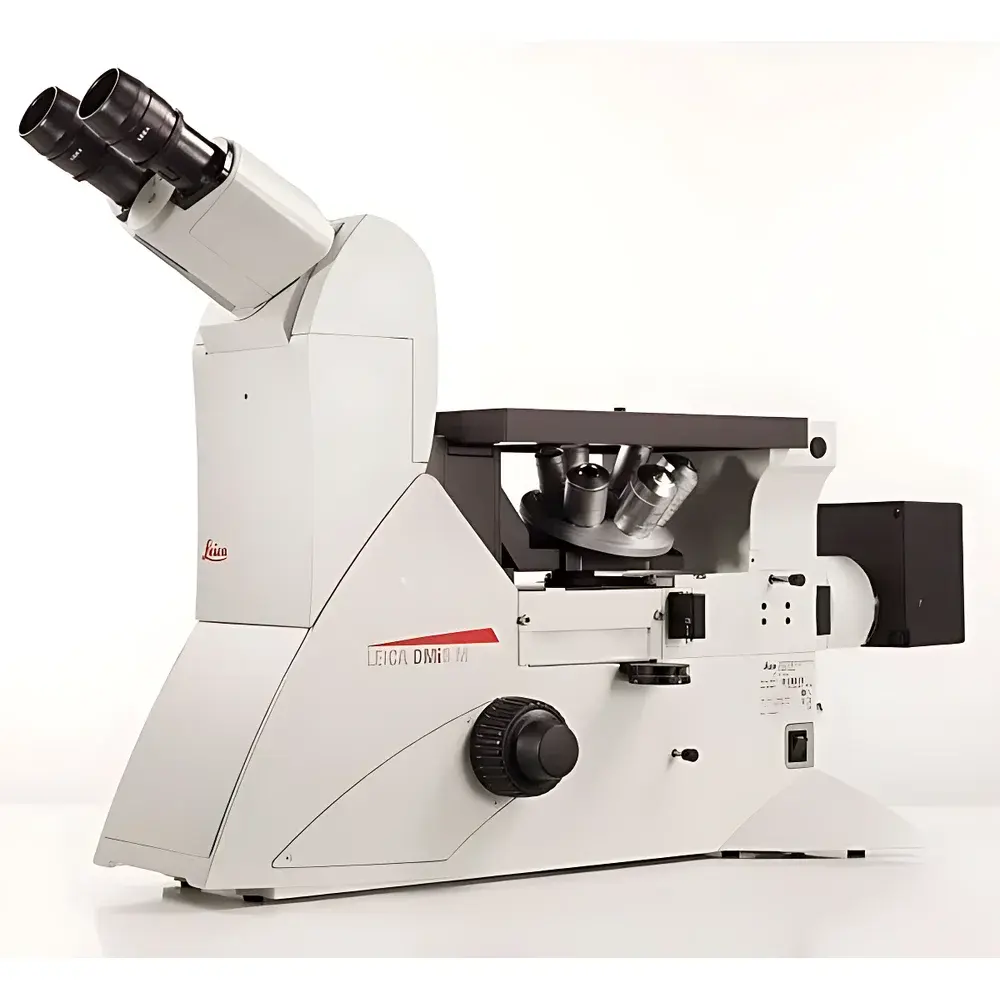
Leica DMi8C Inverted Metallurgical Microscope
| Brand | Leica |
|---|---|
| Origin | Shanghai, China |
| Manufacturer Type | Authorized Distributor |
| Origin Category | Domestic (China-made) |
| Model | DMi8 C |
| Price Range | USD 14,000 – 42,000 |
| Configuration | Inverted |
| Optical Path | Achromatic-Corrected Infinity System |
| Field of View Diameter | 25 mm |
| Objective Turret | 6-position manual/electromechanical (encoded for semi-auto/auto models) |
| Objective Mount | M25 thread, compatible with 32 mm diameter objectives |
| Eyepiece Inclination | Adjustable from 15° to 45° |
| Focusing System | Integrated manual or closed-loop motorized focus with 0.01 µm step resolution |
| Illumination | Integrated LED trans- and epi-illumination with intelligent intensity control |
| Contrast Modes | Brightfield, Darkfield (High-Definition Darkfield), Polarization, Differential Interference Contrast (DIC), Phase Contrast (optional), Extended Depth of Focus (EDF) |
| Automation Level | Manual / Semi-Automatic / Fully Automatic (touchscreen interface, software-controlled illumination & hardware coordination) |
| Imaging Interface | C-mount port for digital cameras |
| Software Suite | Leica Application Suite X (LAS X) with grain size analysis, phase quantification, cast iron evaluation, decarburization depth measurement, and inclusion rating per ASTM E45, ISO 4967, and EN 10247 |
Overview
The Leica DMi8C is a research-grade inverted metallurgical microscope engineered for high-precision microstructural characterization in materials science laboratories and industrial quality control environments. Its inverted optical architecture positions the objective lenses beneath the specimen stage—enabling rapid, stable observation of heavy, irregular, or coated samples without repositioning. The system employs an infinity-corrected, apochromatically optimized optical path supporting a 25 mm field of view, ensuring uniform resolution and chromatic fidelity across the entire image plane. Designed around modular hardware integration, the DMi8C accommodates both manual workflows and fully automated imaging protocols, making it suitable for routine inspection as well as GLP-compliant analytical reporting under ISO/IEC 17025 or ASTM E3, E7, and E112 frameworks.
Key Features
- Inverted configuration with large working distance and enhanced ergonomic access—ideal for bulk specimens, mounted cross-sections, and heat-treated components.
- Closed-loop motorized focusing system delivering 0.01 µm positional repeatability, critical for Z-stack acquisition and precise layer-by-layer analysis.
- 6-position encoded objective turret compatible with Leica’s full range of metallurgical objectives (including long-working-distance, high-NA dry and oil-immersion lenses up to 100×).
- Dual-integrated LED illumination: separate high-stability white-light sources for transmitted (for transparent or semi-transparent thin sections) and reflected (epi-) light paths, each independently controllable and thermally neutral to prevent sample drift or thermal artifact formation.
- Smart illumination memory: automatically recalls and applies optimal intensity, aperture diaphragm position, and condenser height settings per objective/contrast mode combination—reducing setup time and operator variability.
- Multi-contrast capability including High-Definition Darkfield (HDF), polarization, DIC, and optional phase contrast—enabling comprehensive defect identification, grain boundary delineation, and phase discrimination in metals, ceramics, and composites.
- Macro mode providing 35.7 mm field of view—four times larger than standard eyepiece FOV—facilitating rapid survey scanning and contextual correlation between macro- and micro-scale features.
Sample Compatibility & Compliance
The DMi8C supports a broad spectrum of solid-state materials—including ferrous and non-ferrous alloys, sintered ceramics, polymer composites, and additive-manufactured parts—without requiring vacuum or conductive coating. Its robust mechanical stage accommodates specimens up to 100 mm × 100 mm × 50 mm (W × D × H), with optional motorized XY stages and Z-height sensors for automated tile scanning and height mapping. All optical components comply with ISO 10934-1 (microscope terminology) and ISO 8578 (objective lens labeling). The integrated LED illumination meets IEC 62471 photobiological safety standards. For regulated environments, LAS X software supports 21 CFR Part 11 compliance when deployed with audit trail, electronic signature, and user-role management modules.
Software & Data Management
Leica Application Suite X (LAS X) provides a unified platform for image acquisition, quantitative analysis, and report generation. Preconfigured analysis modules include ASTM E112-compliant grain size measurement (using planimetric and intercept methods), ISO 643-based ferrite/pearlite quantification, EN 10247-compliant inclusion rating, decarburization depth profiling via line intensity profiles, and multi-phase segmentation using machine learning-assisted thresholding. Raw image data is stored in TIFF or Leica’s proprietary LIF format with embedded metadata (objective ID, magnification, illumination parameters, calibration coefficients). Export options include PDF reports with traceable measurement logs, CSV tables for statistical process control (SPC), and XML-compatible datasets for integration into LIMS or MES systems.
Applications
- Metallurgical QC: Routine evaluation of casting porosity, weld integrity, heat-affected zone (HAZ) microstructure, and surface treatment uniformity (e.g., carburizing, nitriding).
- Failure analysis: Identification of fatigue cracks, intergranular corrosion, inclusion clusters, and brittle fracture origins in aerospace and automotive components.
- R&D in advanced materials: Characterization of grain refinement mechanisms in nanostructured alloys, phase evolution during thermal cycling, and interface morphology in metal-matrix composites.
- Academic teaching labs: Standardized instruction in metallography principles, ASTM/ISO test method execution, and digital image analysis fundamentals.
- Forensic engineering: Comparative analysis of tool marks, wear patterns, and microstructural anomalies in litigation-support investigations.
FAQ
Does the DMi8C support automated stitching of large-area images?
Yes—when equipped with a motorized XY stage and LAS X software, the system performs seamless panoramic tiling with sub-pixel registration accuracy and automatic exposure balancing across tiles.
Can the microscope be integrated into an existing laboratory network for remote operation?
Absolutely—the DMi8C supports Gigabit Ethernet connectivity and can be accessed via secure remote desktop or Leica’s web-based LAS X Remote interface, enabling off-site collaboration and centralized instrument management.
Is calibration documentation available for ISO/IEC 17025 accreditation?
Leica provides factory calibration certificates traceable to NIST standards, along with detailed maintenance logs and performance verification protocols required for scope accreditation.
What camera interfaces are supported?
The system features a standardized C-mount port and native compatibility with Leica’s DFC series CMOS cameras (e.g., DFC9000 GT), as well as third-party USB3/GigE cameras via DCAM or GenICam drivers.
How does the HDF (High-Definition Darkfield) mode differ from conventional darkfield?
HDF uses a precisely aligned annular LED array and optimized condenser optics to deliver significantly higher contrast, improved signal-to-noise ratio, and edge-enhanced topographic rendering—particularly effective for detecting fine scratches, polishing artifacts, and surface contaminants on reflective specimens.




