
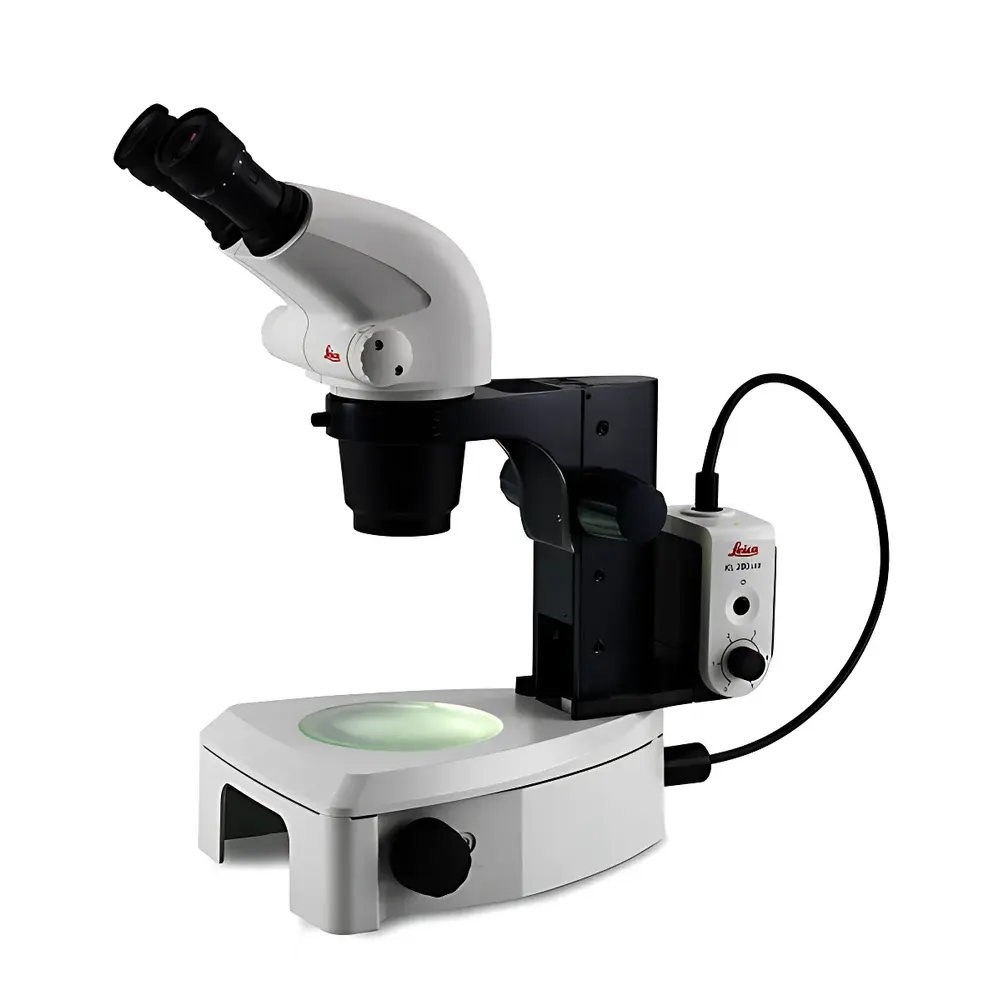
Leica KL300 LED Cold Light Source
| Brand | Leica |
|---|---|
| Origin | Germany |
| Model | KL300 LED |
| Light Source Type | High-Efficiency White LED |
| Illumination Method | Internal (Fiber-Optic Coupled) |
| Power Consumption | <12 W |
| LED Lifetime | ≥50,000 hours |
| Luminous Output | Equivalent to 30 W Halogen Lamp |
| Compatibility | Leica L2 & KL200 Series Accessories |
| Operating Temperature Range | 5–40 °C |
| Safety Class | IEC 61010-1, Class I, IP20 |
| Regulatory Compliance | CE, RoHS, UL/cUL Listed |
Overview
The Leica KL300 LED Cold Light Source is a precision-engineered fiber-optic illumination system designed for demanding optical applications in life sciences, industrial inspection, and academic microscopy laboratories. Unlike conventional thermal light sources, the KL300 employs high-color-rendering white LEDs operating at low junction temperature—eliminating infrared (IR) and ultraviolet (UV) radiation emission while delivering stable, flicker-free illumination. Its photometric output is calibrated to match the spectral irradiance profile and luminous flux of a standard 30 W halogen lamp, ensuring seamless integration with existing Leica stereo and upright microscopes without requiring optical recalibration. The device operates on a constant-current driver architecture, guaranteeing intensity stability (<±1.5% over 8 h) and eliminating thermal drift—a critical requirement for quantitative imaging, time-lapse documentation, and photomicrography under GLP-compliant workflows.
Key Features
- Fiber-optic coupled cold illumination: Delivers uniform, shadow-free lighting via flexible liquid-light-guide or solid-core light guides (diameter range: 3–15 mm), minimizing specimen heating and phototoxicity in live-cell observation.
- Energy-efficient LED platform: Consumes less than 12 W nominal power—reducing laboratory heat load and operational cost by >70% compared to equivalent halogen systems.
- Extended service life: Rated for ≥50,000 hours of operation at full output, translating to >10 years of daily 12-h usage with no lumen depreciation beyond ±5%.
- Full mechanical and electrical interoperability: Directly compatible with all Leica L2-series stands, KL200-series adapters, gooseneck arms, ring lights, and coaxial illuminators—enabling rapid reconfiguration across transmitted, reflected, oblique, and dark-field modalities.
- Integrated thermal management: Passive aluminum heatsink combined with intelligent thermal throttling ensures stable chromaticity (CCT: 5700 K ±150 K) and prevents LED spectral shift during extended operation.
- Regulatory-ready design: Complies with IEC 61010-1 for laboratory equipment safety, carries CE marking per EU Directive 2014/30/EU (EMC) and 2011/65/EU (RoHS), and meets UL/cUL 61010-1 requirements for North American deployment.
Sample Compatibility & Compliance
The KL300 LED supports broad sample compatibility—including heat-sensitive biological specimens (e.g., zebrafish embryos, primary neuronal cultures), polymer thin films, semiconductor wafers, and archival documents—without inducing thermal degradation or photochemical bleaching. Its IR-free output eliminates interference with thermographic measurements or IR-sensitive detectors. For regulated environments, the unit supports audit-ready documentation: intensity calibration certificates traceable to PTB (Physikalisch-Technische Bundesanstalt) standards are available upon request. While not intrinsically compliant with FDA 21 CFR Part 11, its analog intensity control interface can be integrated into validated instrument networks when paired with compliant data acquisition hardware and SOP-defined change-control procedures.
Software & Data Management
The KL300 LED operates as a standalone analog-controlled source with no embedded firmware or network interface. Intensity adjustment is performed via front-panel rotary encoder (0–100% linear scale) or external 0–10 V DC analog input—enabling synchronization with third-party microscope control platforms (e.g., Leica Application Suite X, MicroManager, or custom LabVIEW-based acquisition scripts). No proprietary software is required; however, intensity logging and event-triggered illumination profiles can be implemented through external DAQ systems compliant with ISO/IEC 17025 traceability requirements. Firmware updates are not applicable—hardware longevity is ensured through component-level redundancy and industrial-grade PCB conformal coating.
Applications
- Stereo microscopy for surgical training, entomology, and PCB inspection where consistent color fidelity and minimal thermal load are essential.
- Fluorescence pre-illumination alignment and brightfield documentation in multi-modal imaging setups.
- Non-destructive testing (NDT) of composite materials using oblique fiber-optic lighting to enhance surface defect contrast.
- Documentation of museum artifacts and historical manuscripts under low-radiation visible-spectrum illumination.
- Teaching laboratories requiring robust, maintenance-free illumination with long-term intensity reproducibility across student workstations.
FAQ
Is the KL300 LED compatible with non-Leica microscopes?
Yes—when used with universal fiber-optic couplers (e.g., SMA905 or FC/PC adapters), it interfaces with Olympus, Nikon, Zeiss, and custom optical benches supporting 3–15 mm light guide inputs.
Does it support dimming via digital protocols such as RS-232 or USB?
No—the KL300 LED features analog-only intensity control. Digital integration requires an external DAC module or programmable power supply with 0–10 V output.
Can it be used in cleanroom environments (ISO Class 5 or better)?
Yes—its sealed enclosure (IP20) and absence of outgassing components meet ISO 14644-1 particulate limits when installed outside the cleanroom and routed via pass-through light guides.
What is the recommended maintenance interval?
None—no consumables, filters, or lamps require replacement. Routine cleaning of the fiber-optic connector interface every 6 months is advised to maintain coupling efficiency.
Is intensity calibration provided with shipment?
A factory-issued photometric test report (including spectral power distribution and total luminous flux at 25 °C ambient) is included. NIST-traceable calibration is available as an optional add-on service.




