
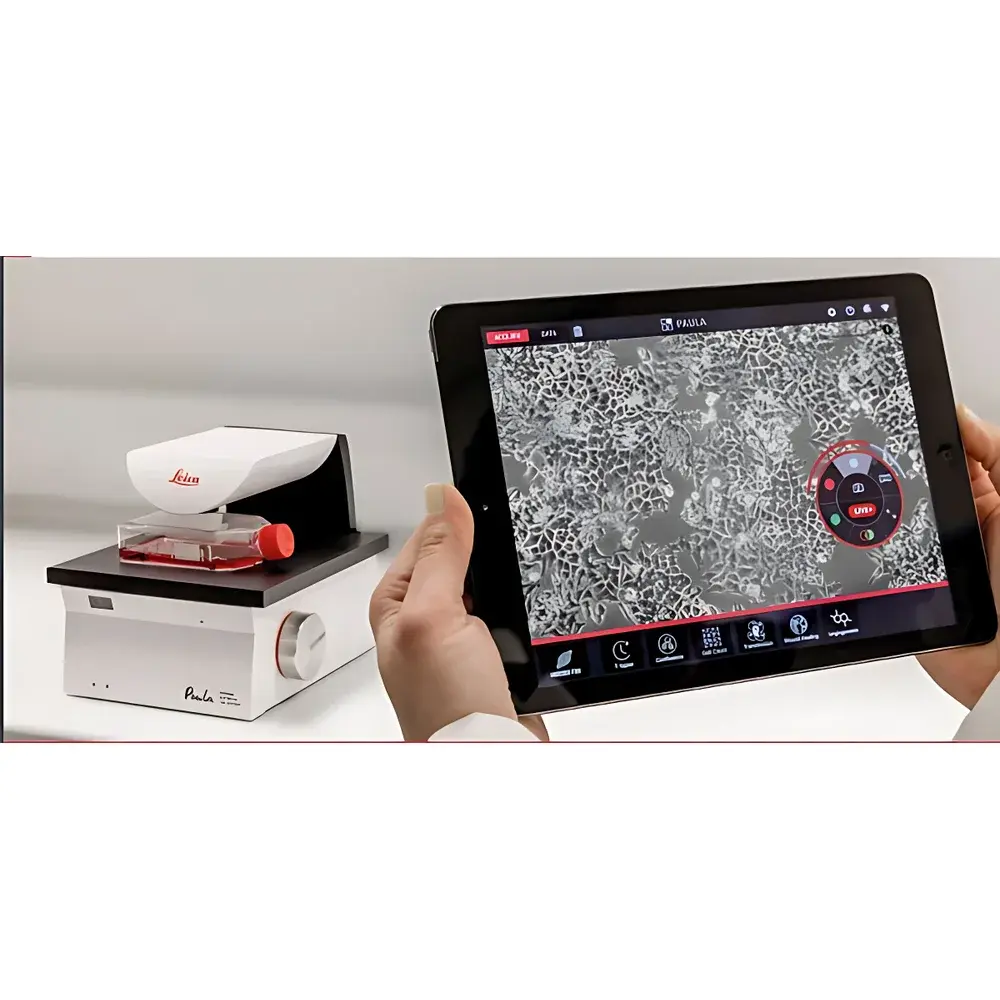
Leica PAULA Intelligent Live-Cell Imaging Monitor
| Brand | Leica |
|---|---|
| Model | PAULA |
| Type | Integrated Live-Cell Monitoring Microscope System |
| Optical Configuration | Phase Contrast + Optional Fluorescence Modules |
| Imaging Mode | Automated Time-Lapse Microscopy |
| Connectivity | Wi-Fi 5 (802.11ac), Ethernet, USB-C |
| Barcode Reader | Integrated High-Speed 1D/2D Scanner |
| Multi-Unit Synchronization | Up to 4 Units via Local Network |
| Data Storage | Onboard SSD + Cloud-Ready Encrypted Database |
| Software Compliance | FDA 21 CFR Part 11–Ready Audit Trail, GLP/GMP-Traceable Metadata Logging |
| Remote Access | Web-Based Dashboard (HTTPS/TLS 1.2), Cross-Platform Client (Windows/macOS/iOS/Android) |
Overview
The Leica PAULA Intelligent Live-Cell Imaging Monitor is an integrated, compact benchtop microscopy platform engineered for automated, non-invasive longitudinal monitoring of adherent mammalian cell cultures under standard incubator conditions. Unlike conventional inverted microscopes requiring manual intervention and environmental disruption, PAULA operates inside CO₂ incubators (up to 40 °C, 95% RH) with optical-grade thermal insulation and vibration-damped optics. Its core measurement principle relies on high-contrast phase contrast imaging combined with AI-assisted pixel-intensity segmentation algorithms to quantify confluence, morphology dynamics, and spatial heterogeneity over time. Designed for routine QC in bioproduction, academic cell biology, and pre-transfection assessment, PAULA delivers objective, operator-independent metrics—eliminating inter-observer variability inherent in manual microscopic evaluation. The system does not perform live-cell fluorescence without optional LED-based excitation modules; all baseline functionality is label-free and compatible with standard tissue-culture-treated vessels (e.g., T25–T175 flasks, 6–96-well plates, Petri dishes).
Key Features
- Incubator-Compatible Design: IP54-rated enclosure with sealed optical path and low-power thermal management enables continuous operation inside humidified, 5% CO₂ incubators without condensation or focus drift.
- Automated Confluence Quantification: Proprietary image analysis engine computes real-time confluence (%) using adaptive thresholding and background subtraction—calibrated against ISO 13319-compliant particle area fraction methodology.
- Barcode-Driven Sample Registration: Integrated industrial-grade scanner reads vessel barcodes (Code 128, QR, DataMatrix) in <100 ms, auto-linking metadata (cell line, passage number, seeding date) to image stacks and analytical reports.
- Configurable Acquisition Scheduling: Define multi-level time-lapse protocols—including variable intervals (1 min to 24 h), conditional triggers (e.g., “acquire when confluence ≥85%”), and multi-position tiling across wells or flasks.
- Regulatory-Ready Data Integrity: All images, logs, and analysis parameters are timestamped, digitally signed, and stored with immutable audit trails meeting FDA 21 CFR Part 11 requirements for electronic records and signatures.
- Cross-Platform Remote Operation: Control PAULA via native web interface (HTTPS-secured), tablet app, or desktop client—supporting role-based access control (RBAC) and concurrent user sessions without performance degradation.
Sample Compatibility & Compliance
PAULA supports standard sterile cell culture consumables manufactured from polystyrene, glass, or polymer-coated substrates. It accommodates vessels up to 175 cm² footprint (T175 flasks) and multiwell formats from 6- to 96-well, including opaque-bottom plates for transmitted-light imaging. No modifications to culture protocols or media formulations are required. The system complies with IEC 61000-6-3 (EMC emissions) and IEC 61010-1 (safety for laboratory equipment). Image analysis algorithms are validated per ISO/IEC 17025 principles for measurement uncertainty estimation, with traceability to NIST-traceable reference slides for confluence calibration. For GMP environments, PAULA’s software architecture supports 21 CFR Part 11-compliant electronic signatures, change control logs, and retrospective data reprocessing with full version history.
Software & Data Management
Leica PAULA Software (v3.x) provides a unified environment for acquisition, analysis, visualization, and reporting. Raw TIFF stacks are stored in a hierarchical, metadata-enriched file structure compliant with the OME-TIFF standard. The embedded database uses SQLite with AES-256 encryption and automatic daily backups to network-attached storage (NAS) or configurable cloud endpoints (AWS S3, Azure Blob). Analytical modules—including Confluence Trend Analysis, Wound Healing (scratch assay) Kinetics, and Transfection Efficiency Estimation (via optional fluorescence module)—generate PDF reports with embedded graphs, statistical summaries (mean ± SD, n≥3), and raw-data export options (CSV, FCS, HDF5). All software updates undergo rigorous regression testing per ISO 13485 Annex C guidelines for medical device software lifecycle management.
Applications
- Pre-Transfection Cell Readiness Assessment: Automate detection of optimal confluence windows (e.g., 70–90% for HEK293T), reducing manual checks by >90% and eliminating weekend interventions.
- Bioprocess Development Support: Monitor CHO or hybridoma growth kinetics under varying feed strategies, correlating morphological changes (e.g., vacuolization, detachment onset) with viability assays.
- CRISPR Workflow Integration: Schedule time-lapse imaging post-nucleofection to quantify editing efficiency via phenotypic scoring (e.g., loss-of-function morphology in p53-KO lines).
- Toxicity Screening: Track real-time morphological responses (blebbing, shrinkage, neurite retraction) in primary neurons or iPSC-derived cardiomyocytes exposed to compound libraries.
- Teaching & Training: Standardize cell culture assessment across student cohorts using reproducible, quantifiable metrics instead of subjective “80% confluent” estimations.
FAQ
Can PAULA be used inside a hypoxia chamber?
Yes—PAULA operates reliably in O₂-controlled environments (0.1–21% O₂) provided temperature and humidity remain within its specified range (20–40 °C, ≤95% RH) and chamber materials do not obstruct barcode scanning or optical access.
Does PAULA require external calibration before each experiment?
No—factory-calibrated optical path and algorithmic confluence models eliminate daily recalibration. Users may optionally run a one-time validation step using Leica-provided reference slides for lab-specific SOP alignment.
How is data security ensured during remote access?
All remote sessions use TLS 1.2+ encrypted tunnels; credentials are authenticated via LDAP/Active Directory integration or local certificate-based login. No image data is cached on client devices.
Is fluorescence imaging included by default?
Phase contrast is standard. Fluorescence capability requires optional LED modules (470 nm, 530 nm, 630 nm) and filter cubes—ordered separately and validated per ISO 10940 for spectral fidelity.
Can PAULA integrate with LIMS or ELN systems?
Yes—via RESTful API supporting JSON payloads and OAuth 2.0 authentication. Pre-built connectors exist for LabVantage, Benchling, and Dotmatics; custom integrations follow ASTM E1578-20 standards for laboratory informatics interoperability.





