
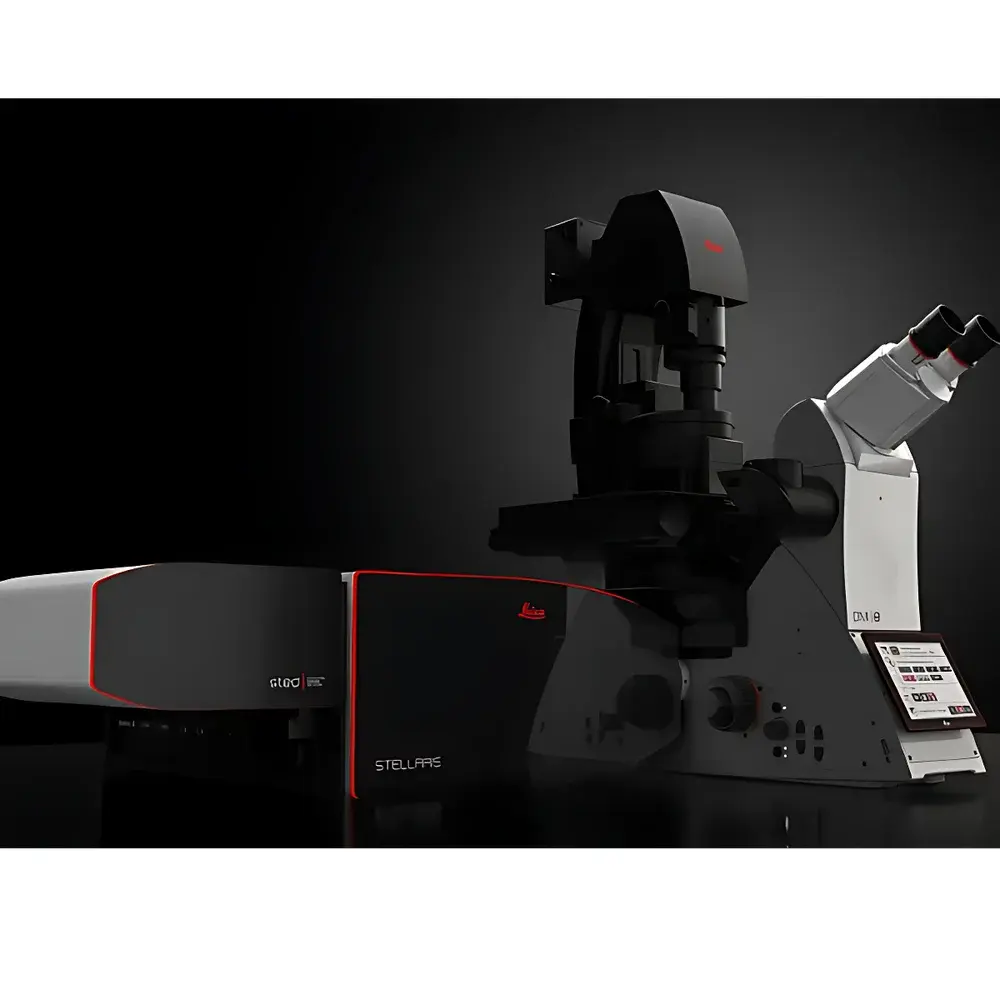
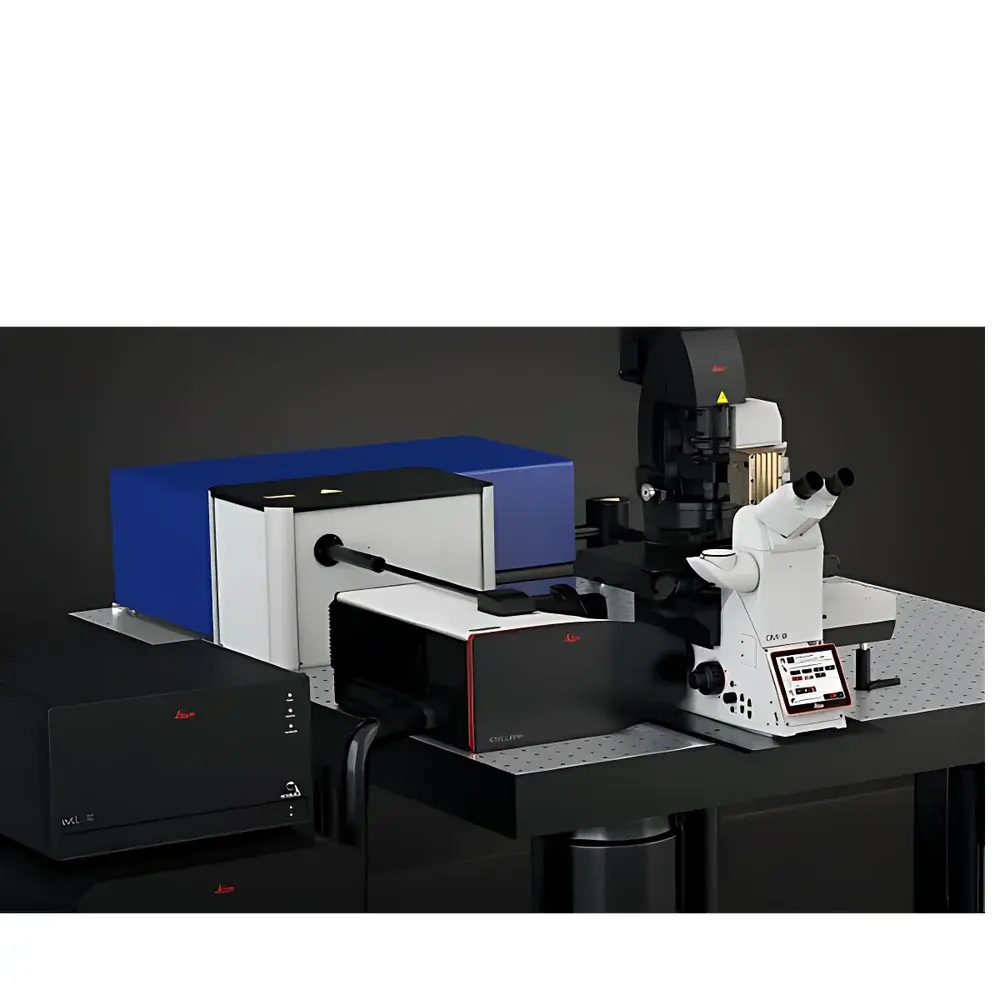
Leica STELLARIS STED Laser Scanning Confocal Microscope with STED Nanoscopy
| Brand | Leica |
|---|---|
| Country of Origin | Germany |
| Model | Leica STELLARIS STED |
| Instrument Type | Point-Scanning Confocal Microscope |
| STED Laser Wavelengths | 592 nm, 660 nm, 775 nm |
| Excitation Range | 440–790 nm (White Light Laser) |
| Detection | Up to 5 spectral Power HyD detectors (HyD S/X/R), 1.5 ns system dead time |
| Objective Support | STED-optimized STED WHITE 100× oil, 93× glycerol (motCORR), 86× water (motCORR) |
| Resolution | <30 nm lateral, <100 nm axial (sample- and fluorophore-dependent) |
| Core Technology | Time-gated STED (TauSTED Xtend), TauSense-enabled lifetime discrimination, FLIM-capable with FALCON module |
| Software Platform | LAS X with ImageCompass, LAS X Navigator, TauSense tools |
Overview
The Leica STELLARIS STED is a fully integrated point-scanning confocal microscope engineered for simultaneous high-fidelity confocal imaging and stimulated emission depletion (STED) nanoscopy. Unlike hybrid or add-on STED systems, STELLARIS STED embeds STED functionality at the optical and electronic architecture level—leveraging Leica’s second-generation White Light Laser (WLL) with acousto-optic beam splitting (AOBS), ultrafast Power HyD hybrid detectors, and a purpose-built optical path optimized for both excitation and STED beam overlap across the full spectral range (440–790 nm). Its core innovation lies in TauSTED Xtend: a time-resolved STED modality that exploits fluorophore lifetime gradients induced by the STED beam to discriminate signal photons from background—enabling sub-30 nm lateral resolution without proportional increases in phototoxicity or photobleaching. This physical separation mechanism preserves quantitative fidelity while extending viable imaging duration in live-cell contexts, making it suitable for dynamic nanoscale processes such as vesicle trafficking, cytoskeletal remodeling, and synaptic protein clustering under near-physiological conditions.
Key Features
- Integrated dual-mode platform: seamless switching between confocal, LIGHTNING deconvolution, and STED nanoscopy within a single acquisition session
- TauSTED Xtend technology: real-time fluorescence lifetime gating to enhance resolution and suppress background—operable with single STED line (e.g., 660 nm) or multi-line configurations
- Three dedicated STED laser lines (592 nm, 660 nm, 775 nm) co-aligned with WLL excitation for optimal PSF overlap and minimal chromatic aberration
- Up to five spectrally resolved Power HyD detectors (HyD S/X/R), each with 1.5 ns system dead time and >10× photon collection efficiency per pixel vs. conventional APDs
- STED-optimized objective suite: STED WHITE 100× oil (resolution-focused), 93× glycerol and 86× water objectives featuring motCORR motorized correction collars for adaptive spherical aberration compensation in thick or thermally variable samples
- Fully automated alignment: one-click beam matching, dye-specific excitation/STED wavelength pairing, and real-time TauSTED parameter optimization via LAS X software
Sample Compatibility & Compliance
The STELLARIS STED supports fixed and live biological specimens—including adherent and suspension mammalian cells, organoids, tissue sections, and cleared whole-mount preparations—without requiring specialized fluorophores. It operates effectively with standard organic dyes (e.g., ATTO dyes, CF dyes), fluorescent proteins (mCherry, mMaple), and far-red emitters compatible with 775 nm STED. The system meets ISO 13485 design control requirements for research-use-only instrumentation and supports audit-ready workflows compliant with GLP and GMP documentation standards. All raw photon-timestamped data are stored in open HDF5 format, enabling traceability for FDA 21 CFR Part 11–aligned environments when paired with validated LAS X deployment protocols. TauSTED’s dose-reduction capability facilitates long-term time-lapse nanoscopy under low-light conditions consistent with EMBL and NIH guidelines for live-cell imaging ethics.
Software & Data Management
LAS X serves as the unified acquisition and analysis environment, incorporating ImageCompass for AI-assisted region-of-interest selection and quality feedback during acquisition. TauSense modules provide real-time lifetime-based contrast enhancement, background subtraction, and resolution tuning—without post-processing interpolation. FALCON (Fluorescence Lifetime Analysis with Component Optimization) enables spectral-unmixing of overlapping STED dyes via phasor plot analysis, supporting multiplexed nanoscale colocalization studies. All datasets retain full photon arrival time stamps, permitting retrospective re-gating, FLIM-FRET quantification, and cross-platform validation in third-party tools (e.g., Python-based PHANTAST, MATLAB-based SimFCS). Metadata—including laser power, dwell time, detector gain, and STED depletion intensity—is embedded in every image file, ensuring reproducibility and compliance with FAIR (Findable, Accessible, Interoperable, Reusable) data principles.
Applications
The STELLARIS STED is routinely deployed in structural cell biology, neurobiology, and infectious disease research where molecular-scale spatial relationships must be resolved in context. Typical use cases include: mapping nanodomains of membrane receptors (e.g., EGFR, TLR4) relative to lipid raft markers; visualizing synaptic vesicle pool organization pre- and post-stimulation; resolving individual nuclear pore complex subunits in intact nuclei; tracking mitochondrial fission/fusion dynamics at <50 nm precision; and quantifying chromatin nanoarchitecture in differentiated versus pluripotent stem cells. Its compatibility with expansion microscopy (ExM) and CLEM (correlative light-electron microscopy) workflows further extends its utility in multimodal structural phenotyping. The system is widely adopted in core facilities serving academic consortia and pharmaceutical R&D labs conducting target engagement and mechanism-of-action studies.
FAQ
What distinguishes TauSTED from conventional intensity-based STED?
TauSTED uses fluorophore lifetime modulation—not intensity attenuation—to isolate STED-resolved photons, enabling higher effective resolution at lower depletion intensities and preserving quantitative signal linearity.
Can I perform multicolor STED with overlapping emission spectra?
Yes—when combined with FALCON on STELLARIS 8, lifetime-based unmixing separates spectrally identical but lifetime-distinct fluorophores (e.g., SiR-tubulin vs. JF646-actin) without spectral crosstalk.
Is motCORR correction required for all STED applications?
It is essential for deep-tissue or live-cell imaging where refractive index mismatches induce spherical aberration; less critical for thin, fixed, coverslip-mounted samples.
Does the system support FRAP or FCS after STED acquisition?
Yes—STED WHITE 86× water objective and Power HyD detectors are optimized for STED-FCS; LAS X includes built-in autocorrelation analysis modules compatible with photon-counting data.
How is calibration traceability maintained across STED sessions?
System alignment is verified daily using NIST-traceable fluorescent microbeads; resolution validation follows ISO 20599:2020 procedures using sub-resolution bead clusters and line-spread function analysis.





