
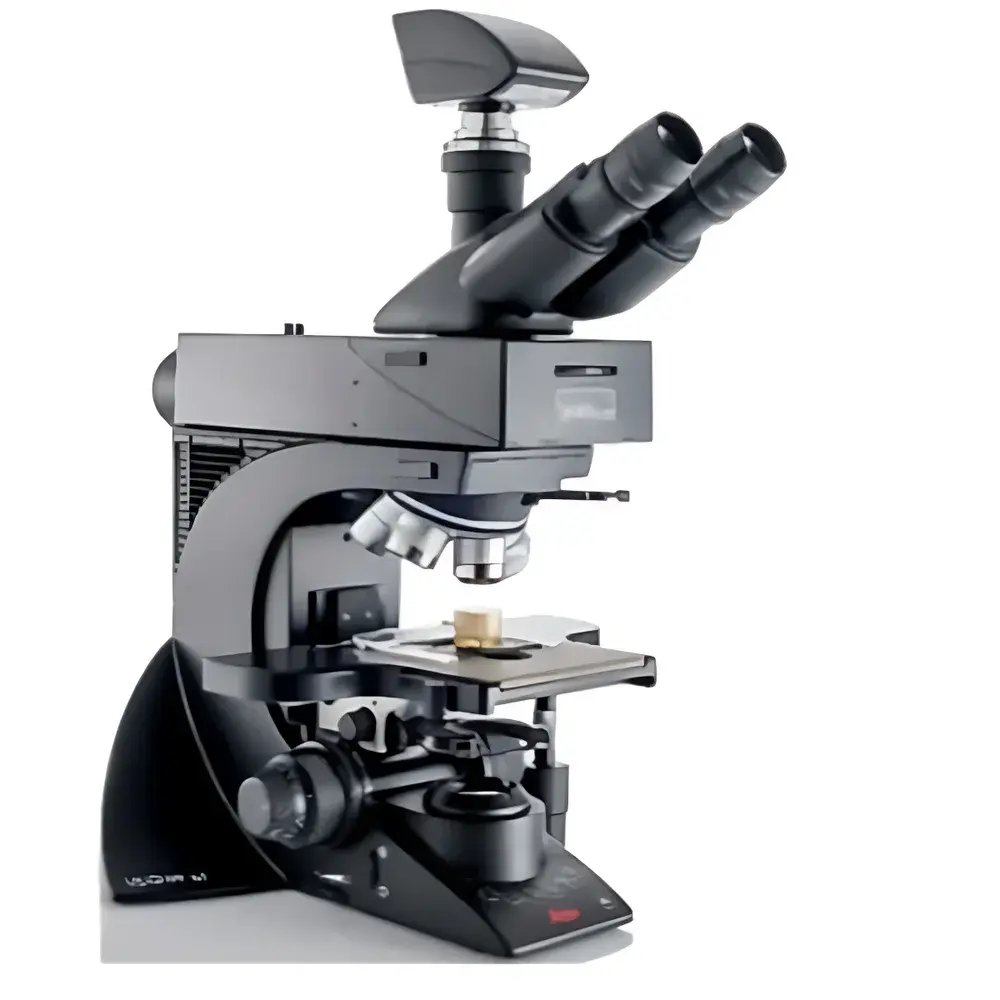
Leica Visoria M Materials Microscope
| Brand | Leica |
|---|---|
| Country of Origin | Germany |
| Model | Visoria M |
| Optical Configuration | Encoded, Motorized Illumination Control |
| Observation Modes | Brightfield, Darkfield, Polarized Light, Differential Interference Contrast (DIC), Oblique Illumination, Fluorescence (optional) |
| Macro Objective | Optional 0.7× Objective (FOV ≈ 36 mm) |
| Software Platform | Enersight |
| Compliance | Designed for ISO/IEC 17025-compliant labs, supports audit-trail–enabled workflows per GLP/GMP requirements |
| Imaging Interface | Integrated tablet display (no PC required), HDMI output |
| Ergonomics | Adjustable height stand, tilting monitor arm, low-fatigue observation posture |
Overview
The Leica Visoria M Materials Microscope is an engineered solution for industrial metallurgy, failure analysis, quality assurance, and advanced materials R&D. Built on Leica Microsystems’ legacy of precision optical design and German manufacturing rigor, the Visoria M employs high-NA infinity-corrected optics and modular illumination architecture to deliver consistent, reproducible imaging across multiple contrast mechanisms. Its core measurement principle relies on optimized light–matter interaction—leveraging controlled illumination geometry, polarization state modulation, and interference-based contrast generation—to resolve microstructural features such as grain boundaries, phase distributions, inclusions, surface scratches, porosity, coating delamination, and interfacial defects in opaque and semi-transparent specimens. Unlike conventional teaching or routine inspection microscopes, the Visoria M integrates hardware-level encoding with software-defined workflows, enabling traceable, repeatable, and standardized documentation of material characterization procedures.
Key Features
- Encoded optical system with motorized, auto-calibrated illumination management: brightness adjusts dynamically upon magnification or contrast mode change—eliminating manual recalibration and reducing setup time by up to 40%.
- Multi-contrast capability: simultaneous support for brightfield, darkfield, polarized light, DIC, oblique illumination, and fluorescence (with optional filter cubes)—each optimized for specific material response characteristics (e.g., DIC for topographic relief in polished metals; polarized light for crystallographic anisotropy in ceramics).
- Optional 0.7× macro objective: provides a field-of-view of ~36 mm at low magnification, enabling rapid sample survey, defect triage, and region-of-interest selection prior to high-magnification analysis.
- Integrated tablet-based imaging interface: eliminates dependency on external PCs; supports touch-driven annotation, real-time image capture, and immediate export in TIFF, JPEG, or vendor-neutral formats (e.g., TIFF + metadata XML).
- Ergonomic workstation design: height-adjustable base, articulating monitor arm, and seated/standing-compatible posture reduce musculoskeletal strain during extended inspection sessions—validated per ISO 9241-5 and EN 614-1 guidelines.
Sample Compatibility & Compliance
The Visoria M accommodates flat, polished, or as-received solid samples up to 200 mm × 200 mm × 75 mm (W × D × H) on its mechanical XY stage (manual or motorized options). It is routinely deployed for metallurgical cross-sections, sintered ceramics, printed circuit boards (PCBs), composite laminates, thermal barrier coatings, and additive-manufactured metal parts. All illumination and optical modules comply with IEC 61000-6-3 (EMC) and IEC 62471 (photobiological safety). The system supports documentation integrity per ISO/IEC 17025:2017 Clause 7.8.2 (reporting of measurement uncertainty) and facilitates GLP/GMP-aligned recordkeeping when used with Enersight’s audit-trail and electronic signature modules (21 CFR Part 11 compliant configuration available).
Software & Data Management
Enersight software serves as the central operational interface for the Visoria M. It provides calibrated measurement tools—including layer-thickness profiling (for coatings, plating, and diffusion zones), multi-field stitching (XY panorama with sub-pixel alignment), extended depth-of-field (EDOF) reconstruction via Z-stack fusion, and intensity-normalized multi-modal image fusion (e.g., overlaying brightfield structural data with darkfield defect contrast). Image metadata—including objective ID, magnification, illumination mode, exposure settings, and timestamp—is embedded automatically. Export formats include annotated PDF reports, CSV measurement logs, and FAIR-compliant HDF5 containers for integration into LIMS or PLM systems.
Applications
- Quality control in foundries and heat-treatment facilities: grain size quantification (ASTM E112), inclusion rating (ASTM E45), decarburization depth measurement.
- Fault analysis of electronic components: solder joint voiding assessment, wire bond integrity, die attach delamination detection.
- R&D of advanced ceramics and composites: fiber orientation mapping, interfacial debonding analysis, thermal cycling-induced microcrack propagation.
- Coating and surface engineering: PVD/CVD layer thickness validation, anodized film uniformity evaluation, corrosion pit morphology classification.
- Regulatory submissions: generation of auditable image archives for FDA 510(k), CE marking technical files, or AS9100-certified production records.
FAQ
Does the Visoria M require a dedicated PC for operation?
No—its integrated tablet interface enables full microscope control, image acquisition, and basic measurement without external computing hardware.
Can Enersight software be installed on third-party Windows workstations?
Yes; standalone Enersight licenses support installation on validated Windows 10/11 systems for offline analysis or report generation.
Is DIC functionality available with all objective lenses?
DIC requires matched Wollaston prisms and Nomarski-compatible objectives (5×–100×); it is not supported with the 0.7× macro lens.
How is calibration traceability maintained across users and shifts?
Encoded hardware registers every optical change; Enersight logs all parameter modifications with user ID, timestamp, and device serial number—enabling full forensic audit trails.
What maintenance intervals are recommended for long-term optical stability?
Leica recommends annual performance verification per ISO 10934-1 (microscope metrology) and biannual cleaning of condenser optics and sensor windows by certified service engineers.



