
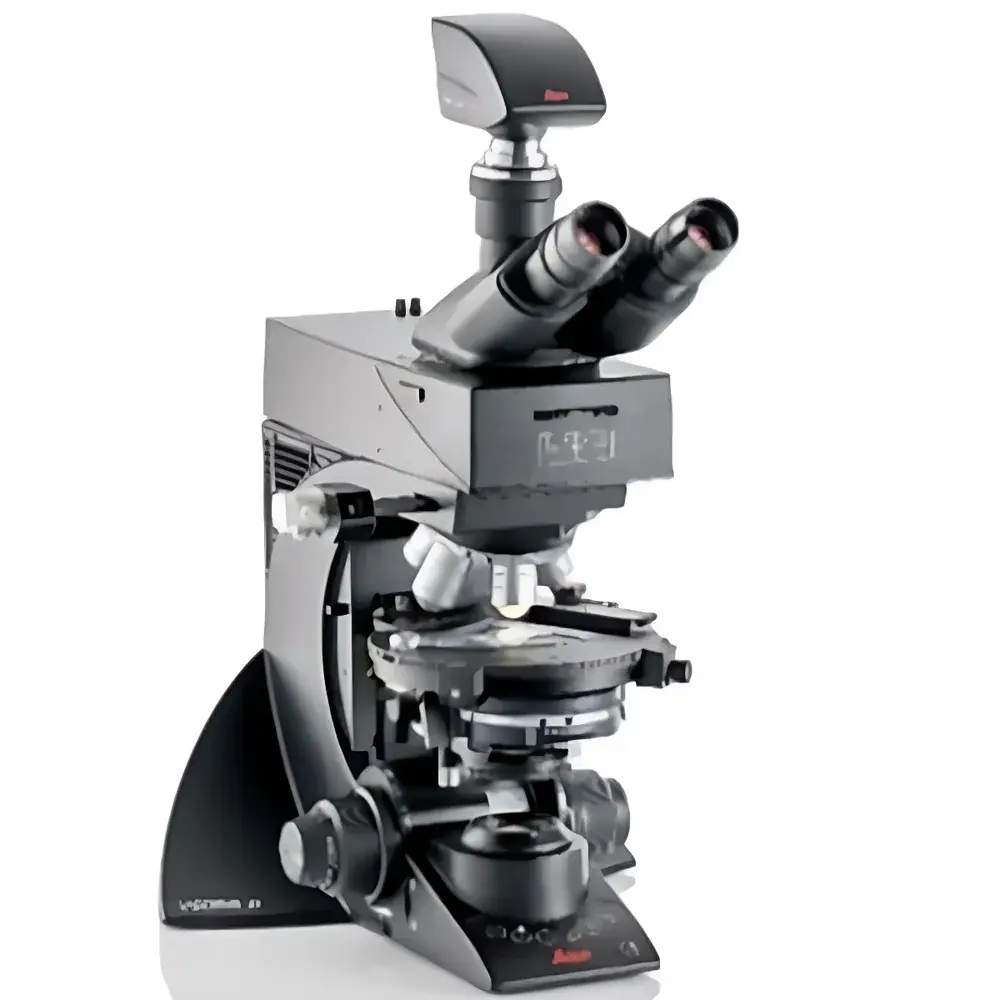
Leica Visoria P Polarizing Microscope
| Brand | Leica |
|---|---|
| Origin | Germany |
| Model | Visoria P |
| Category | Imported Instrument |
| Distribution Type | Authorized Distributor |
| Pricing | Available Upon Request |
Overview
The Leica Visoria P Polarizing Microscope is an engineered solution for quantitative optical characterization of birefringent and anisotropic materials. Built upon classical polarized light microscopy principles—namely, the interaction of linearly polarized illumination with crystalline or structured specimens—the Visoria P enables precise analysis of optical path differences, extinction angles, interference colors, and retardation. Its optical architecture incorporates strain-free optics, including low-stress objectives certified to DIN/ISO 10934-1 standards for polarization fidelity, a precision 360° rotating specimen stage with vernier scale (±0.1° repeatability), and a fully encoded nosepiece with per-objective centering alignment. The system supports both plane-polarized (PP) and conoscopic (conoscopic) observation modes, facilitating both routine identification of mineral phases and advanced crystallographic evaluation via interference figure analysis. Designed for laboratory environments where reproducibility, ergonomic sustainability, and regulatory traceability are essential, the Visoria P integrates seamlessly into GLP-compliant workflows in geoscience, polymer science, pharmaceutical solid-state analysis, and biomaterials research.
Key Features
- Encoded optical train with automatic illumination intensity adjustment—light output dynamically optimized when switching magnification or contrast mode (e.g., between crossed polars and circular polarization), eliminating manual brightness recalibration.
- Ergonomic, eyepiece-free digital operation: native tablet-based interface enables relaxed seated posture, reduced neck and ocular strain, and immediate image review without intermediate PC hardware.
- Enersight software platform integration: provides intuitive workflow navigation for measurement, annotation, multi-modal image fusion (e.g., overlaying brightfield, darkfield, and polarized channels), and EDOF (Extended Depth of Field) stack reconstruction.
- Dedicated polarizing components: strain-free objectives with individual centering capability; removable Bertrand lens for conoscopic imaging; three optional conoscopy modules (Standard Bertrand block, Bertrand A/B module, Advanced Conoscopy Module) supporting interference figure capture under convergent beam conditions.
- Automated illumination correction: real-time compensation for vignetting and field non-uniformity ensures consistent photometric integrity across the full FOV—critical for comparative quantitative analysis and ASTM E112 grain size assessments.
- Manual XY motorized stage compatibility: supports tile-scan stitching for large-area mapping at high resolution, enabling comprehensive structural survey of heterogeneous samples such as thin sections, coated substrates, or composite laminates.
Sample Compatibility & Compliance
The Visoria P accommodates standard 26 mm and 46 mm diameter thin sections, polished metallographic mounts (up to 50 mm × 75 mm), and biological slides (76 mm × 26 mm). It complies with ISO 8578 (microscope mechanical tolerances), ISO 10934-1 (polarization performance), and IEC 61000-6-3 (EMC emission standards). For regulated environments, Enersight software supports 21 CFR Part 11–compliant user authentication, electronic signatures, and full audit trail logging—including timestamped parameter changes, image acquisition metadata, and calibration event records. All polarization components are traceable to NIST-calibrated reference standards via Leica’s factory certification documentation.
Software & Data Management
Enersight serves as the unified control and analysis environment for the Visoria P. It delivers vendor-neutral TIFF/PNG export, DICOM-compatible metadata embedding, and batch-processing pipelines for layer-thickness quantification (e.g., polymer film or oxide coating measurements using retardation-to-thickness conversion models). Measurement data—including retardation values (nm), slow-axis orientation (degrees), and interference color grading—is exportable to CSV or Excel for statistical analysis. Image archives are organized by project, user, date, and instrument configuration, with optional integration into enterprise LIMS or ELN systems via standardized REST API endpoints.
Applications
- Geological petrography: identification and orientation analysis of quartz, feldspar, mica, and carbonate minerals in thin sections using interference figures and extinction angle mapping.
- Materials science: detection of residual stress in transparent polymers (e.g., PMMA, PC), phase segregation in copolymers, and crystallinity assessment in semicrystalline thermoplastics.
- Pharmaceutical development: solid-form screening of active pharmaceutical ingredients (APIs), polymorph differentiation, and hydrate/anhydrate characterization under controlled humidity stages.
- Metallurgy: evaluation of inclusion morphology and birefringence in steel alloys, aluminum composites, and turbine blade coatings.
- Biology: visualization of collagen fiber alignment in connective tissues, starch granule birefringence in plant cells, and chiral liquid crystal domains in model membranes.
FAQ
Does the Visoria P support automated calibration of polarization axis alignment?
Yes—through encoded stage rotation and objective turret positioning, the system enables repeatable, software-guided calibration of polarizer/analyzer azimuth and compensator zero points, with validation reports generated per ASTM E2384.
Can Enersight software perform quantitative retardation measurements?
Yes—using calibrated quarter-wave and full-wave compensators, Enersight calculates retardation values (in nanometers) from interference color charts or direct phase-shift analysis, with uncertainty propagation based on input optical parameters.
Is the Visoria P compatible with third-party digital cameras?
It supports industry-standard C-mount interfaces and USB3 Vision–compliant sensors; however, full feature access (e.g., EDOF, illumination sync, and polarization mode metadata tagging) requires Leica-certified DMC series cameras.
What safety certifications does the Visoria P hold?
It carries CE marking per EU Directive 2014/30/EU (EMC) and 2014/35/EU (LVD), and conforms to EN 61000-6-2 for immunity in laboratory electromagnetic environments.
How is data integrity ensured during long-term archival?
Enersight embeds EXIF and custom XMP metadata—including instrument ID, operator ID, exposure settings, polarization state, and stage coordinates—into every exported image file, ensuring full FAIR (Findable, Accessible, Interoperable, Reusable) compliance.




