
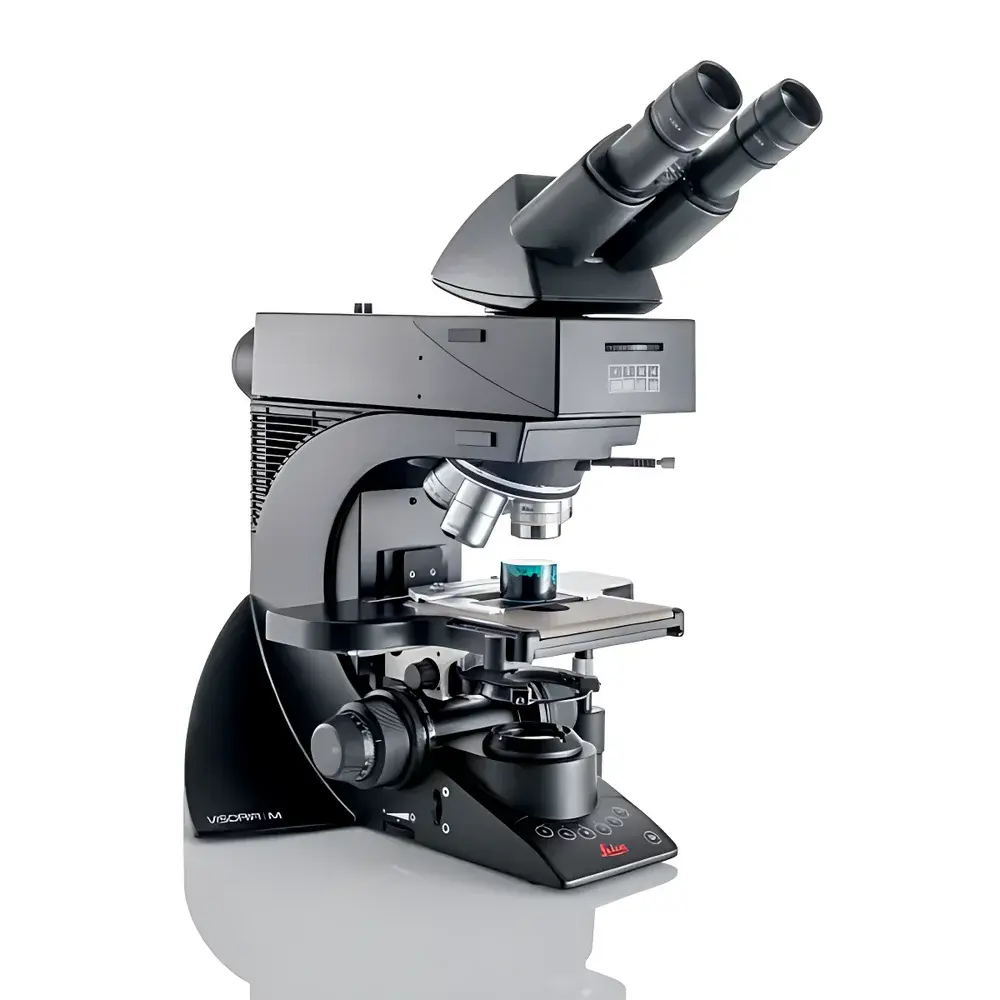
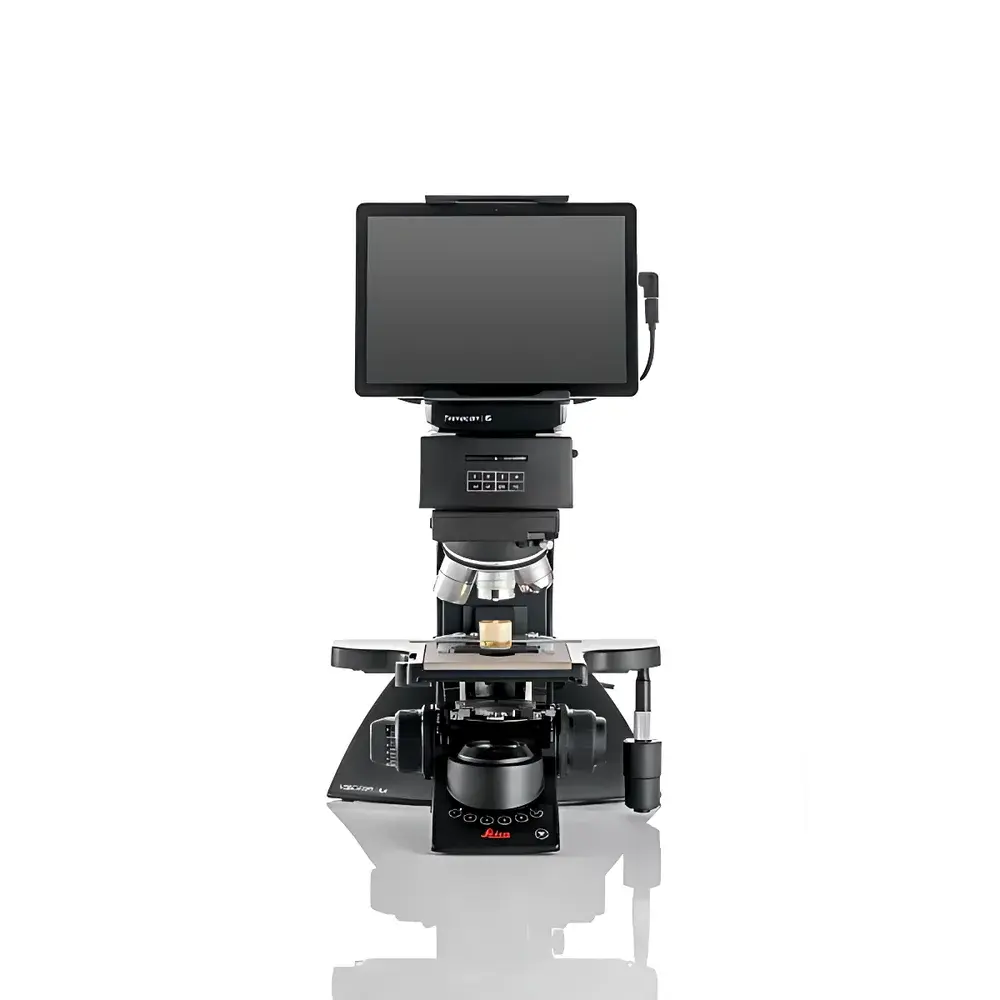
Leica Visoria M Upright Metallurgical Microscope
| Brand | Leica |
|---|---|
| Origin | Shanghai, China |
| Manufacturer Type | Authorized Distributor |
| Product Type | Upright |
| Imaging Analysis System | Integrated Enersight Software Platform |
| Observation Modes | Brightfield, Darkfield, Polarization, Differential Interference Contrast (DIC), Oblique Illumination, Fluorescence |
| Macro Objective Option | 0.7× |
| Ergonomic Design | Yes |
| Digital-Only Operation | Supports tablet-based, eyepiece-free imaging |
| Illumination Control | Encoded, Auto-Adaptive Brightness Management |
| Image Processing Features | Extended Depth of Field (EDOF), Flat-Field Illumination Correction, Multi-Mode Image Fusion (e.g., BF + DF), XY Tile Scan with Manual Stage |
Overview
The Leica Visoria M Upright Metallurgical Microscope is an engineered solution for routine microstructural analysis of opaque, reflective specimens in industrial quality control, failure analysis, and materials R&D laboratories. Designed specifically for metallurgical and advanced material inspection, it employs incident illumination optics with precision Köhler illumination pathways and encoded optical components to ensure reproducible, traceable imaging conditions. Unlike conventional upright microscopes used for biological applications, the Visoria M features a reinforced mechanical stage, high-numerical-aperture reflective objectives optimized for metallographic polishing artifacts, and modular illumination paths supporting multiple contrast mechanisms—including brightfield (BF), darkfield (DF), polarization (POL), differential interference contrast (DIC), oblique illumination, and fluorescence—without mechanical realignment. Its upright configuration accommodates large, heavy, or irregularly shaped samples commonly encountered in foundry, aerospace, electronics, and additive manufacturing environments.
Key Features
- Encoded optical train with auto-recognition of objective magnification and observation mode, enabling automatic illumination intensity adjustment and metadata tagging per image frame.
- Integrated Enersight software platform delivering calibrated measurement, layer-thickness quantification (e.g., coating, plating, diffusion zones), and automated EDOF stack acquisition without third-party plugins.
- Ergonomic, low-fatigue design including adjustable height stand, tilting binocular tube (optional), and tablet-first digital interface—eliminating eyepiece use and reducing cervical strain during extended inspection sessions.
- 0.7× macro objective (optional) providing ~36 mm field-of-view at low magnification for rapid sample survey, defect triage, and region-of-interest selection prior to high-magnification analysis.
- Flat-field corrected reflective objectives (5×–100×) with anti-reflection coatings optimized for visible and near-UV spectral ranges; compatible with standard ISO 8039-compliant metallographic specimen preparation protocols.
- Modular LED illumination system with color temperature stability (5700 K ± 150 K) and intensity linearity across all magnifications—compliant with ASTM E3–22 requirements for consistent photomicrography.
Sample Compatibility & Compliance
The Visoria M accepts standard 25 mm, 30 mm, and 50 mm diameter metallographic mounts, as well as unmounted bulk specimens up to 120 mm × 80 mm × 50 mm (W × D × H). It supports both polished and etched surfaces per ASTM E407 and ISO 4967 standards. The system complies with IEC 61000-6-3 (EMC emissions) and IEC 61000-6-2 (immunity), and its software architecture adheres to ALCOA+ principles for data integrity. Enersight provides audit-trail functionality meeting FDA 21 CFR Part 11 requirements for electronic records and signatures when deployed in regulated GMP/GLP environments.
Software & Data Management
Enersight is a dedicated, standalone imaging platform—not a generic third-party application—designed exclusively for Leica materials microscopy workflows. It supports DIC vector calibration, multi-channel overlay (e.g., BF + fluorescence), and ISO/IEC 17025-aligned uncertainty propagation in thickness measurements. All image metadata—including objective ID, illumination mode, exposure time, gamma correction, and stage coordinates—is embedded in TIFF files using EXIF and custom XML schemas. Data export formats include CSV (for statistical process control integration), PDF reports with embedded annotations, and DICOM-SR for cross-platform archival in LIMS environments.
Applications
- Electronics: Inspection of PCB solder joints, wire bond integrity, die surface defects, and contamination on silicon wafers using oblique illumination and DIC for topographic sensitivity.
- Metallurgy & Heat Treatment: Grain size evaluation (ASTM E112), inclusion rating (ASTM E45), decarburization depth measurement, and phase distribution mapping in steels and superalloys.
- Composites & Ceramics: Fiber orientation analysis, interfacial debonding detection, porosity quantification (ISO 4527), and thermal barrier coating (TBC) thickness profiling via layer-edge segmentation.
- Automotive & Aerospace: Fatigue crack initiation site identification, wear track morphology assessment, and coating adhesion failure analysis under cyclic loading conditions.
- R&D Labs: In situ correlation of microstructure evolution (e.g., during annealing or corrosion testing) with mechanical test data using synchronized stage positioning and time-lapse EDOF capture.
FAQ
Does the Visoria M support automated focus mapping for rough or tilted samples?
Yes—when paired with the optional motorized Z-drive and Enersight’s EDOF module, the system acquires and fuses up to 64 focal planes per field, generating a single all-in-focus image with sub-micron axial resolution.
Can Enersight perform ASTM-compliant grain size analysis without manual thresholding?
Yes—the software includes a validated, ISO/IEC 17025-traceable grain detection algorithm based on gradient-enhanced watershed segmentation, with user-adjustable sensitivity and automatic reporting against ASTM E112 Annex A2.
Is the 0.7× macro objective parfocal with standard metallographic objectives?
No—it is mechanically decoupled and requires manual turret rotation; however, its working distance (65 mm) and field uniformity enable rapid transition between macro survey and micro-detail inspection without stage repositioning.
What documentation is provided for IQ/OQ validation in regulated facilities?
Leica supplies a comprehensive validation package including installation qualification (IQ) checklists, operational qualification (OQ) test protocols for illumination stability, stage repeatability (±0.5 µm), and software function verification aligned with GAMP 5 guidelines.
How is illumination uniformity maintained across different magnifications and contrast modes?
The encoded LED driver dynamically adjusts current output and aperture diaphragm position in real time, maintaining ±3% intensity variation across the field—verified per ISO 9241-307 for visual ergonomics and quantitative image analysis.



