
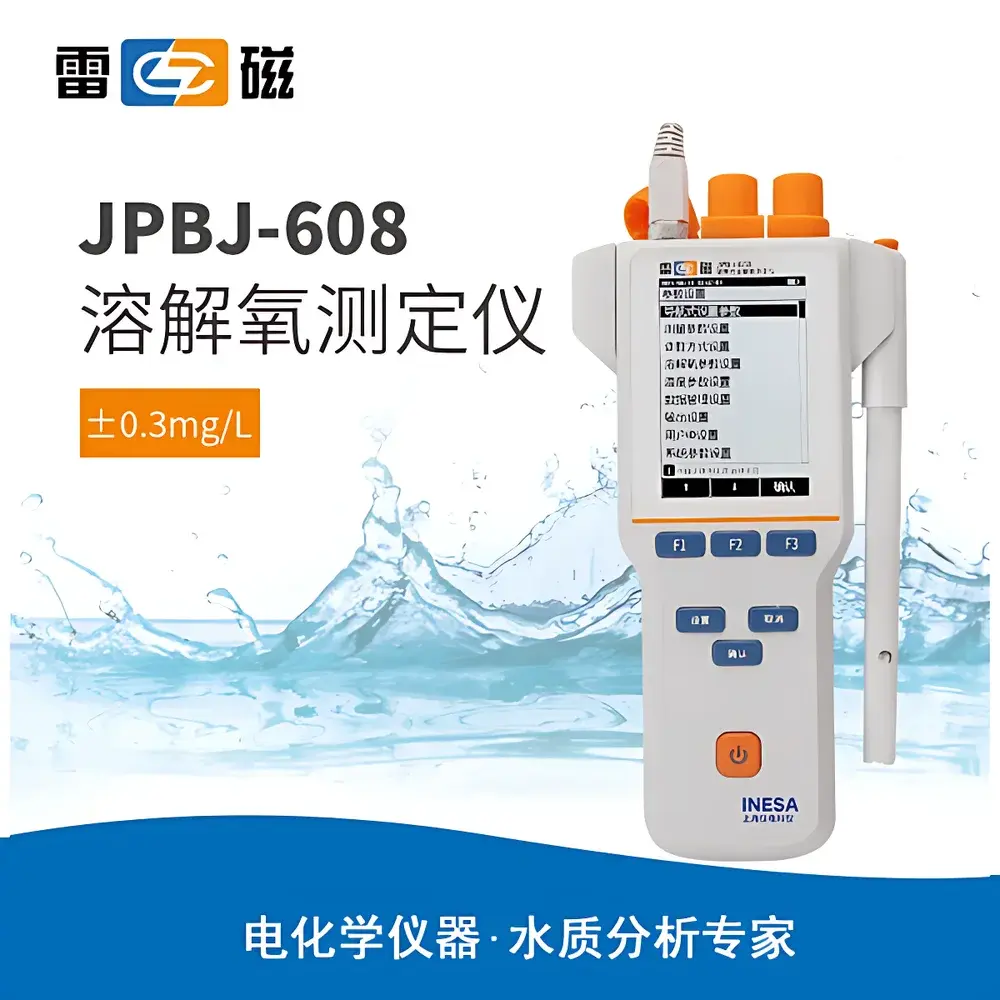
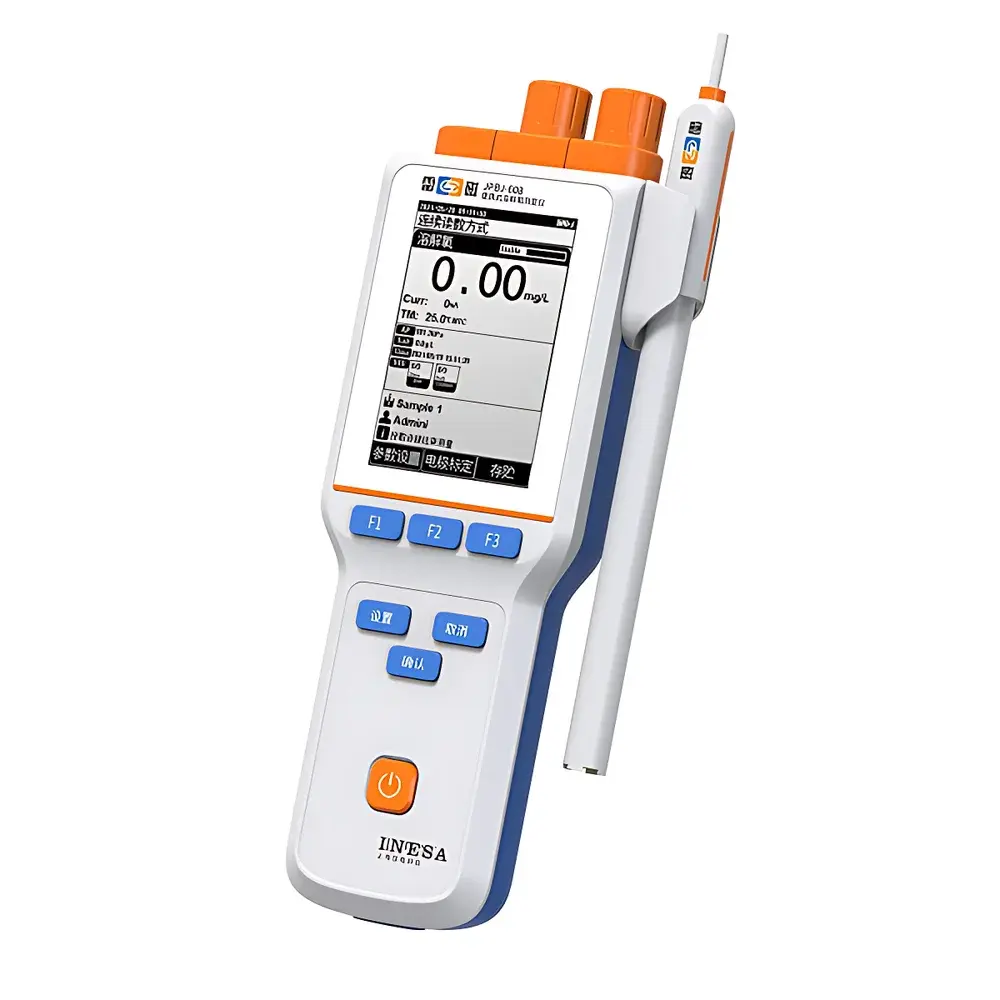
Leichi JPBJ-608 Portable Dissolved Oxygen Meter
| Brand | Leichi |
|---|---|
| Origin | Shanghai, China |
| Model | JPBJ-608 |
| Instrument Type | Portable |
| Measurement Principle | Polarographic Electrochemical Probe |
| DO Range | (0.00–50.00) mg/L |
| Accuracy | ±0.30 mg/L for values ≤20.00 mg/L |
| Resolution | 0.01 mg/L (DO), 0.1 °C/°F (temperature), 0.1% (saturation) |
| Response Time | ≤45 s (90% response at 20.0 °C) |
| Temperature Compensation | Automatic, with manual salinity compensation |
| Atmospheric Pressure Compensation | kPa, mmHg, atm selectable |
| IP Rating | IP65 |
| Data Storage | 500 sets |
| Power | Rechargeable Li-ion battery, USB-C charging support (DC5V input) |
| Dimensions | 80 × 225 × 35 mm |
| Weight | 0.4 kg |
Overview
The Leichi JPBJ-608 Portable Dissolved Oxygen Meter is a field-deployable electrochemical analyzer engineered for reliable, on-site measurement of dissolved oxygen (DO) concentration in natural waters, wastewater, aquaculture systems, and environmental monitoring applications. It operates on the polarographic principle—utilizing a Clark-type membrane-covered electrode with a cathode (typically gold or platinum) and anode (silver/silver chloride) immersed in an electrolyte solution. When oxygen diffuses through the selective gas-permeable membrane, it is reduced at the cathode surface, generating a current proportional to the partial pressure of oxygen. This current is linearly converted to concentration units (mg/L) after rigorous temperature, atmospheric pressure, and salinity compensation. Designed for rugged outdoor use, the JPBJ-608 meets IP65 ingress protection standards, ensuring resistance to dust and low-pressure water jets—critical for field technicians working in rain, high humidity, or near splashing water bodies.
Key Features
- High-resolution 2.8-inch LCD display with adjustable backlight for optimal readability under varying ambient light conditions
- Automatic endpoint detection with multiple read modes: continuous auto-read, timed interval reading, manual hold, and programmable sampling intervals
- Integrated dual-compensation system: automatic temperature compensation (−5.0 to 110.0 °C) and user-selectable atmospheric pressure compensation (kPa, mmHg, or atm)
- Manual salinity correction (0–50 g/L) to minimize ionic strength-induced measurement drift in estuarine or brackish environments
- Factory-calibrated polarographic DO probe included—supports zero-oxygen (sodium sulfite) and full-scale (air-saturated water or Winkler titration reference) calibration protocols
- Robust mechanical design: lightweight (0.4 kg), compact footprint (80 × 225 × 35 mm), and ergonomic carrying case with wrist strap and protective silicone sleeve
- Extended operational runtime via high-capacity rechargeable lithium-ion battery with real-time charge status indicator and low-battery warning
Sample Compatibility & Compliance
The JPBJ-608 is validated for direct immersion measurements in freshwater, seawater (with salinity correction), effluent streams, groundwater, and surface runoff. Its polarographic sensor exhibits minimal flow dependency above 5 cm/s, making it suitable for static or low-flow sampling points. The instrument complies with fundamental metrological requirements outlined in ISO 5814:2012 (Water quality — Determination of dissolved oxygen — Electrochemical probe method) and supports traceable calibration practices aligned with GLP (Good Laboratory Practice) frameworks. While not certified for regulated pharmaceutical or clinical use, its data integrity features—including timestamped storage, operator ID tagging (via optional software configuration), and non-editable audit logs—facilitate internal QA/QC documentation and regulatory readiness for municipal and industrial environmental reporting.
Software & Data Management
Data generated by the JPBJ-608 is stored locally in non-volatile memory (500 measurement records with DO value, temperature, saturation %, pressure, salinity, date/time stamp, and calibration history). Export is enabled via USB interface using Leichi’s proprietary PC communication software (Windows-compatible), supporting CSV and PDF report generation. Raw datasets retain full metadata for retrospective analysis and trend evaluation. Optional RS-232 output allows connection to standard serial printers for immediate hardcopy output—configurable formatting includes single-value printouts, multi-parameter tables, or compliance-ready summary sheets. All data transfers are unidirectional (device-to-PC), eliminating risk of firmware corruption during synchronization.
Applications
- Field-based assessment of oxygen depletion events in rivers, lakes, and reservoirs during algal bloom monitoring
- Wastewater treatment plant process control—particularly in aeration basins, oxidation ditches, and secondary clarifiers
- Aquaculture site management, including pond DO profiling and recirculating aquaculture system (RAS) health diagnostics
- Educational laboratory instruction on aquatic chemistry, biogeochemical cycling, and sensor fundamentals
- Regulatory compliance sampling per national ambient water quality criteria (e.g., US EPA Region 10, China’s GB 3838-2002)
- Emergency response deployment during chemical spills or thermal discharges where rapid DO screening informs mitigation priorities
FAQ
What calibration standards are required for routine operation?
Two-point calibration is recommended: zero-oxygen (using sodium sulfite solution) and saturated-air (at known temperature, pressure, and salinity). Calibration verification against a Winkler titration standard is advised quarterly or after electrode membrane replacement.
Can the JPBJ-608 measure dissolved oxygen in highly turbid or suspended-solid-laden samples?
Yes—the polarographic probe is insensitive to particulates; however, prolonged exposure to abrasive sediments may accelerate membrane wear. Regular cleaning and membrane inspection are essential in such matrices.
Does the instrument support FDA 21 CFR Part 11-compliant electronic signatures?
No—the JPBJ-608 does not implement role-based access control, electronic signature capture, or audit trail encryption required for Part 11 compliance. It is intended for non-GxP field use.
How often should the DO electrode membrane and electrolyte be replaced?
Typical service life is 3–6 months under normal field use. Replacement frequency increases in high-temperature, high-salinity, or contaminated environments. Visual inspection for membrane cloudiness or electrolyte crystallization is the primary maintenance indicator.
Is the USB interface compatible with macOS or Linux operating systems?
The native communication protocol is Windows-only; however, raw data export via CSV from Windows-PC can be imported into cross-platform analytical tools (e.g., R, Python pandas, or LibreOffice Calc) without loss of fidelity.
Related Products







