
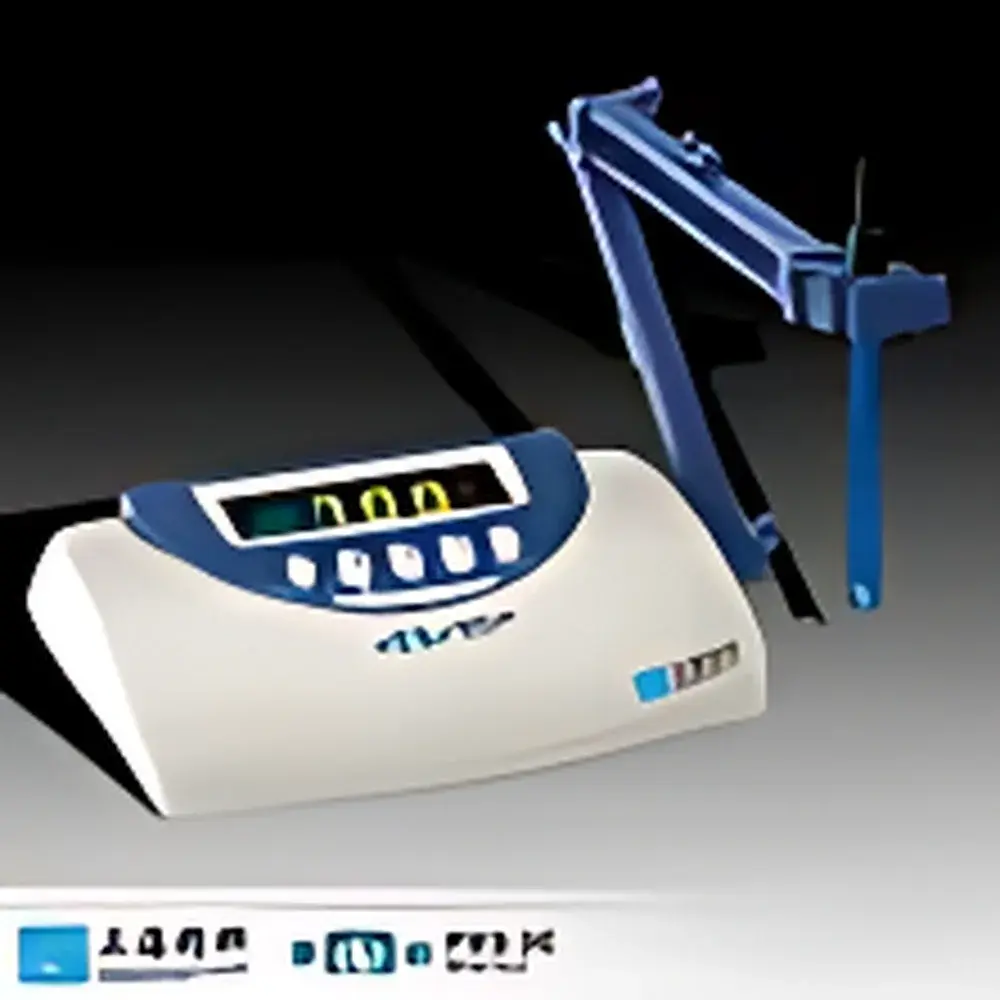
Leici DDSJ-308A Benchtop Conductivity Meter
| Brand | Leici |
|---|---|
| Origin | Shanghai, China |
| Model | DDSJ-308A |
| Detection Parameters | Single-parameter (Conductivity/TDS/Salinity/Temperature) |
| Form Factor | Benchtop |
| Conductivity Range | 0.000 µS/cm to 199.9 mS/cm |
| TDS Range | 0.000 mg/L to 99.9 g/L |
| Salinity Range | (0.00–8.00)% |
| Temperature Range | (−5.0 to 105.0) °C |
| Accuracy | ±0.5% FS (Conductivity & TDS), ±0.1% FS (Salinity), ±0.3 °C ±1 digit (Temperature) |
| Minimum Resolution | 0.01 µS/cm |
| Electrode Constant Options | 0.01, 0.1, 1, 10 cm⁻¹ |
| Data Storage Capacity | 200 measurement sets |
| Interface | RS-232 serial port |
| Compliance | Meets JJG 376–2007 (Chinese National Verification Regulation for Conductivity Meters), suitable for GLP-compliant environments with audit-ready data handling |
Overview
The Leici DDSJ-308A is a precision benchtop conductivity meter engineered for routine and high-accuracy electrochemical analysis in quality control laboratories, environmental monitoring stations, pharmaceutical water systems, and academic research settings. It operates on the fundamental principle of measuring the electrical conductance of aqueous solutions—directly proportional to ion concentration—using a two-electrode or four-electrode cell (depending on selected probe configuration). The instrument supports simultaneous measurement of conductivity, total dissolved solids (TDS), salinity, and temperature, with automatic temperature compensation (ATC) based on user-selectable or built-in NTC thermistor input. Its microprocessor-controlled architecture ensures stable signal acquisition, adaptive range switching, and minimal thermal drift over extended operation. Designed to meet the metrological requirements of JJG 376–2007—the national verification regulation for conductivity meters in China—the DDSJ-308A delivers traceable performance under routine laboratory conditions and is compatible with Good Laboratory Practice (GLP) documentation workflows when paired with REX DC software.
Key Features
- Four-parameter measurement capability: conductivity, TDS, salinity, and temperature—each displayed simultaneously on a blue-backlit dot-matrix LCD with full Chinese interface (localized firmware only; English UI not supported)
- Auto-ranging functionality across five decades (0.000 µS/cm to 199.9 mS/cm), eliminating manual scale selection errors
- Programmable electrode constant (0.01, 0.1, 1.0, or 10.0 cm⁻¹) and customizable TDS conversion factor (0.4–1.0), enabling calibration flexibility for diverse sample matrices
- Integrated ATC using Pt1000 or NTC sensor input (−5.0 to 105.0 °C), supporting both linear and non-linear compensation algorithms per IEC 60746-3
- Non-volatile memory storing up to 200 complete measurement records—including timestamp, parameter values, electrode constant, and temperature—with recall, deletion, and export functions
- Dual printing modes: real-time thermal printing via RS-232-connected TP-16 printer or batch printout of stored datasets
- Robust mechanical design: compact housing (290 × 200 × 70 mm), ABS+PC enclosure, and IP20-rated protection for benchtop stability and ESD resistance
Sample Compatibility & Compliance
The DDSJ-308A accommodates a broad spectrum of aqueous samples—from ultrapure water (using the optional 0.01 cm⁻¹ titanium alloy cell with sealed flow-through chamber) to concentrated brines and industrial process streams. Its modular electrode support enables interchangeability between low-conductivity (e.g., Type DJS-0.01T) and high-conductivity (e.g., DJS-10T) sensors without hardware modification. While the device itself does not carry CE, UKCA, or FDA 510(k) certification, its measurement methodology aligns with ISO 7888 (water quality — determination of electrical conductivity), ASTM D1125 (standard test methods for electrical conductivity of water), and USP (Water Conductivity). When used with REX DC data acquisition software, it supports basic audit trail generation—time-stamped entries, operator ID logging (via manual input), and immutable record export—as foundational elements for GLP/GMP-aligned documentation.
Software & Data Management
Data exchange is facilitated exclusively through the RS-232 serial interface (DB9 male connector, TTL-level logic, 9600 bps default). The proprietary REX DC software (Windows-compatible, no macOS/Linux support) provides real-time graphing, statistical analysis (mean, SD, min/max), CSV export, and report generation. All stored measurements retain metadata: date/time stamp, measured values, selected electrode constant, ambient temperature, and calibration status flags. Though lacking native 21 CFR Part 11 compliance features (e.g., electronic signatures, role-based access control), the system permits manual archiving of exported .csv files into validated LIMS or ELN platforms for regulatory submission. Firmware updates are performed offline via PC connection and require Leici-certified utility tools—not publicly distributed.
Applications
- Pharmaceutical water systems: Monitoring purified water (PW) and water for injection (WFI) per USP acceptance criteria at 25 °C
- Environmental labs: Field-deployable validation of surface water, groundwater, and wastewater effluent conductivity for EPA Method 120.1 compliance screening
- Power plant chemistry: Feedwater and condensate purity assessment in steam-cycle systems where sub-1 µS/cm detection is critical
- Food & beverage QA: Batch verification of rinse water conductivity during CIP validation and final product solution consistency checks
- Academic teaching labs: Electrochemistry fundamentals instruction—including Kohlrausch’s law, molar conductivity trends, and temperature dependence modeling
FAQ
Does the DDSJ-308A support automatic calibration verification (ACV) or multi-point conductivity calibration?
No. It supports only single-point or two-point manual calibration using standard KCl solutions (e.g., 84 µS/cm, 1413 µS/cm, 12.88 mS/cm). No built-in ACV or slope/offset diagnostics are implemented.
Is the instrument compatible with ASTM D1125-compliant temperature correction protocols?
Yes—its ATC algorithm follows the linear approximation defined in ASTM D1125 Annex A1 (α = 2.0 %/°C reference), with optional user-defined temperature coefficients for non-standard electrolytes.
Can the RS-232 interface be adapted to USB using a generic converter?
Yes, provided the converter maintains correct handshake signaling (RTS/CTS) and emulates a COM port at 9600 bps, 8N1. However, Leici does not validate third-party adapters; use of original REX DC software is required for reliable communication.
What is the maximum allowable sample temperature for continuous measurement?
The instrument’s specified operating temperature range is −5.0 to 105.0 °C, but sustained exposure above 80 °C may accelerate sensor degradation and reduce long-term calibration stability—especially with glass-bodied electrodes.
Does the device meet IP rating requirements for humid laboratory environments?
It carries no formal IP rating; however, its sealed front-panel membrane keypad and vented chassis design provide adequate protection against incidental splashes and ambient humidity typical of ISO Class 8 cleanrooms or QC labs.





