
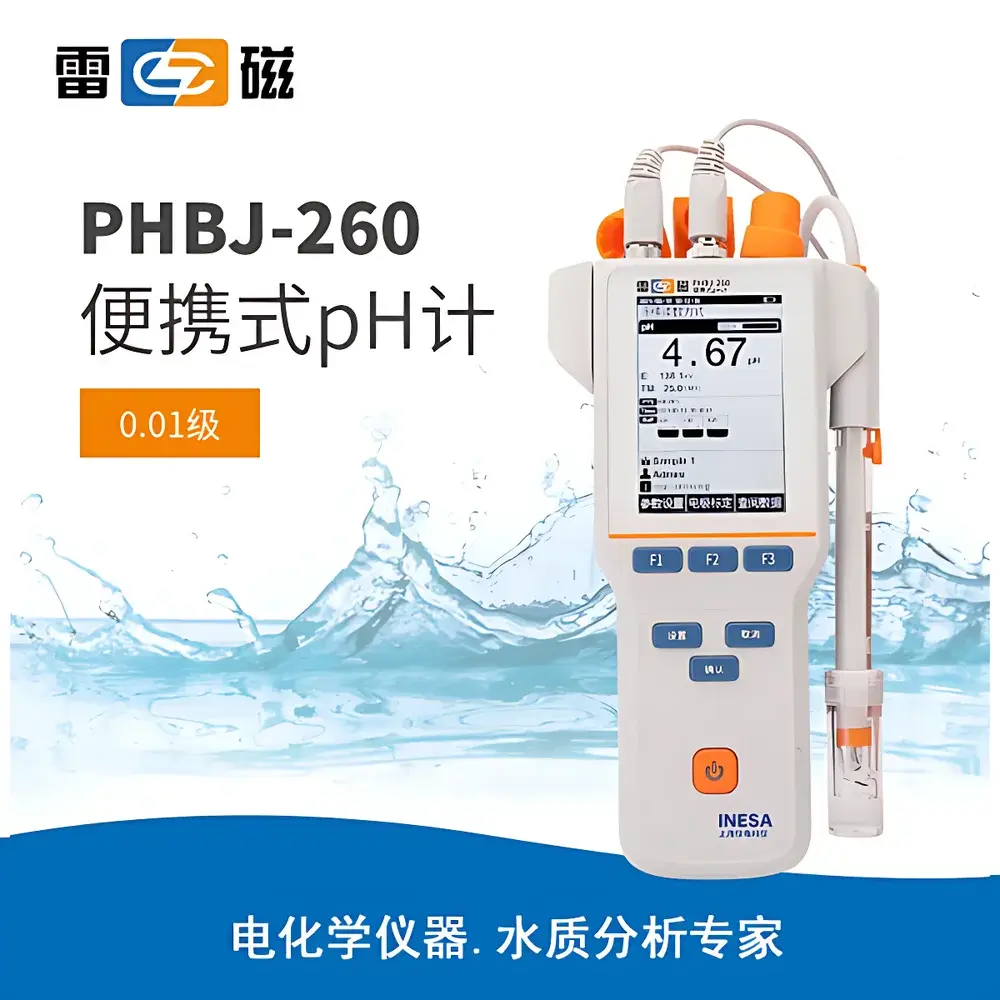
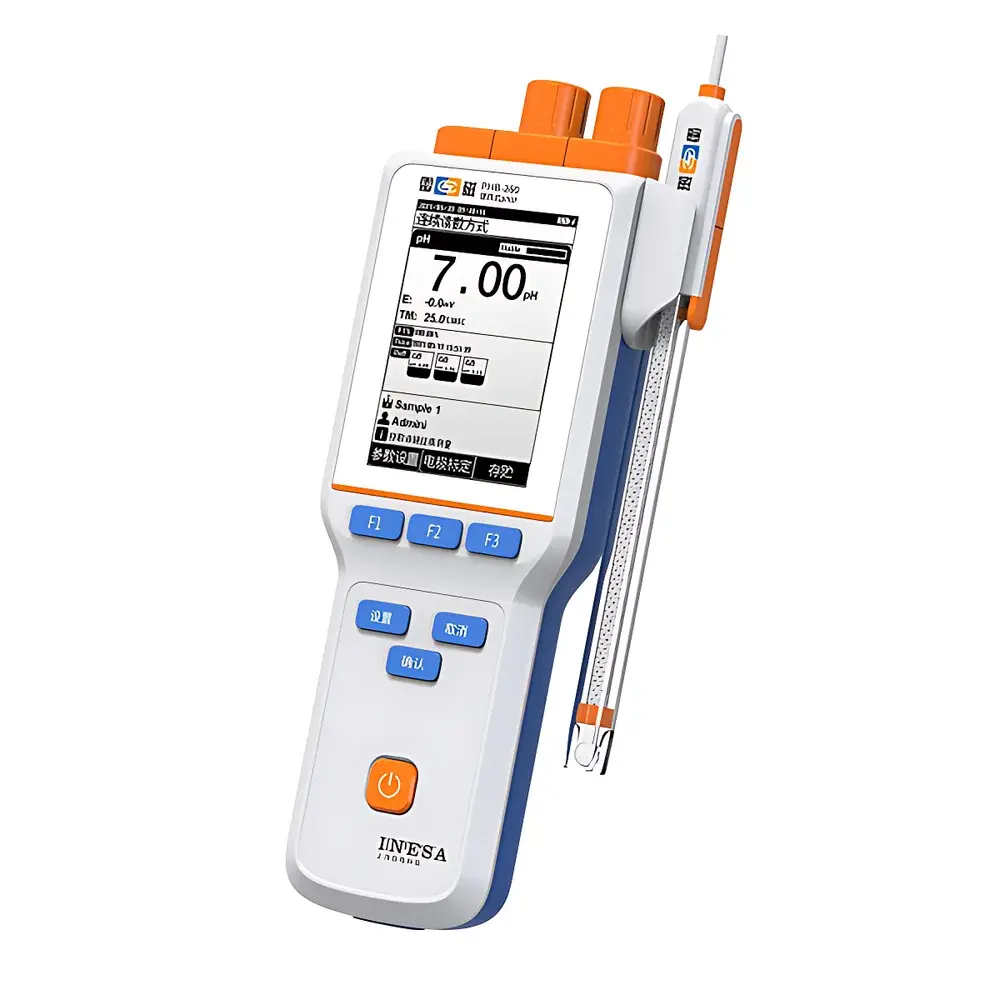
Leici PHBJ-260 Portable pH Meter
| Brand | Leici |
|---|---|
| Origin | Shanghai, China |
| Model | PHBJ-260 |
| Instrument Type | Portable |
| Parameter Types | Multi-parameter (pH, mV, Temperature) |
| pH Measurement Range | (-2.00 to 20.00) pH |
| pH Resolution | 0.01 pH |
| pH Accuracy | ±0.01 pH |
| mV Range | (-2000.0 to 2000.0) mV |
| mV Resolution | 0.1 mV |
| mV Accuracy | ±0.1% FS or ±0.3 mV |
| Temperature Range | (-5.0 to 110.0) °C / (23.0 to 230.0) °F |
| Temperature Resolution | 0.1 °C / 0.1 °F |
| Temperature Accuracy | ±0.2 °C |
| Calibration Points | 1–5-point pH calibration |
| Buffer Recognition | Auto-identification of GB, DIN, and NIST standard buffer sets |
| Data Storage Capacity | 500 measurement records |
| Protection Rating | IP65 |
| Power Supply | Rechargeable Li-ion battery with USB-C/DC5V charging support |
| Dimensions (L×W×H) | 80 × 255 × 35 mm |
| Weight | 0.4 kg |
Overview
The Leici PHBJ-260 Portable pH Meter is a high-precision, field-deployable electrochemical instrument engineered for reliable pH, mV, and temperature measurements in diverse environmental, industrial, and educational settings. Based on potentiometric measurement principles—where the potential difference between a pH-sensitive glass electrode and a stable reference electrode is converted into a logarithmic pH value—the PHBJ-260 delivers laboratory-grade accuracy in a rugged, handheld form factor. Its extended pH range of –2.00 to 20.00 accommodates highly acidic or alkaline samples commonly encountered in wastewater treatment, electroplating baths, semiconductor cleaning processes, and chemical synthesis QA/QC. Designed for operational continuity in non-laboratory environments, the device integrates intelligent endpoint detection algorithms, automatic temperature compensation (ATC), and dual-unit temperature display (°C/°F), ensuring traceable, reproducible results under variable ambient conditions.
Key Features
- High-resolution 0.01 pH resolution with ±0.01 pH accuracy at 25 °C, compliant with Chinese JJG 119–2018 and ISO 7888 standards for portable pH meters
- Multi-parameter capability: simultaneous pH, mV (±2000.0 mV, 0.1 mV resolution), and temperature (–5.0 to 110.0 °C) measurement
- Intelligent auto-buffer recognition supporting three internationally referenced calibration protocols: GB (China), DIN (Germany), and NIST (USA)
- Five-point pH calibration with user-defined buffer management, enabling traceable calibration history and custom buffer set configuration
- IP65-rated enclosure with silicone protective sleeve, wrist strap, and shock-absorbing carrying case—validated for dust-tight operation and water jet resistance
- Advanced data handling: 500 internal storage slots with timestamp, electrode ID, calibration log, and temperature metadata; exportable via USB to PC using Leici’s certified communication software
- Comprehensive power management: rechargeable Li-ion battery (up to 100 hours continuous use), low-battery warning, real-time charging status indicator, and compatibility with standard 5 V DC power banks
Sample Compatibility & Compliance
The PHBJ-260 is optimized for aqueous and mildly aggressive liquid samples, including process streams, surface waters, soil extracts, food homogenates, and pharmaceutical buffers. It supports direct immersion with its included tri-combination pH electrode (Ag/AgCl reference, gel-filled junction, and integrated temperature sensor), eliminating the need for separate temperature probes. The instrument conforms to GLP (Good Laboratory Practice) requirements through mandatory audit trails—including operator ID (optional), calibration timestamps, buffer lot numbers, and electrode serial tracking. All stored data include electronic signatures and immutable metadata, satisfying documentation expectations for ISO/IEC 17025-accredited laboratories and FDA-regulated environments operating under 21 CFR Part 11 guidelines for electronic records.
Software & Data Management
Leici’s proprietary PC communication software enables bidirectional data exchange, firmware updates, and report generation in PDF or CSV formats. Each measurement record contains full contextual metadata: date/time stamp, measured values, calibration parameters (slope, offset, asymmetry potential), electrode condition indicators, and ambient temperature. The software supports batch export, filtering by date range or electrode ID, and customizable report templates aligned with internal SOPs or external regulatory submissions. No cloud dependency or subscription model is required—data remain fully under user control on local workstations. Firmware upgrades are delivered as signed binary packages, preserving cryptographic integrity and enabling feature enhancements such as expanded buffer library support or enhanced noise-rejection algorithms.
Applications
- Environmental monitoring: Field validation of pH in rivers, lakes, and effluent discharge points per EPA Method 150.1 and ISO 10523
- Quality control in food & beverage production: Batch verification of brine solutions, dairy processing tanks, and fermentation media
- Pharmaceutical manufacturing: In-process testing of buffer preparations and cleaning validation solutions per USP
- Academic teaching labs: Student experiments requiring robust, intuitive instrumentation with built-in diagnostics and recovery functions
- Industrial maintenance: Routine checks of boiler feedwater, cooling tower chemistry, and electroplating electrolytes where extreme pH ranges are routine
FAQ
What calibration standards does the PHBJ-260 recognize automatically?
The meter auto-detects and applies correction factors for GB, DIN, and NIST-certified pH buffer solutions—each defined by their nominal pH at 25 °C and temperature coefficient tables.
Can the device store calibration history alongside measurement data?
Yes. Every calibration event is archived with date/time, buffer IDs used, slope (%), offset (mV), and electrode asymmetry potential—accessible via on-device review or PC export.
Is the included electrode suitable for non-aqueous or high-protein samples?
The standard tri-combination electrode is optimized for aqueous matrices. For viscous, protein-rich, or low-ionic-strength samples, Leici recommends optional electrodes with open-junction or sleeve-type references.
Does the PHBJ-260 support RS-232 printer output?
Yes. A standard DB9 RS-232 port enables direct connection to compatible thermal printers; print templates include raw data, calibration summary, and GLP header fields.
How is traceability ensured during firmware updates?
All firmware releases are digitally signed and version-locked. Update logs—including timestamp, previous version, and installer ID—are retained in device memory and exported with measurement data.





