
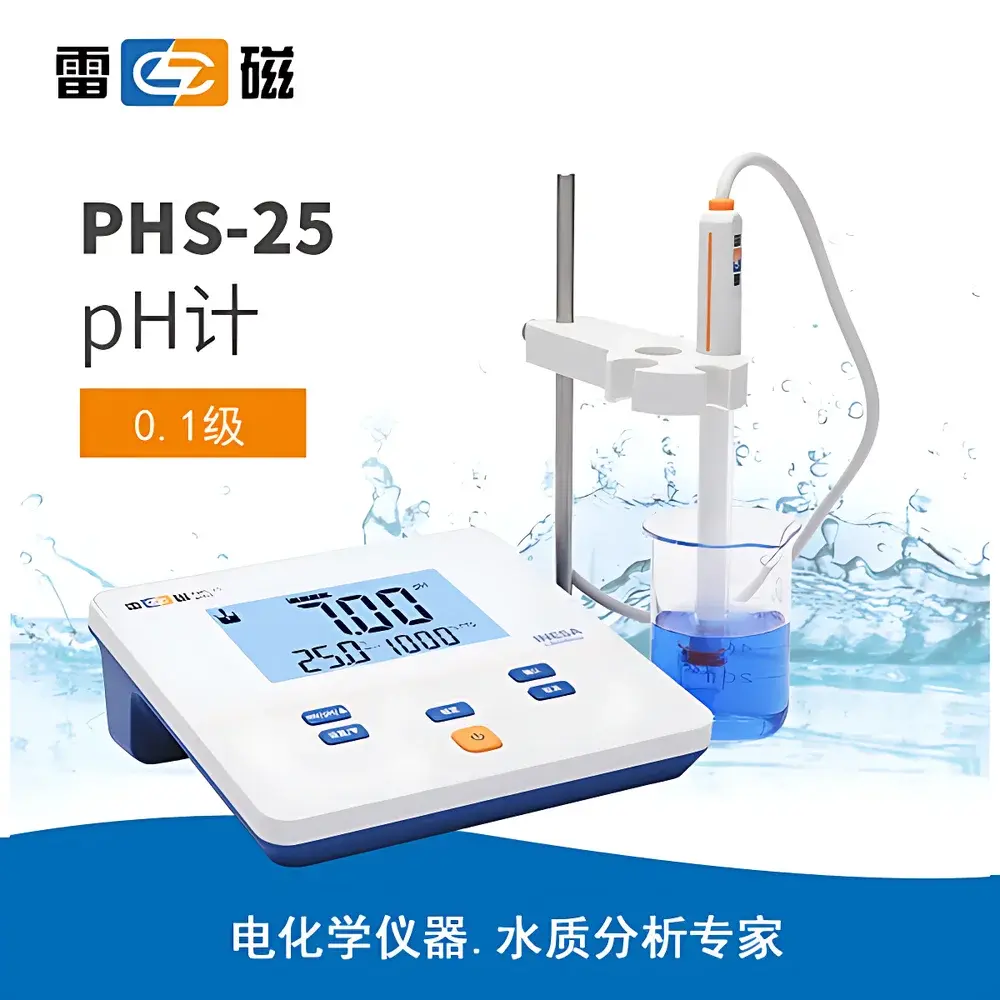
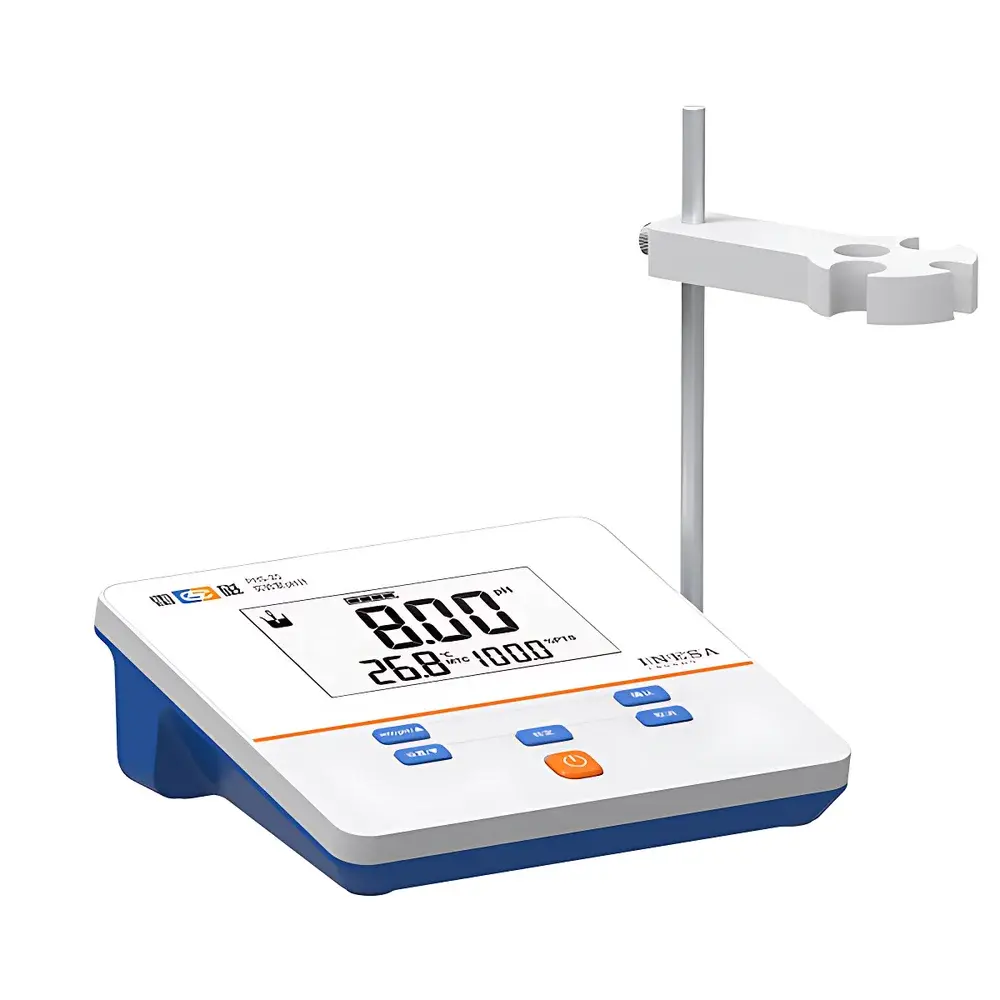
Leici PHS-25 Benchtop pH Meter
| Brand | Leici |
|---|---|
| Origin | Shanghai, China |
| Model | PHS-25 |
| Instrument Type | Benchtop |
| Parameter Types | Dual (pH and mV) |
| pH Measurement Range | 0.00–14.00 pH |
| pH Resolution | 0.01 pH |
| pH Accuracy | ±0.05 pH |
| mV Range | −1400 to +1400 mV |
| mV Resolution | 1 mV |
| mV Accuracy | ±1% FS |
| Temperature Compensation | Manual |
| Calibration Solutions | GB Standard Buffers at pH 4.00, 6.86, and 9.18 |
| Calibration Points | 1–2 point |
| Display | LCD with Stability Indicator |
| Protection Rating | IP54 |
| Power Supply | AC/DC Adapter (Input: 100–240 VAC |
| Output | 20 VDC / 1500 mA) |
| Dimensions | 200 × 160 × 63 mm |
| Weight | 0.6 kg |
Overview
The Leici PHS-25 is a benchtop dual-parameter electrochemical instrument engineered for routine pH and millivolt (mV) measurements in academic teaching laboratories, quality control environments, and industrial process support settings. It operates on the principle of potentiometric measurement, detecting the potential difference between a glass pH sensing electrode and a reference electrode immersed in an aqueous sample. This voltage—generated in accordance with the Nernst equation—is converted into a pH value using built-in calibration algorithms. Designed to meet national metrological verification requirements per Chinese JJG 119–2018 (Laboratory pH Meters), the PHS-25 complies with general-purpose accuracy specifications for Class 0.1 pH meters. Its compact footprint, integrated stability indicator, and manual temperature compensation make it suitable for environments where ambient temperature remains relatively stable and precise traceable calibration is required without automated thermal correction.
Key Features
- Benchtop form factor with ergonomic layout and high-contrast LCD display featuring real-time stability flag for confident endpoint reading
- Dual-parameter functionality: simultaneous pH and mV measurement modes, supporting redox potential (ORP) evaluation and electrode diagnostics
- IP54-rated enclosure providing protection against dust ingress and water splashes—suitable for general laboratory workbenches and light industrial use
- Intelligent buffer recognition system that auto-detects standard GB-certified calibration solutions at pH 4.00, 6.86, and 9.18, reducing operator error during standardization
- Support for 1-point or 2-point pH calibration with user-defined buffer options, enabling flexibility when non-standard buffers are employed
- Manual temperature compensation (MTC) via numeric keypad input, compatible with common laboratory thermometers for consistent correction across samples
- Power management features including auto-off after 10 minutes of inactivity and power-loss memory retention to preserve calibration and configuration settings
- Comprehensive accessory set: includes a combination pH electrode, adjustable electrode stand, protective dust cover, and pre-measured GB-compliant buffer powder sachets
Sample Compatibility & Compliance
The PHS-25 is intended for aqueous or low-viscosity aqueous-based solutions with total dissolved solids (TDS) below 5,000 ppm and conductivity above 10 µS/cm. It is not recommended for non-aqueous solvents, highly viscous media, or samples containing strong oxidizers or sulfides that may poison the Ag/AgCl reference junction. The instrument conforms to GB/T 11165–2022 (General Requirements for Laboratory pH Meters) and supports traceable calibration under ISO/IEC 17025–compliant QA procedures when used with certified reference materials. While not validated for GMP or FDA 21 CFR Part 11 environments, its calibration history, parameter lockout, and reset-to-factory functions facilitate basic GLP documentation workflows.
Software & Data Management
The PHS-25 operates as a standalone instrument with no embedded data logging or PC connectivity. All measurements are displayed in real time and must be manually recorded. Calibration data—including date, buffer IDs, slope (%), and offset (mV)—are retained in non-volatile memory and accessible via the menu interface. The device supports factory reset and parameter restoration, aiding in audit readiness and multi-user lab environments. For laboratories requiring electronic records, external integration may be achieved using optional RS-232 or USB-to-serial adapters (not included), though native driver support is limited to legacy Windows platforms.
Applications
- Academic instruction in general chemistry and analytical labs for teaching fundamental acid-base theory and electrode behavior
- Routine QC testing of drinking water, wastewater effluents, boiler feedwater, and swimming pool maintenance solutions
- Monitoring pH stability during fermentation, food processing, and agricultural soil extract analysis
- Verification of buffer preparation accuracy and electrode performance prior to high-precision titrations or ion chromatography runs
- Field-deployable use in mobile environmental testing units where ruggedness and battery-free operation (via AC adapter) are advantageous
FAQ
What calibration standards are supported by the PHS-25?
The instrument automatically recognizes GB-standard pH 4.00, 6.86, and 9.18 buffer solutions. Custom buffers can also be entered manually with user-defined pH values.
Does the PHS-25 support automatic temperature compensation (ATC)?
No—it provides only manual temperature compensation (MTC). An external thermometer is required to input the sample temperature before measurement.
Is the included pH electrode refillable or replaceable?
The supplied combination electrode features a gel-filled reference system and is designed as a field-replaceable unit with standard BNC connector compatibility.
Can the PHS-25 be used for non-aqueous samples?
It is not recommended for organic solvents, oils, or highly dehydrating media, as these may damage the hydrated glass membrane or cause reference junction clogging.
What is the expected service life of the pH electrode under normal use?
With proper storage in KCl solution and regular cleaning, the electrode typically maintains specification performance for 12–18 months in moderate-use environments.





