
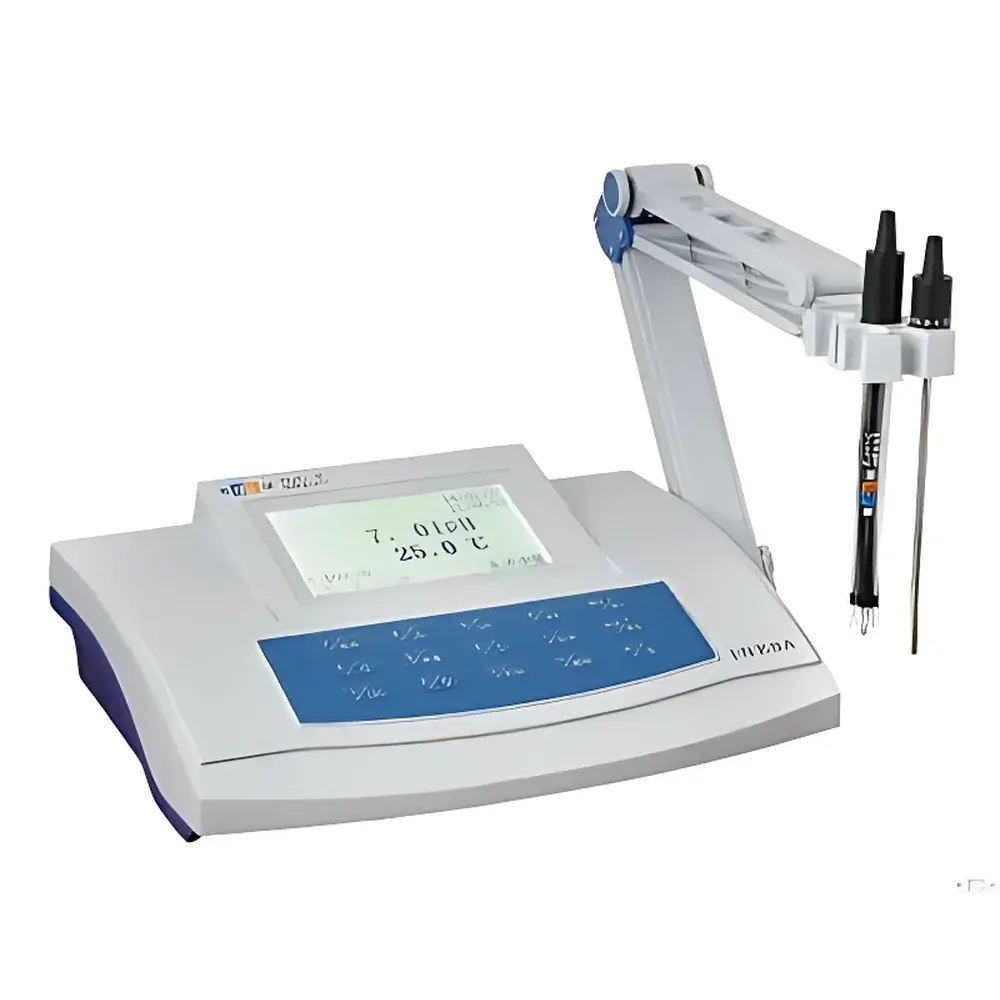
Leici PHSJ-3F Portable pH Meter / pH/ORP/Temperature Analyzer
| Brand | Leici |
|---|---|
| Origin | Shanghai, China |
| Model | PHSJ-3F |
| Instrument Type | Portable |
| Parameter Types | pH, mV (ORP), Temperature |
| Measurement Accuracy | ±0.01 pH |
| Measurement Range | pH –2.000 to 20.000 |
| Resolution | 0.01 pH / 1 mV / 0.1 °C |
| Accuracy | ±0.01 pH ±1 digit |
| Calibration Solutions | China-standard buffer set (pH 4.01, 6.86, 9.18) |
| GLP Compliance | Yes |
| Data Storage | 500 GLP-compliant records |
| Interface | USB |
| Power | 9 V DC (800 mA, center-positive) |
Overview
The Leici PHSJ-3F is a portable, microprocessor-controlled pH/ORP/temperature analyzer engineered for field deployment and routine laboratory use in quality control, environmental monitoring, pharmaceutical manufacturing, and academic research. It operates on the fundamental principle of potentiometric measurement: the potential difference between a pH-sensitive glass electrode and a stable reference electrode is converted into a pH value using the Nernst equation, with automatic temperature compensation applied in real time. Designed to meet the operational rigor of ISO/IEC 17025-accredited laboratories and GMP-regulated environments, the PHSJ-3F delivers Class 0.01 accuracy per IEC 62253 and conforms to national metrological verification regulation JJG 119–2018 for laboratory pH meters in China — a benchmark widely referenced in APAC regulatory submissions.
Key Features
- Smart-Read function: Automatically detects electrochemical equilibrium and locks stable readings, minimizing operator-dependent variability.
- Timed-Read mode: Configurable interval logging (1–60 min) for unattended batch monitoring of fermentation broths, wastewater effluents, or bioreactor media.
- Cont-Read (continuous monitoring) mode: Real-time graphical trend display of pH drift, enabling kinetic analysis of acid-base reactions or CO₂ absorption dynamics.
- Electrode health diagnostics: Alerts for low slope (±30 mV), or slow response time (>15 s to 95% step change), supporting predictive maintenance.
- Firmware upgradability via USB: Ensures long-term compatibility with evolving calibration protocols and regulatory reporting formats.
- GLP-compliant data governance: Assignable user IDs, full audit trail of calibration events (including date/time, buffer IDs, slope/%DR, offset), and timestamped measurement records.
- Triple isopotential point selection (pH 7.00, 6.98, 7.02): Optimized for low-conductivity samples including ultrapure water (ASTM D1193 Type I), boiler feedwater (ASME PTC 19.11), and deionized rinse solutions.
- Auto-buffer recognition for five standard Chinese buffers (pH 1.68, 4.01, 6.86, 9.18, 12.45), reducing mis-calibration risk during multi-point calibration sequences.
Sample Compatibility & Compliance
The PHSJ-3F supports aqueous and mildly buffered solutions across industrial and environmental matrices — including municipal drinking water, pharmaceutical excipient slurries, electroplating baths, and soil leachates. Its input impedance (>3×10¹² Ω) ensures minimal loading error with high-resistance electrodes used in low-ionic-strength applications. The instrument complies with electromagnetic compatibility standards GB/T 18268.1–2010 (equivalent to IEC 61326-1) and safety standard GB 4793.1–2007 (IEC 61010-1). All stored data include mandatory GLP fields: operator ID, calibration certificate traceability, electrode serial number, ambient temperature, and atmospheric pressure (if connected to optional external sensor). Data export meets FDA 21 CFR Part 11 requirements when paired with Leici’s certified PC software (LIS-Link v3.2), providing electronic signatures, audit logs, and immutable record archiving.
Software & Data Management
USB connectivity enables bidirectional communication with Windows-based LIS-Link software for configuration, firmware updates, and structured data export in CSV or PDF report formats. Each of the 500 onboard storage slots retains: measured pH/mV/°C values, calibration parameters (slope, offset, R²), user ID, date/time stamp, and electrode identification. Software supports batch printing of calibration reports compliant with ISO/IEC 17025 clause 7.7 and USP environmental monitoring documentation. Exported datasets are compatible with LIMS platforms via ODBC drivers and support metadata tagging for sample ID, location code, and analytical method reference (e.g., “EPA Method 150.1”).
Applications
- Pharmaceutical QC: Monitoring pH of injectable formulations (USP ), buffer preparation, and cleaning validation rinse water.
- Environmental labs: Field testing of surface water (ISO 10523), wastewater influent/effluent (EPA 150.1), and acid mine drainage.
- Food & beverage: Shelf-life studies of acidic beverages, dairy fermentation pH profiling, and HACCP critical control point verification.
- Power generation: Boiler water alkalinity control (ASME D20.1), condensate purity assurance, and corrosion inhibitor efficacy testing.
- Academic teaching: Electrochemistry labs demonstrating Nernstian behavior, liquid junction potential effects, and temperature coefficient quantification.
FAQ
What calibration buffers are supported?
The PHSJ-3F auto-recognizes five China-certified calibration buffers (pH 1.68, 4.01, 6.86, 9.18, 12.45) and allows manual entry of custom buffer values per ISO 17025 Annex A.3.
Does the instrument support automatic temperature compensation (ATC)?
Yes — it accepts input from integrated Pt1000 thermistors or external ATC probes (Leici T-100 series), applying the standardized temperature coefficient (–0.00301 pH/°C at 25°C) per NIST SP 260-170.
Can measurement data be exported for regulatory submission?
All 500 stored records include GLP-mandated metadata and export as tamper-evident PDFs with digital signature capability via LIS-Link software, satisfying FDA 21 CFR Part 11 and EU Annex 11 requirements.
Is the device suitable for ultrapure water measurement?
With selectable isopotential points and high-input-impedance circuitry, it meets ASTM D1193 Type I water specification requirements when used with low-diffusion double-junction electrodes.
What power options are available for extended field use?
The unit operates on 9 V DC (center-positive, 800 mA); optional rechargeable Li-ion battery packs (Leici BP-3F) provide >12 h continuous operation and retain full GLP logging functionality during power transitions.
Related Products




