
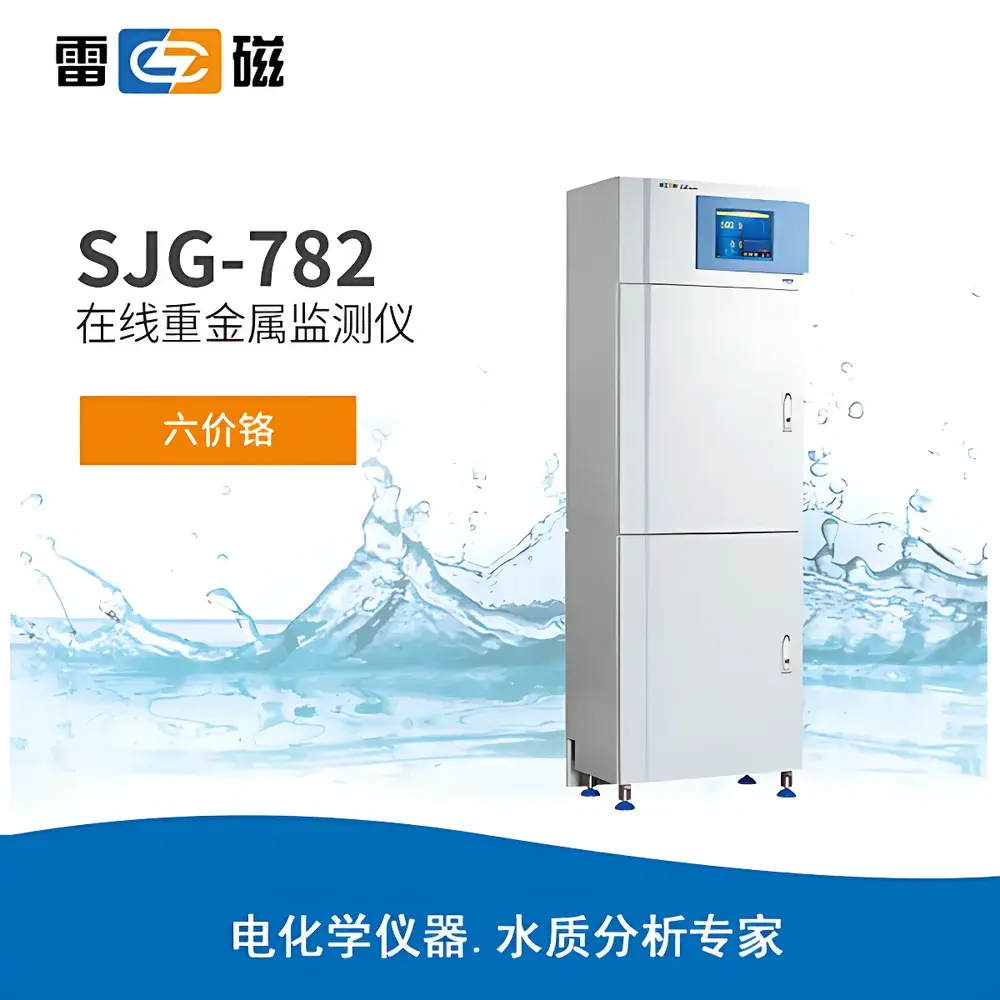
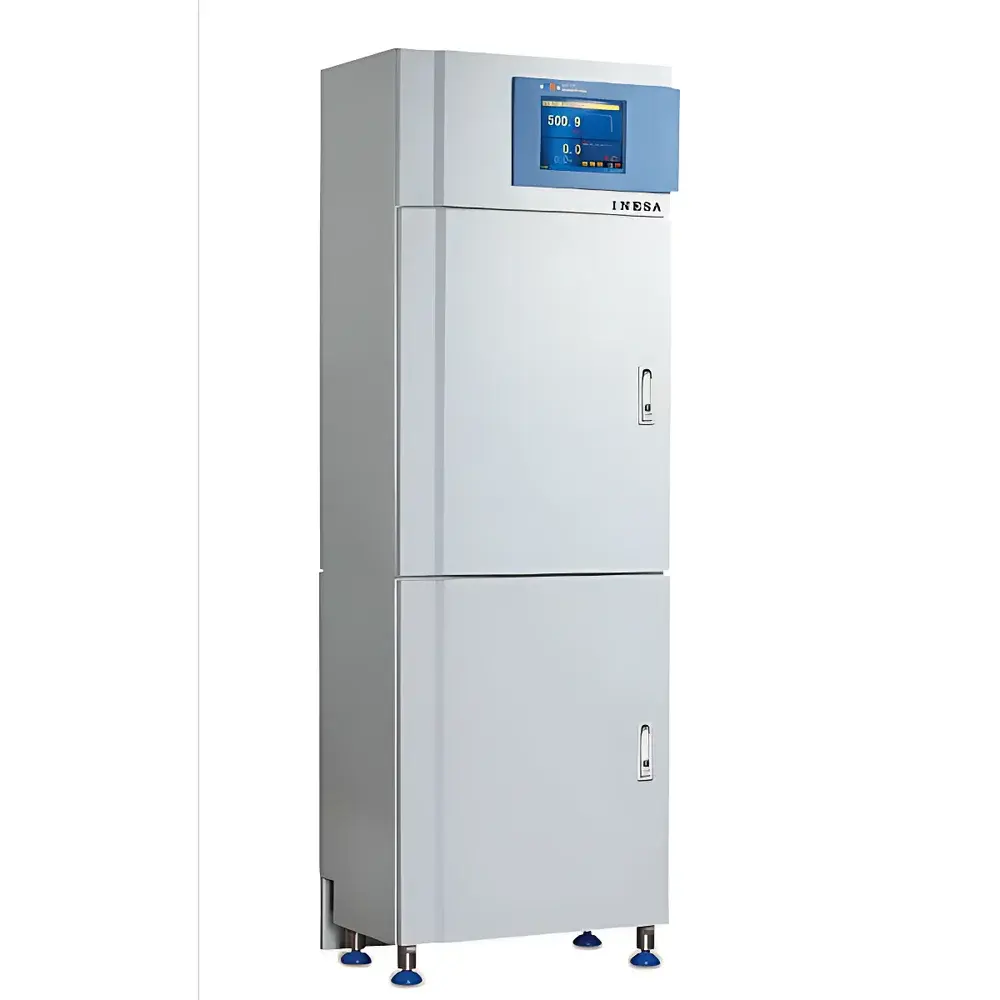
Leici SJG-782 Online Hexavalent Chromium (Cr(VI)) Monitor
| Brand | Leici |
|---|---|
| Origin | Shanghai, China |
| Manufacturer Type | Authorized Distributor |
| Origin Category | Domestic (PRC) |
| Model | SJG-782 |
| Quotation | ¥78,000 CNY |
| Instrument Type | Online Analyzer |
| Detection Principle | Spectrophotometry (Diphenylcarbazide Method) |
| Target Analyte | Hexavalent Chromium (Cr(VI)) |
| Accuracy | ±10% of full scale |
| Resolution | 0.001 mg/L |
| Measurement Range | 0.00–5.00 mg/L |
| Repeatability | ≤5% RSD |
| Stability | ≤10% FS/4 h |
| Zero Drift | ±5% FS/24 h |
| Span Drift | ±5% FS |
| LOD | 0.01 mg/L |
| MTBF | ≥720 h |
| Power Supply | AC 220 V ±10%, 50 Hz ±1% |
| Dimensions (W×D×H) | 400 × 550 × 1680 mm |
| Weight | 50 kg |
| Display | 7-inch color TFT touchscreen (Chinese UI) |
| Calibration Modes | Manual / Cyclic / Timed / Continuous |
| Measurement Modes | Manual / Cyclic / Timed / Continuous |
| Communication Interfaces | RS-232 or RS-485 (user-selectable) |
| Data Storage | Internal non-volatile memory with timestamped logging |
| Alarm Output | Dual-level (high/low) concentration threshold relay output |
Overview
The Leici SJG-782 Online Hexavalent Chromium (Cr(VI)) Monitor is an industrial-grade, fully automated spectrophotometric analyzer engineered for continuous, real-time quantification of hexavalent chromium in aqueous matrices. It implements the standardized diphenylcarbazide (DPC) colorimetric reaction—fully compliant with GB 7467–1987 “Water Quality – Determination of Hexavalent Chromium – Spectrophotometric Method Using Diphenylcarbazide”—to generate a stable magenta-colored complex proportional to Cr(VI) concentration. The instrument integrates optical path stabilization, temperature-controlled reaction cuvettes, and dual-beam photometric detection to minimize drift and enhance long-term reproducibility. Designed for unattended operation in demanding environmental and industrial settings, the SJG-782 delivers trace-level sensitivity (LOD: 0.01 mg/L) with a linear dynamic range spanning 0.00–5.00 mg/L—suitable for regulatory compliance monitoring, process effluent control, and source water protection.
Key Features
- Regulatory-compliant methodology: Fully aligned with GB 7467–1987, ensuring method equivalence with accredited laboratory reference procedures.
- Robust optical architecture: Dual-beam photometer with LED light source and interference-filtered detection at 540 nm, minimizing baseline fluctuation from lamp aging or ambient thermal variation.
- Intelligent calibration management: Supports four independent calibration strategies—manual, cyclic (e.g., every 2/4/8 hours), timed (scheduled daily), and continuous (auto-referencing)—enabling adaptability across variable sample loads and regulatory audit requirements.
- Full operational flexibility: Integrated 7-inch resistive touchscreen with intuitive Chinese GUI; supports manual step-by-step hardware diagnostics, parameter customization (e.g., reaction time, mixing speed, reagent volume), and real-time status visualization.
- Reliable data integrity: Automatic timestamped storage of all measurement values, calibration events, maintenance logs, and alarm triggers; internal memory retains >100,000 records with export capability via serial interface.
- Industrial connectivity: RS-232 or RS-485 Modbus RTU protocol support (user-configurable) for seamless integration into SCADA, DCS, or PLC-based supervisory systems; dry-contact relay outputs for high/low concentration alarms.
Sample Compatibility & Compliance
The SJG-782 is validated for direct analysis of raw and treated water samples including potable water, surface water, municipal wastewater, and industrial effluents from electroplating, leather tanning, pigment manufacturing, and ferroalloy production. Sample turbidity ≤50 NTU and suspended solids <10 mg/L are recommended to avoid optical interference; optional integrated filtration (not included) may be deployed upstream for high-solids applications. While not certified to ISO/IEC 17025 or EPA Method 7196A out-of-the-box, its adherence to GB 7467–1987 provides technical equivalence for domestic regulatory reporting in China. For international deployments, users should perform site-specific method validation per ISO 8466-1 or ASTM D5257 to establish performance criteria under local matrix conditions.
Software & Data Management
Data handling follows GLP-aligned principles: all measurements, calibrations, and system events are immutably logged with date/time stamps, operator ID (if configured), and contextual metadata (e.g., calibration standard lot number, reagent expiry). The embedded firmware enforces audit-trail functionality—no record deletion or modification is possible without full system-level administrative access. Exported CSV files include column headers compatible with LIMS import protocols. Remote configuration and firmware updates are supported via secure serial link; no cloud dependency or external web service is required, preserving network security in air-gapped facilities.
Applications
- Continuous compliance monitoring at municipal drinking water intakes and distribution points where Cr(VI) is regulated under China’s GB 5749–2022.
- Effluent discharge verification for electroplating and anodizing lines, ensuring adherence to local environmental permits (e.g., DB31/199–2018 in Shanghai).
- Process feedback control in chrome passivation baths, enabling closed-loop reagent dosing based on real-time Cr(VI) depletion rates.
- Early-warning surveillance in river basins downstream of chromite ore processing or stainless steel manufacturing zones.
- Support for environmental impact assessments (EIAs) requiring high-frequency temporal resolution of Cr(VI) dynamics during seasonal runoff events.
FAQ
Does the SJG-782 comply with U.S. EPA or EU WFD standards?
The analyzer implements GB 7467–1987, which is technically equivalent to EPA Method 7196A and ISO 11083. However, formal recognition under 40 CFR Part 136 or EU Directive 2000/60/EC requires site-specific validation and third-party certification.
What reagents are consumed during operation?
Standard operation requires sulfuric acid (1+1), phosphoric acid (10% v/v), diphenylcarbazide solution (0.5 g/L in acetone), and potassium permanganate (for Cr(III) oxidation if total chromium speciation is needed). Reagent consumption is ~2.5 mL per analysis cycle.
Can the instrument operate in outdoor enclosures?
Yes—provided ambient temperature is maintained between 5–40 °C and relative humidity remains below 85% non-condensing. Optional thermostatic cabinet integration is recommended for unheated outdoor installations.
Is remote diagnostic support available?
Leici provides remote troubleshooting via secure serial tunneling (with user permission); firmware patches and configuration templates are distributed through authorized distributor channels—not public download portals.
How often must the optical cell be cleaned?
Under typical low-turbidity influent conditions, cleaning is required every 7–14 days. An automated ultrasonic cleaning module (optional accessory) extends intervals to ≥30 days.







