
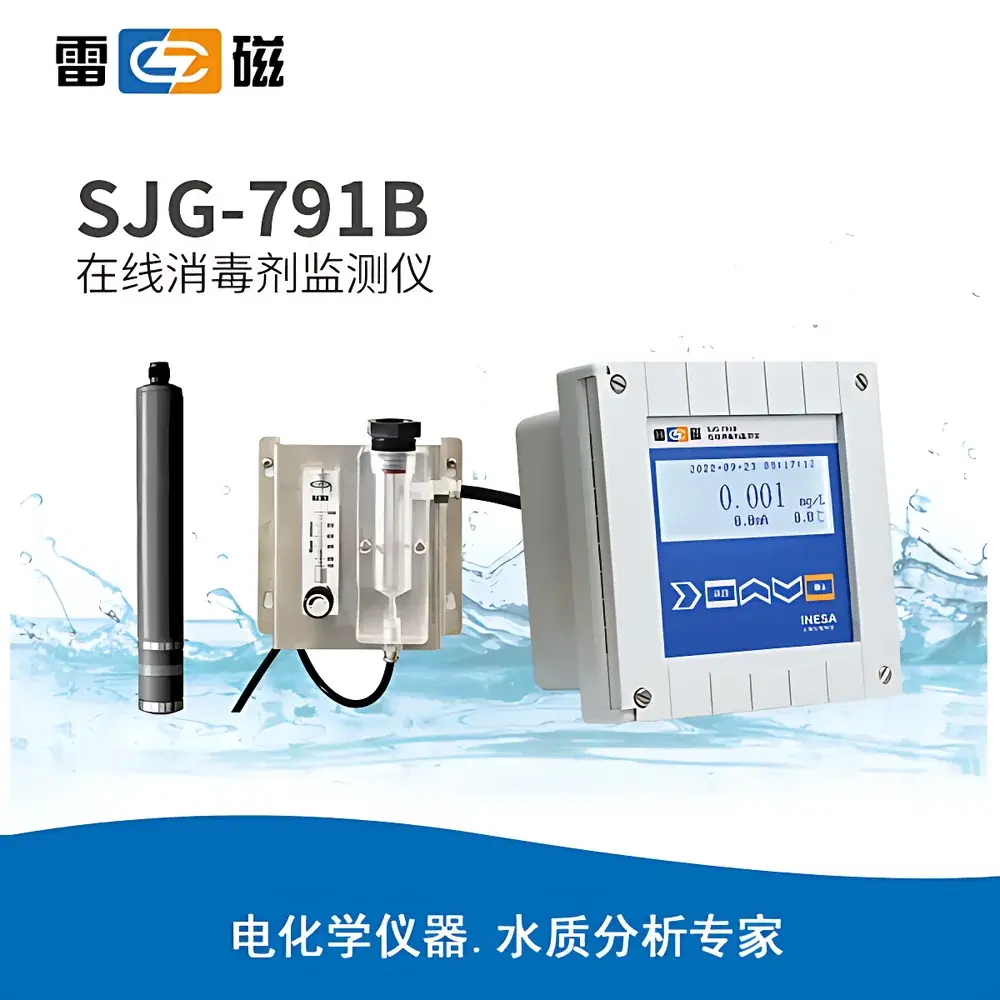
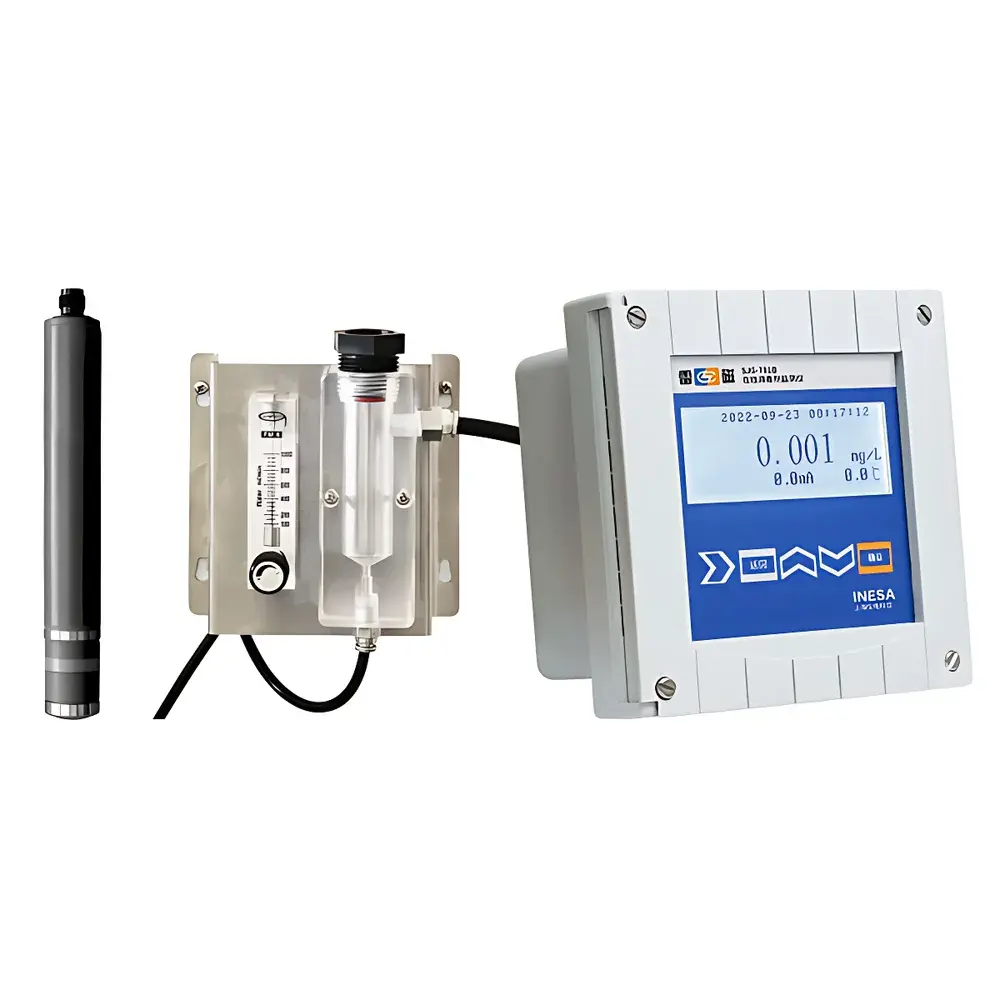
Leici SJG-791B Online Residual Chlorine and Chlorine Dioxide Analyzer
| Brand | Leici |
|---|---|
| Origin | Shanghai, China |
| Model | SJG-791B |
| Instrument Type | Online Analyzer |
| Measurement Principle | Electrochemical Amperometric Sensor Method |
| Measurable Parameters | Residual Chlorine / Total Chlorine / Chlorine Dioxide / Ozone (user-selectable single parameter) |
| Measurement Range | 0.005–2.000 mg/L (standard range) |
| Accuracy | ±1% FS (for residual chlorine with DCS4H-M0c electrode) |
| Resolution | 0.001 mg/L |
| Temperature Compensation | Automatic (5–40 °C sample range) |
| Output | Isolated 4–20 mA (600 Ω max load), RS-485 Modbus RTU |
| Enclosure Rating | IP65 |
| Power Supply | AC 220 V ±10%, 50 Hz |
| Installation | Wall-mounted analyzer + flow-through sensor |
Overview
The Leici SJG-791B Online Residual Chlorine and Chlorine Dioxide Analyzer is an industrial-grade electrochemical monitoring system engineered for continuous, real-time measurement of disinfectant residuals in potable water distribution networks, municipal drinking water treatment plants, secondary water supply tanks, wastewater disinfection processes, healthcare facility effluent streams, and recreational water systems including swimming pools. It operates on the amperometric principle—applying a fixed polarization voltage across a three-electrode (for chlorine species) or two-electrode (for ClO₂ and O₃) sensing cell to quantify the reduction current generated by electroactive disinfectants at the working electrode surface. This current is linearly proportional to analyte concentration within the calibrated range, enabling stable, low-drift quantification under variable hydraulic conditions. The instrument supports field-selectable configuration for one of four oxidants—free chlorine, total chlorine, chlorine dioxide, or ozone—ensuring operational flexibility without hardware replacement.
Key Features
- High-resolution digital display with intuitive membrane keypad interface for local configuration, calibration, and status monitoring
- Automatic temperature compensation (5–40 °C) using integrated Pt1000 thermistor in the flow cell, minimizing thermal drift in field deployments
- Dual operating modes: continuous real-time measurement or programmable interval sampling (1–3600 seconds), optimizing sensor longevity and power efficiency
- Non-volatile memory retention with power-loss recovery—retains calibration coefficients, alarm thresholds, and system settings during unexpected outages
- Configurable high/low limit alarms with hysteresis control to prevent relay chatter; relay output rated 2.5 A / 250 V AC (resistive load)
- IP65-rated enclosure suitable for indoor and semi-outdoor mounting environments, resistant to dust ingress and water splashes per IEC 60529
Sample Compatibility & Compliance
The SJG-791B is validated for use with clean-to-moderately-turbid aqueous matrices typical of treated drinking water, chlorinated wastewater effluents, and recirculated pool water. It requires a minimum sample flow rate of 0.3 L/min through its standard 5 m flow-through sensor assembly (DCS4H-M0c, DCP4H-M0c, DCD10.1H-M0c, or DOZ10.1H-M0c). Sensor compatibility follows standardized electrochemical interface protocols aligned with ASTM D1253 (chlorine), ISO 7393-2 (chlorine dioxide), and EN 15127-1 (ozone). While not certified for regulatory submission under US EPA or EU Drinking Water Directive Annexes, the analyzer meets functional requirements for routine process control and GLP-aligned operational monitoring when paired with documented calibration and maintenance procedures.
Software & Data Management
- Isolated 4–20 mA analog output with fully configurable zero/span mapping (e.g., 0.005 mg/L = 4 mA, 2.000 mg/L = 20 mA), supporting integration into SCADA, DCS, or PLC systems
- RS-485 serial interface compliant with Modbus RTU protocol (addressable up to 247 nodes), enabling remote polling of real-time values, alarm states, and diagnostic codes
- Onboard data logger stores up to 2000 timestamped records (date/time + measured value + temperature); storage interval programmable from 1 second to 1 hour
- Local data review via front-panel navigation; no proprietary software required for basic retrieval or export
- No FDA 21 CFR Part 11 compliance features (e.g., electronic signatures, audit trail)—intended for non-GMP industrial applications
Applications
The SJG-791B serves as a critical node in multi-point water quality assurance strategies. In municipal water utilities, it monitors residual chlorine decay across distribution grids to verify disinfectant persistence and detect stagnation zones. At hospital wastewater discharge points, it ensures chlorine dioxide dosing meets local environmental permits prior to release. In swimming pool management, it maintains oxidative potential within WHO-recommended bounds (0.2–1.0 mg/L free chlorine) while preventing over-chlorination that generates harmful disinfection by-products (DBPs). Its modular sensor architecture also supports pilot-scale validation of alternative disinfectants such as ozone in tertiary treatment trains—providing trace-level stability essential for oxidation-reduction potential (ORP) correlation studies.
FAQ
What oxidants can the SJG-791B measure simultaneously?
It measures only one disinfectant at a time—free chlorine, total chlorine, chlorine dioxide, or ozone—selected during initial setup. Sensor swapping is required to change analytes.
Is the instrument compatible with existing SCADA infrastructure?
Yes, via isolated 4–20 mA output (configurable scaling) and RS-485 Modbus RTU, enabling direct integration without gateway hardware.
What is the recommended calibration frequency?
Daily verification with NIST-traceable standard solutions is advised for critical applications; weekly full calibration is typical for stable process environments.
Can the sensor be installed in pressurized pipelines?
No—the flow-through sensor requires gravity-fed or low-pressure (<0.1 MPa) bypass stream installation with laminar flow conditioning; inline tee fittings are not supported.
Does the analyzer support automatic pH compensation?
No—pH correction is not implemented. Users must ensure sample pH remains within 6.0–8.0 for accurate free chlorine measurement, per electrochemical response characteristics.







