
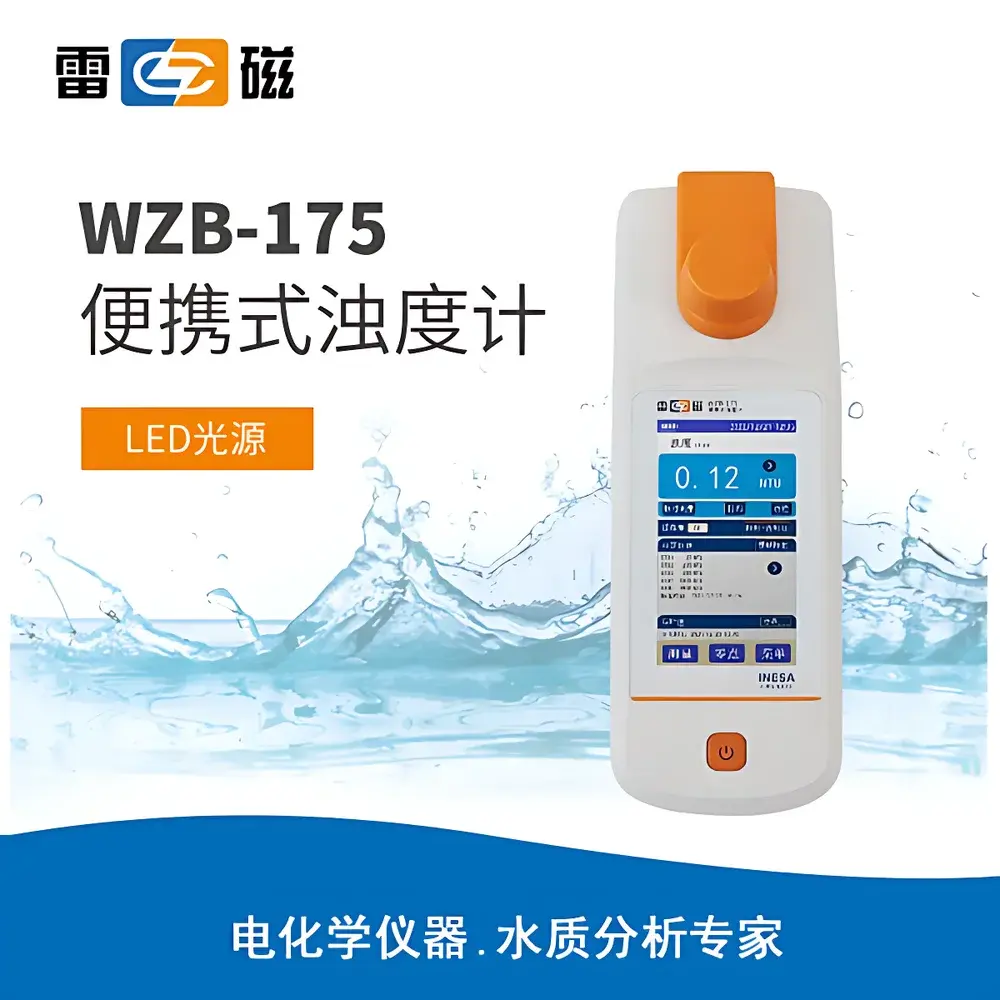
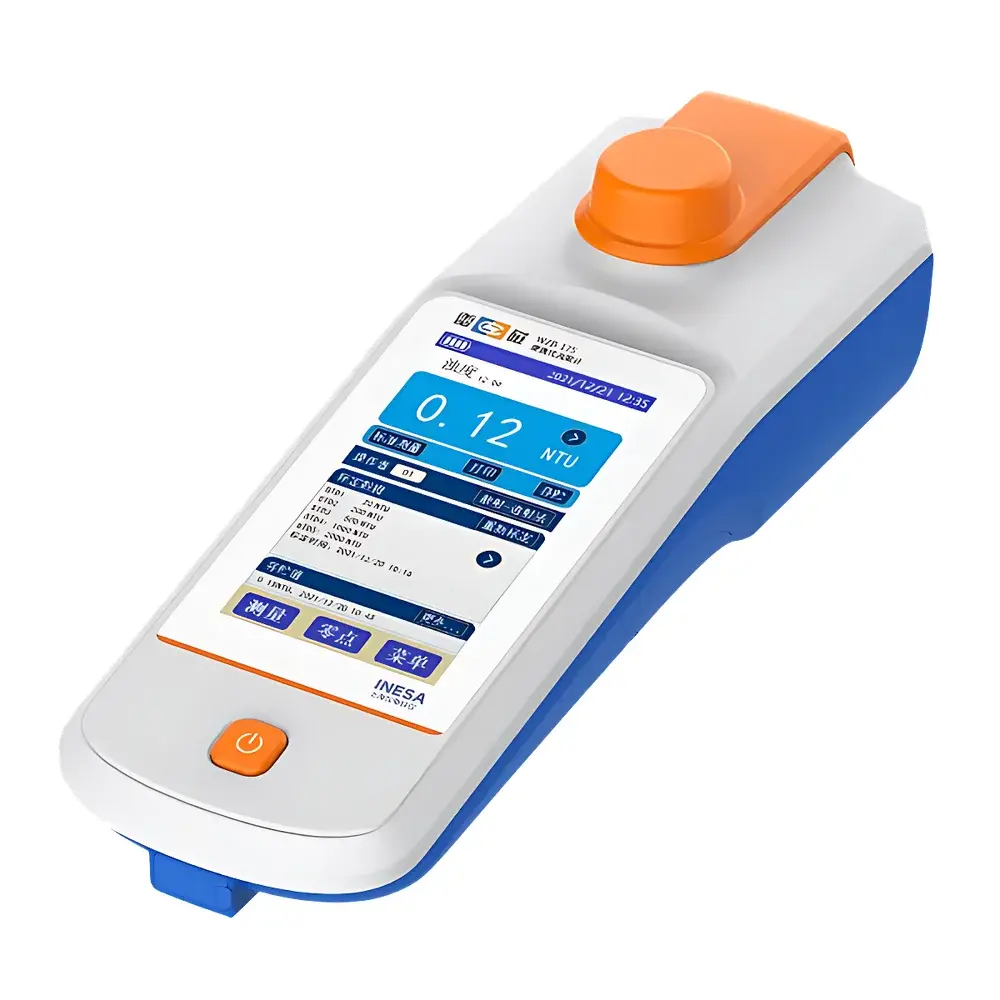
Leici WZB-175 Portable Turbidimeter
| Brand | Leici |
|---|---|
| Origin | Shanghai, China |
| Model | WZB-175 |
| Type | Portable |
| Measurement Range | 0–2000 NTU (auto-ranging across four sub-ranges) |
| Resolution | 0.01/0.1/1 NTU (auto-adjusted by range) |
| Accuracy | ±6% FS |
| Repeatability | ≤0.5% |
| Zero Drift | ±0.5% FS / 30 min |
| Stability | ±0.5% FS / 30 min |
| Light Source | 860 nm infrared LED |
| Compliance | ISO 7027, HJ 1075-2019 |
| Display | 4.3-inch color TFT touch screen |
| Data Storage | 2000 measurements with timestamp, sample ID, and calibration log |
| Protection Rating | IP65 |
| Operating Temperature | 5–40 °C |
| Relative Humidity | ≤85% RH (non-condensing) |
| Power | Rechargeable Li-ion battery (USB-C charging support), AC adapter input: 100–240 VAC, output: 5 VDC / 2 A |
| Dimensions & Weight | 90 × 250 × 90 mm, ~0.8 kg |
Overview
The Leici WZB-175 Portable Turbidimeter is an ISO 7027-compliant optical instrument engineered for field-deployable, high-reliability turbidity measurement in water quality monitoring applications. It employs a stable 860 nm infrared LED light source to minimize color interference and ensure compliance with the nephelometric principle defined in ISO 7027 and China’s environmental standard HJ 1075–2019. The instrument operates on dual optical detection modes—nephelometric (90° scattered light) and ratio-mode (scattered + transmitted light)—enabling robust performance across diverse sample matrices, including surface water, wastewater effluent, drinking water distribution systems, and process streams in municipal and industrial settings. Its compact, ruggedized chassis and IP65-rated enclosure allow operation in humid, dusty, or intermittently wet environments without compromising optical integrity or electronic stability.
Key Features
- Infrared 860 nm LED light source with thermal stabilization for long-term photometric consistency and reduced spectral interference from sample coloration
- Dual measurement modes: Standard 90° scattering (NTU/FNU) and ratio-mode (scattering + transmission) for improved accuracy in highly absorbing or heterogeneous suspensions
- Auto-ranging capability across four dynamic ranges: 0.00–9.99 NTU, 10.0–99.9 NTU, 100–999 NTU, and 1000–2000 NTU—with automatic resolution switching (0.01 / 0.1 / 1 NTU)
- 4.3-inch capacitive color TFT touchscreen interface with intuitive icon-driven navigation, multi-language support (English, Chinese), and real-time graphical trend display
- GLP-compliant data management: Each stored record includes timestamp, operator ID (optional), calibration status, measurement mode, and unit selection (NTU, FNU, or EBC)
- Integrated zero-point correction and up to six-point calibration (2, 20, 200, 500, 1000, 2000 NTU) using traceable Formazin or StablCal™ reference standards
- IP65 ingress protection, shock-absorbing rubberized housing, and integrated carry case with molded foam for transport and storage
- Rechargeable lithium-ion battery supporting ≥12 hours of continuous operation; USB-C port enables direct charging from power banks or PCs
Sample Compatibility & Compliance
The WZB-175 is validated for use with standard 25-mm round glass cuvettes (included) and compatible with ASTM D6508, ISO 7027, US EPA Method 180.1, and HJ 1075–2019. It accommodates samples with moderate particulate loadings, low-to-moderate absorbance, and non-aggregating suspended solids. For high-turbidity or viscous samples, users may apply dilution protocols per ISO 7027 Annex B. The instrument meets electromagnetic compatibility (EMC) requirements per IEC 61326-1 and is designed for routine use under GLP and ISO/IEC 17025-aligned laboratory practices. Calibration traceability is maintained through documented use of NIST-traceable or certified secondary standards.
Software & Data Management
Data export and instrument configuration are supported via Micro-USB connection using Leici’s proprietary PC communication software (Windows-compatible). Export formats include CSV and XML, preserving full metadata—including calibration history, operator annotations, and audit trail timestamps. The internal memory retains 2000 measurement records with cyclic overwrite protection. All data entries comply with basic GLP requirements: immutable timestamps, user-defined sample IDs, and automatic logging of calibration events. While the device does not implement FDA 21 CFR Part 11 electronic signature functionality, its audit-ready data structure supports manual verification workflows required for regulatory reporting and internal QA/QC documentation.
Applications
- Field verification of drinking water treatment plant effluent turbidity prior to distribution
- Monitoring sediment discharge at construction site stormwater outfalls (per NPDES permit requirements)
- Performance evaluation of membrane filtration units and coagulation-flocculation processes
- Environmental monitoring of rivers, lakes, and reservoirs during algal bloom events or post-storm runoff
- Validation of point-of-use filter cartridges in commercial and residential settings
- Educational use in environmental science laboratories for method validation and student training in optical metrology principles
FAQ
What turbidity units does the WZB-175 support?
The instrument displays results in NTU (Nephelometric Turbidity Units), FNU (Formazin Nephelometric Units), and EBC (European Brewery Convention) units, with automatic conversion based on selected calibration standard and measurement mode.
Is the WZB-175 suitable for wastewater with high organic content?
Yes—when operated in ratio mode (scattering + transmission), it mitigates errors caused by sample color and absorption, improving reliability for wastewater and digested sludge supernatants within the 0–2000 NTU range.
How often should zero and span calibration be performed?
Zero calibration is recommended before each measurement session; multi-point calibration is advised daily for critical applications or after instrument transport or temperature shifts exceeding 5 °C.
Does the instrument support external printer connectivity?
Yes—it features an RS-232 serial interface compatible with industry-standard thermal printers for immediate hardcopy output of measurement reports and calibration certificates.
Can measurement data be exported to LIMS systems?
Direct LIMS integration is not embedded; however, exported CSV files contain structured fields (e.g., “Timestamp”, “NTU_Value”, “Calibration_Status”) enabling scripted ingestion into most LIMS platforms via middleware or manual upload.



