
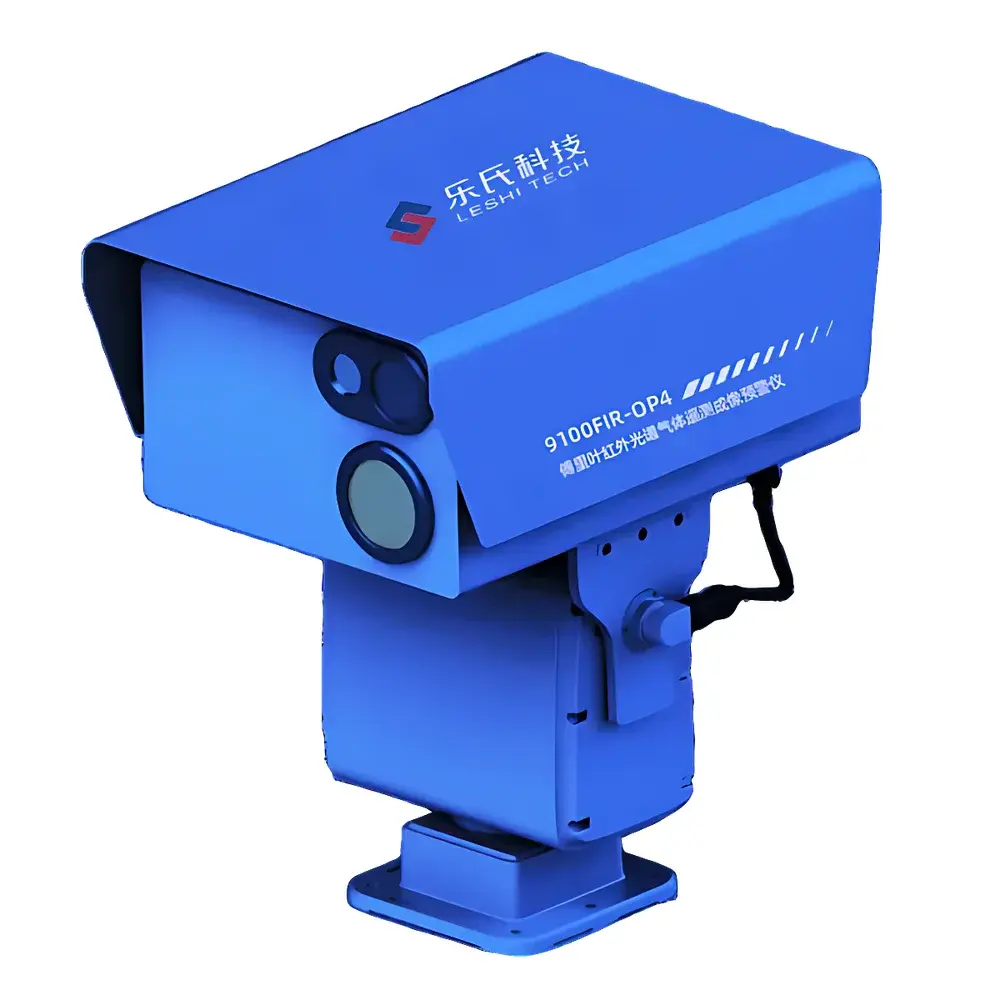
LESHI 9100FIR-OP4 Passive Fourier Transform Infrared (FTIR) Open-Path Gas Imaging and Early-Warning System
| Brand | LESHI |
|---|---|
| Origin | Beijing, China |
| Manufacturer Type | Authorized Distributor |
| Origin Category | Domestic (China-made) |
| Model | 9100FIR_OP4 |
| Pricing | Upon Request |
| Detection Range | ≥5 km |
| Spectral Resolution | High (FTIR-based) |
| Thermal Sensitivity | ≤25 mK |
| Gas Detection Sensitivity | ppm-level |
| Supported Gases | >500 toxic, flammable, explosive, and chemical warfare agents |
| Operating Modes | Fixed-point, 360° panoramic, user-defined ROI scanning |
| Deployment Platforms | Fixed-station, vehicle-mounted, airborne, marine-mounted |
| Detector Type | Military-grade HgCdTe (MCT) focal plane array |
Overview
The LESHI 9100FIR-OP4 is a passive, open-path Fourier Transform Infrared (FTIR) gas imaging and early-warning system engineered for wide-area, real-time detection and chemical mapping of hazardous gaseous plumes. Unlike active laser-based or point-sampling analyzers, the 9100FIR-OP4 operates on the principle of passive remote sensing—capturing naturally emitted or thermally contrasted infrared radiation from gas clouds against ambient background radiance. By acquiring interferometric spectral data across the mid-infrared (MIR) region (typically 2–14 µm), the system performs high-resolution spectral analysis to identify molecular absorption signatures unique to each compound. This enables simultaneous qualitative identification and quantitative concentration retrieval—without physical contact or sample extraction—making it ideal for perimeter surveillance, fugitive emission monitoring, and emergency response scenarios where rapid, non-intrusive assessment is critical.
Key Features
- Passive FTIR architecture eliminates need for external illumination sources, ensuring covert, low-power, and全天候 (24/7) operational capability under daylight and nighttime conditions.
- High thermal sensitivity (≤25 mK) enabled by a cooled, military-grade HgCdTe (MCT) focal plane array detector, delivering robust signal-to-noise performance in low-contrast thermal environments.
- Real-time spectral imaging with spatial resolution supporting plume localization, directional tracking, and dynamic concentration mapping at distances up to 5 km.
- Multi-mode scanning functionality—including fixed-point stare, 360° azimuthal sweep, and user-defined region-of-interest (ROI) scanning—enables adaptive deployment across heterogeneous terrain and infrastructure layouts.
- Lightweight, modular mechanical design facilitates rapid field deployment on tripods, vehicles, UAVs, maritime vessels, or permanent monitoring stations without structural reinforcement.
- Embedded spectral library containing >500 reference spectra for industrial VOCs, toxic industrial chemicals (TICs), chemical warfare agents (CWAs), greenhouse gases, and combustion byproducts—validated against NIST and ASTM E2877 spectral databases.
- Intuitive graphical user interface (GUI) with drag-and-drop ROI definition, real-time false-color gas overlay, time-lapse plume evolution playback, and configurable alarm thresholds based on concentration, area coverage, or rate of change.
Sample Compatibility & Compliance
The 9100FIR-OP4 does not require physical sampling or calibration gases during routine operation. It detects gaseous species via their intrinsic IR absorption features, rendering it inherently compatible with volatile organic compounds (VOCs), inorganic acids (e.g., HF, HCl, NH₃), hydrocarbons (e.g., CH₄, C₂H₄, C₃H₈), sulfur compounds (e.g., SO₂, H₂S), nitrogen oxides (NOₓ), and organophosphorus nerve agents (e.g., sarin, VX). The system supports compliance workflows aligned with ISO 14001 environmental management systems, EPA Method 320 for open-path optical sensing, and EU Directive 2010/75/EU (IED) requirements for continuous emissions monitoring. Data acquisition and storage adhere to principles of ALCOA+ (Attributable, Legible, Contemporaneous, Original, Accurate, Complete, Consistent, Enduring, Available), enabling traceability for regulatory reporting and incident investigation.
Software & Data Management
The integrated control and analysis software provides full spectral processing pipeline: interferogram apodization, Fourier transformation, radiometric calibration, atmospheric correction (using MODTRAN-based modeling), spectral unmixing (via constrained least-squares or MCR-ALS algorithms), and concentration path-length inversion. All raw interferograms, calibrated spectra, gas maps, and metadata are stored in HDF5 format with embedded timestamps, GPS coordinates (when GNSS-enabled), and instrument configuration logs. Audit trails record user actions, parameter changes, and alarm events—supporting GLP/GMP-aligned documentation practices. Export options include CSV, GeoTIFF, KML, and PDF reports compliant with internal QA/QC protocols and third-party review requirements.
Applications
- Continuous perimeter monitoring of petrochemical refineries, LNG terminals, and chemical manufacturing facilities for leak detection and dispersion modeling.
- Emergency response coordination during industrial accidents, transportation spills, or terrorist incidents involving hazardous materials.
- Urban air quality surveillance—tracking fugitive emissions near wastewater treatment plants, landfills, and highway corridors.
- Regulatory compliance verification for fugitive VOC emissions under EPA LDAR programs and EU Industrial Emissions Directive (IED).
- Military CBRN defense: standoff detection of battlefield chemical threats and post-event forensic attribution.
- Scientific research in atmospheric chemistry, including flux measurements and boundary-layer transport studies.
FAQ
What types of gases can the 9100FIR-OP4 detect?
It identifies over 500 gases—including toxic industrial chemicals (e.g., Cl₂, PH₃), flammables (e.g., CH₄, C₂H₂), corrosives (e.g., HF, SO₂), and chemical warfare agents—based on their fundamental vibrational absorption bands in the mid-IR spectrum.
Does the system require calibration gases or consumables?
No. As a passive remote sensor, it relies on inherent atmospheric radiance and reference blackbody calibration; no gas cylinders, filters, or reagents are needed for standard operation.
How is data validated for regulatory reporting?
Spectral data undergoes atmospheric correction and quantification using traceable reference libraries; full audit logs, timestamped metadata, and HDF5 archival ensure defensibility in compliance audits.
Can the system operate in adverse weather conditions?
Performance may be attenuated under heavy fog, rain, or snow due to MIR scattering; however, the system includes real-time atmospheric transmission estimation to flag low-confidence measurements.
Is the software compatible with existing SCADA or EMS platforms?
Yes—via Modbus TCP, OPC UA, or RESTful API interfaces, enabling integration into centralized environmental management systems and industrial control networks.
Related Products







