
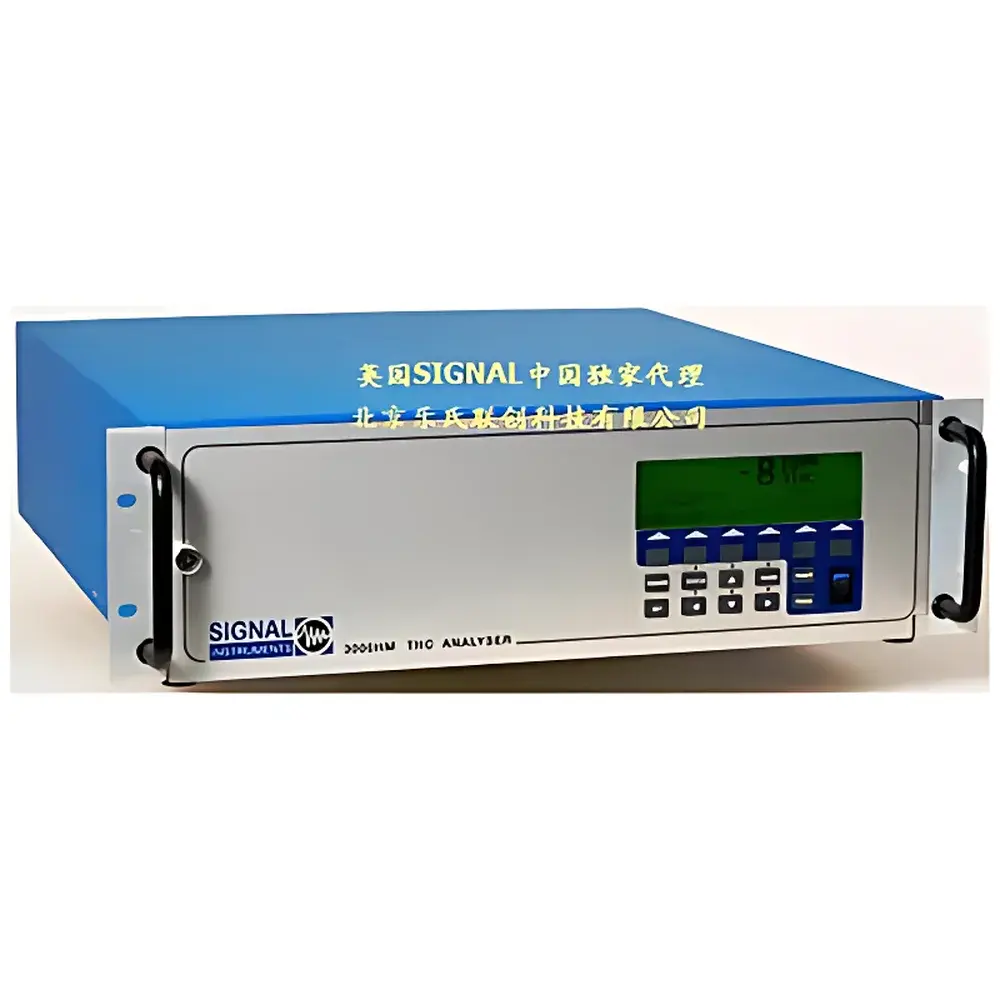
SIGNAL Model 3000HM Heated Flame Ionization Detector (HFID) Total Hydrocarbon Analyzer
| Brand | SIGNAL |
|---|---|
| Origin | United Kingdom |
| Model | 3000HM |
| Detection Principle | Heated Flame Ionization Detection (HFID) |
| Instrument Type | Online Continuous Emission Monitoring System (CEMS) |
| Measurement Range | 0–4 / 10 / 40 / 100 / 400 / 1,000 / 4,000 / 10,000 ppm (auto-ranging) |
| Resolution | ±1% of full scale or ±0.2 ppm (whichever is greater) |
| Accuracy | ±1% of full scale or ±0.2 ppm (whichever is greater) |
| Response Time | T90 < 1.5 s |
Overview
The SIGNAL Model 3000HM is a heated flame ionization detector (HFID)-based online total hydrocarbon (THC) analyzer engineered for continuous, high-fidelity measurement of volatile organic compounds (VOCs), non-methane hydrocarbons (NMHC), total organic carbon (TOC), and combustion-related hydrocarbon emissions. Operating on the well-established principle of catalytic combustion followed by ionization in a hydrogen-air flame at elevated temperatures (typically >180 °C), the 3000HM maintains the entire sample path—including sampling line, filter, flow controller, and detector chamber—at a thermally stabilized temperature. This design prevents condensation of higher-molecular-weight hydrocarbons (e.g., C₈–C₁₂ aliphatics, aromatics, esters, ketones, alcohols, and fatty acids), thereby eliminating adsorption losses and ensuring quantitative recovery across complex industrial gas matrices. Its fast T90 response (<1.5 s) enables real-time process feedback, alarm triggering, and dynamic emission compliance tracking—critical for regulatory reporting under EU IED (Industrial Emissions Directive), U.S. EPA Method 25A, and ISO 11843-2.
Key Features
- Heated sample train (180–200 °C) with integrated thermal management to prevent condensate formation and ensure representative sampling of semi-volatile organics
- Dual-stage air purification system: built-in catalytic scrubber for FID combustion air + zero-air generator for low-range stability and baseline integrity
- Auto-ranging detection capability spanning eight decades (0–4 ppm to 0–10,000 ppm; optional 0–10% v/v), configurable via front-panel interface or remote command
- Fuel flexibility: supports H₂/He carrier mix for variable O₂ environments; H₂-only operation permitted when ambient O₂ concentration is stable and known
- MCERTS-certified architecture compliant with UK Environment Agency requirements for CEMS validation and long-term reliability
- Embedded diagnostics dashboard with real-time status indicators for flame health, detector voltage, flow stability, and temperature uniformity
- Remote control interface via RS-232/485 and Modbus RTU protocols; compatible with DCS, SCADA, and PLC-based plant automation systems
Sample Compatibility & Compliance
The 3000HM demonstrates robust performance across diverse sample streams including flue gases from thermal oxidizers, solvent recovery units, paint spray booths, chemical reactors, and biogas upgrading facilities. It exhibits strong linear correlation (R² > 0.999) with reference standards for aliphatic, aromatic, oxygenated, and chlorinated VOCs—including toluene, xylene, ethyl acetate, acetone, ethanol, and methyl ethyl ketone—without requiring compound-specific calibration. The analyzer meets MCERTS Performance Standards for THC analyzers (PS 22), satisfies EN 15267-3 type approval criteria for automated monitoring systems, and supports audit-ready data integrity through secure time-stamped logging. Optional methane-selective configuration enables NMHC calculation per EN 12619 and EPA Method 25A, with dual-channel analog outputs (CH₄ and NMHC) available upon request.
Software & Data Management
The 3000HM integrates seamlessly with SIGNAL’s SIGEMS software suite—a Windows-based platform designed for environmental compliance reporting and CEMS data governance. SIGEMS provides automated calibration scheduling, drift correction logs, alarm event tagging, and PDF/CSV export conforming to ISO 14001 and ISO 50001 documentation requirements. All raw and processed data are stored with full audit trail functionality, including user action timestamps, parameter change history, and instrument fault codes—fully aligned with FDA 21 CFR Part 11 electronic record controls when deployed in regulated manufacturing environments. Data transmission supports TLS-secured MQTT and OPC UA protocols for enterprise-level integration into cloud-based environmental dashboards.
Applications
- Continuous emission monitoring (CEM) of THC/NMHC from industrial combustion sources (boilers, incinerators, kilns)
- Real-time solvent vapor monitoring in coating, printing, and adhesive application processes
- Leak detection and repair (LDAR) program support with rapid response to fugitive emissions
- Performance verification of thermal/catalytic oxidizers and carbon adsorption systems
- Biogas quality assurance and landfill gas composition trending
- Research-grade hydrocarbon quantification in engine exhaust and atmospheric simulation chambers
FAQ
What sample temperature range is supported without external conditioning?
The 3000HM accommodates inlet gas temperatures up to 200 °C; no external heating or dilution is required for hot/wet stack sampling.
Can the 3000HM differentiate between methane and non-methane hydrocarbons?
Yes—when equipped with the optional methane catalytic converter and dual-detector configuration, it delivers simultaneous CH₄ and NMHC outputs per EN 12619 Annex B.
Is the analyzer suitable for high-humidity or corrosive gas streams?
Its heated stainless-steel flow path and inert ceramic detector components provide resistance to moisture-induced quenching and moderate acid gas exposure (e.g., SO₂ ≤ 100 ppm, NOₓ ≤ 500 ppm).
How frequently does the system require calibration verification?
Per MCERTS PS 22, daily zero/span checks are recommended; full multi-point calibration is advised every 7–14 days depending on application severity and regulatory jurisdiction.
Does the 3000HM support GLP/GMP-compliant data handling?
With SIGEMS and enabled audit trail features, it satisfies ALCOA+ principles (Attributable, Legible, Contemporaneous, Original, Accurate, Complete, Consistent, Enduring, Available) for regulated laboratory and production environments.
Related Products







