
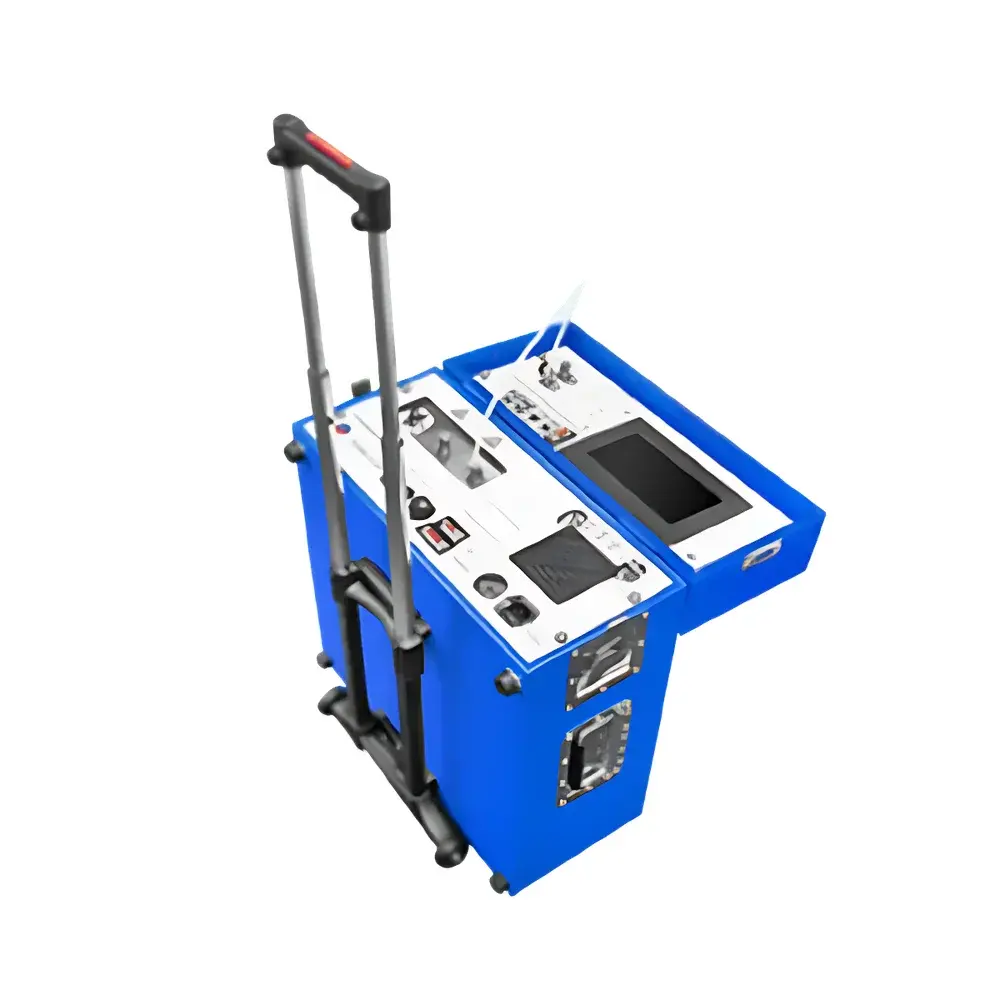
LESHI 9100FIRair-G Portable High-Precision Greenhouse Gas Analyzer
| Brand | Leshi |
|---|---|
| Origin | Beijing, China |
| Manufacturer Type | Authorized Distributor |
| Country of Origin | China |
| Model | 9100FIRair-G |
| Technology Principle | Fourier Transform Infrared (FTIR) Spectroscopy |
| Detection Principle | Mid-Infrared Absorption Spectroscopy |
| Accuracy | ≤ ±2% FS |
| Repeatability | ≤ 2% RSD |
| Measured Gases | N₂O, CH₄, CO₂, SF₆, NF₃, CFCs (Chlorofluorocarbons), PFCs (Perfluorocarbons) |
| Simultaneous Quantification Capacity | Up to 50 compounds |
| Spectral Range | 485–8500 cm⁻¹ |
| Spectral Resolution | 1 cm⁻¹ (standard), optional higher/lower resolutions available |
| Sample Cell Volume | 300 mL |
| Detector | DTGS (Deuterated Triglycine Sulfate), room-temperature operation, >10-year lifetime |
| Reference Source | Solid-State VSECL Laser, >10-year lifetime |
| Quantitative Spectral Library | ≥400 compounds (freely accessible and user-expandable) |
| Qualitative Spectral Library | 5874 compounds |
| Software Features | Auto-ranging mode, user-defined calibration file creation, spectral library import/export, GLP-compliant data logging |
Overview
The LESHI 9100FIRair-G Portable High-Precision Greenhouse Gas Analyzer is a field-deployable FTIR-based gas measurement system engineered for quantitative and qualitative analysis of multiple infrared-active greenhouse gases in ambient air and industrial effluent streams. Operating on the principle of Fourier Transform Infrared Spectroscopy, the instrument acquires full mid-infrared absorbance spectra (485–8500 cm⁻¹) with 1 cm⁻¹ resolution, enabling untargeted screening and simultaneous multi-component quantification without prior chromatographic separation. Its optical architecture employs a Michelson interferometer coupled with a thermoelectrically stabilized DTGS detector and a long-lifetime solid-state VSECL reference laser—eliminating the need for cryogenic cooling or frequent source replacement. Designed for regulatory-grade environmental monitoring, the 9100FIRair-G delivers trace-level sensitivity and high spectral fidelity under variable field conditions, supporting compliance-driven workflows across atmospheric research, emissions verification, and process optimization.
Key Features
- Full-spectrum FTIR acquisition (485–8500 cm⁻¹) enables detection of all IR-absorbing species—including non-targeted compounds—within a single scan.
- 1 cm⁻¹ nominal spectral resolution ensures robust peak discrimination for overlapping bands (e.g., CH₄ at 3017 cm⁻¹ and N₂O at 2224 cm⁻¹), critical for accurate multicomponent deconvolution.
- Compact 300 mL multipass gas cell reduces sample volume requirements and accelerates gas exchange (<60 s for full purge at 1 L/min flow), minimizing analysis cycle time during mobile surveys.
- Simultaneous quantification of up to 50 gas components per spectrum, supported by built-in chemometric algorithms (PLS, MCR-ALS) and real-time baseline correction.
- Freely accessible quantitative spectral library covering ≥400 compounds—including all major GHGs (CO₂, CH₄, N₂O, SF₆), halocarbons (CFC-11, CFC-12, HCFC-22), and fluorinated alternatives (NF₃, CF₄, C₂F₆)—with user-editable calibration parameters.
- Comprehensive qualitative library of 5874 reference spectra facilitates rapid identification of unknown emissions using correlation-based search and spectral matching (dot-product, Euclidean distance).
- Room-temperature DTGS detector and solid-state VSECL laser ensure operational stability across −10 °C to +45 °C ambient ranges, with >10-year service life and no consumables.
Sample Compatibility & Compliance
The 9100FIRair-G accepts gaseous samples directly via standard 6 mm OD PTFE tubing or integrated sampling probe. It accommodates dry or humidified air (up to 95% RH, non-condensing), stack gases (diluted to <10% H₂O v/v), and ambient air without pre-concentration or chemical scrubbing. All measurements adhere to ISO 14064-3 verification protocols for GHG inventories and align with EPA Method TO-16 spectral validation criteria. The system supports audit-ready data integrity through timestamped spectral acquisition, detector temperature logs, and interferogram quality flags. Firmware complies with IEC 61508 SIL 2 functional safety principles for field instrumentation and includes configurable lockout mechanisms for GLP/GMP environments.
Software & Data Management
The embedded LESHI SpectraView™ software provides a Windows-compatible interface with dual operating modes: field acquisition (real-time spectrum display, auto-ranging concentration plots, alarm thresholds) and lab-based post-processing (peak integration, spectral subtraction, multivariate calibration). Raw interferograms and processed absorbance spectra are stored in HDF5 format with embedded metadata (instrument ID, GPS coordinates, operator tag, calibration version). Audit trails record all parameter modifications, library updates, and report exports—fully compliant with FDA 21 CFR Part 11 requirements when deployed with optional digital signature module. Users may generate ISO/IEC 17025-compliant certificates of analysis, including uncertainty budgets derived from repeatability studies and calibration curve residuals.
Applications
- Atmospheric Monitoring: Mobile mapping of urban GHG plumes, background station profiling, and boundary layer flux estimation using eddy covariance-integrated sampling.
- Industrial Emissions Verification: Real-time stack monitoring at cement kilns, semiconductor fabrication facilities, and refrigerant reclamation plants—supporting EU ETS MRV and California AB 32 reporting.
- Energy Infrastructure Assessment: Fugitive methane detection along pipeline corridors, LNG terminal vent stacks, and offshore platform flare characterization.
- Agricultural Emission Studies: Chamber-based quantification of enteric fermentation and manure management emissions under controlled environmental conditions.
- Research & Method Development: Validation of satellite-derived GHG column concentrations (e.g., TROPOMI, OCO-2), intercomparison with CRDS and GC-MS platforms, and spectral library expansion for emerging fluorinated compounds.
FAQ
What spectral resolution options are available beyond the standard 1 cm⁻¹ setting?
Optional configurations support 0.5 cm⁻¹ (enhanced speciation) and 4 cm⁻¹ (high-speed survey mode), both factory-calibrated and software-selectable.
Can the instrument perform real-time background subtraction during continuous monitoring?
Yes—dynamic background referencing is enabled via dual-beam interleaved scanning or user-defined reference spectra acquired before deployment.
Is the quantitative spectral library compatible with third-party chemometric software?
All library files are distributed in JCAMP-DX format and fully interoperable with GRAMS/AI, OPUS, and MATLAB-based PLS toolkits.
How is calibration traceability maintained across field deployments?
Each unit ships with NIST-traceable gas standards (CO₂/N₂, CH₄/N₂, SF₆/N₂) and a certificate of spectral alignment verified against SRM 1921b.
Does the system meet explosion-proof requirements for hazardous area use?
The base model is rated for Class I, Division 2 environments; ATEX/IECEx-certified variants (9100FIRair-G-Ex) are available upon request.







