
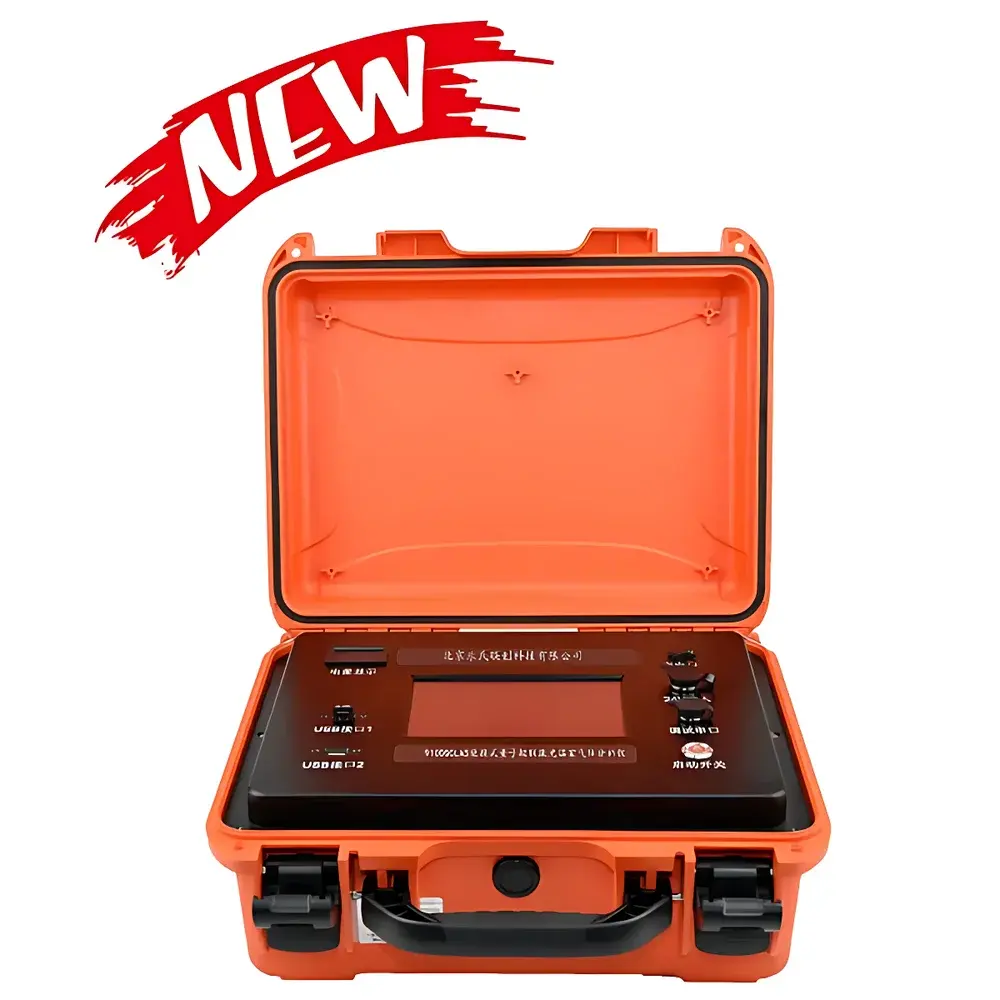
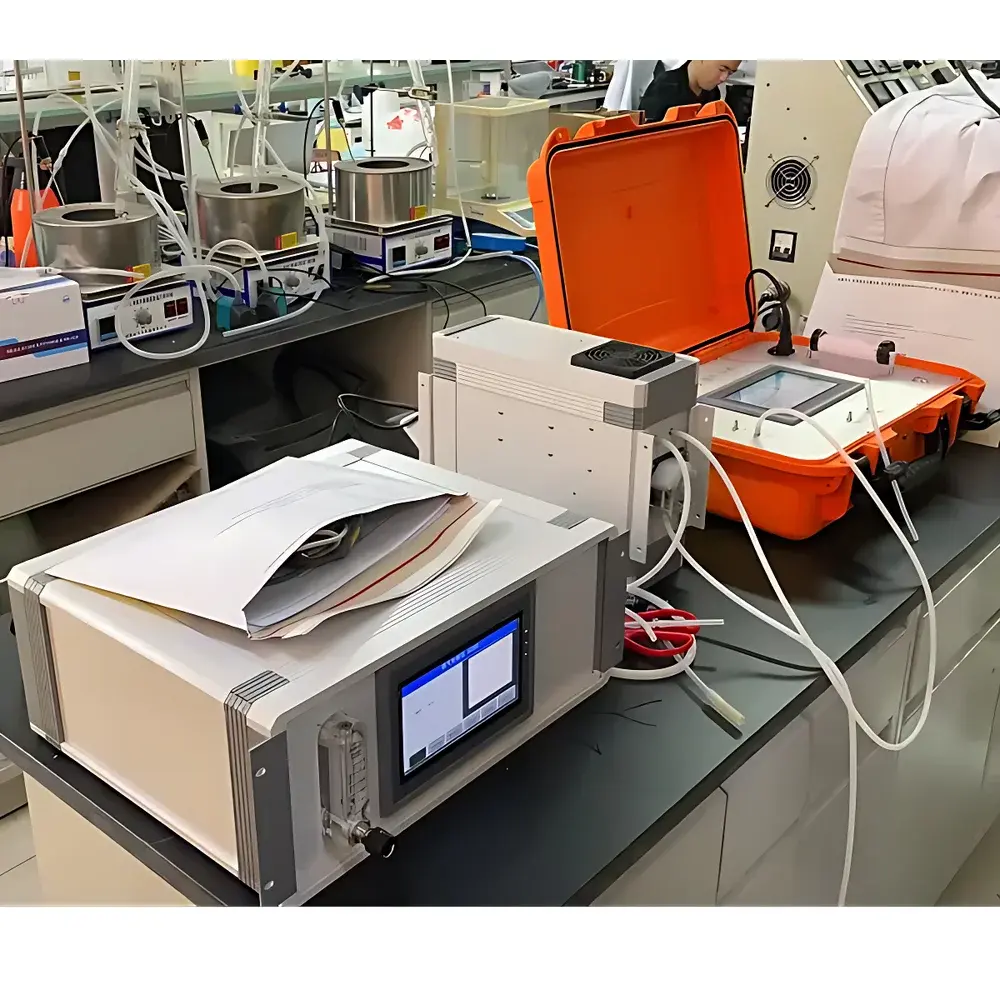
LESHI 9100QCLAS Quantum Cascade Laser Absorption Spectrometer for Multi-Gas Greenhouse Gas Monitoring
| Brand | Leshi |
|---|---|
| Origin | Beijing, China |
| Manufacturer Type | Authorized Distributor |
| Country of Origin | China |
| Model | 9100QCLAS |
| Detection Gases & Ranges | CO₂ (0–10,000 ppm), CH₄ (0–100 ppm), N₂O (0–10 ppm), H₂O (0–30,000 ppm) |
| Detection Limits | CO₂ ≤ 0.1 ppm, CH₄ ≤ 2 ppb, N₂O ≤ 0.1 ppb |
| Measurement Principle | Tunable Quantum Cascade Laser Absorption Spectroscopy (QCLAS) with Fabry–Pérot Interferometer Reference and Dual-Path Calibration |
| Power Supply | Internal Rechargeable Li-ion Battery (≥8 h continuous operation) or 12–24 V DC |
| Display | 7-inch HD capacitive touchscreen with real-time spectral visualization |
| Data Output | USB, RS-232, Ethernet, optional 4G/LTE module |
| Compliance | Designed to support ISO 14064-2, EPA Method TO-15/TO-11A alignment, and GLP-compliant data logging per FDA 21 CFR Part 11 audit trail requirements |
Overview
The LESHI 9100QCLAS Quantum Cascade Laser Absorption Spectrometer is an engineered solution for high-fidelity, multi-component greenhouse gas (GHG) monitoring in both field-deployed and semi-permanent environmental monitoring applications. At its core, the instrument implements tunable quantum cascade laser absorption spectroscopy (QCLAS)—a physics-based, first-principles measurement technique that exploits the unique mid-infrared (MIR) vibrational-rotational absorption signatures of target molecules. Unlike broadband NDIR or electrochemical sensors, QCLAS delivers species-specific quantification by scanning a narrow-linewidth (<0.001 cm⁻¹), current-tuned quantum cascade laser across precisely defined rovibrational transitions of CO₂ (2307 cm⁻¹), CH₄ (1305 cm⁻¹), N₂O (2200 cm⁻¹), and H₂O (1390 cm⁻¹). The optical path integrates a dual-beam configuration: one beam traverses the sample cell under controlled pressure and temperature, while the second references a sealed calibration cell containing trace-certified gas standards. Real-time compensation is enabled via a built-in Fabry–Pérot interferometer, which monitors laser wavelength drift and thermal drift—ensuring long-term baseline stability without manual recalibration.
Key Features
- Multi-gas simultaneous detection: Quantifies CO₂, CH₄, N₂O, and H₂O in a single optical pass with independent spectral fitting algorithms.
- Sub-ppb detection sensitivity: Achieves ≤0.1 ppb N₂O, ≤2 ppb CH₄, and ≤0.1 ppm CO₂ detection limits under standard operating conditions (1-s integration, 100 mPa pressure control).
- Integrated active humidity management: Combines Peltier-cooled condensation trap (−10 °C dew point) with programmable peristaltic drain pump to suppress H₂O spectral interference and prevent optical window fogging.
- Field-hardened architecture: All-aluminum monocoque chassis, IP54-rated enclosure, shock-absorbing internal mounts, and extended temperature operation (−10 °C to +45 °C).
- Self-contained power system: Rechargeable lithium-ion battery pack supports ≥8 hours of continuous sampling at 1 Hz, with hot-swappable capability and state-of-charge telemetry.
- Open-system modularity: Standardized M12 and SMA interfaces allow plug-and-play integration of external meteorological sensors (T/P/RH), flow controllers, or particulate filters.
Sample Compatibility & Compliance
The 9100QCLAS accepts ambient air, stack effluent (diluted to ≤10% H₂O v/v), and soil flux chamber headspace samples via standardized 6 mm OD PTFE tubing. Sample inlet pressure is actively regulated between 70–105 kPa using a closed-loop solenoid valve system; temperature is stabilized at 40 °C ±0.2 °C to minimize condensation and adsorption artifacts. The analyzer meets ISO 14064-2 technical requirements for GHG inventory verification and aligns with EPA’s recommended practices for fugitive emission quantification (e.g., Method 21 extensions for CH₄, Method TO-15 for speciated VOC/GHG co-monitoring). Data integrity is maintained through time-stamped, cryptographically signed raw spectra storage and configurable audit trails compliant with FDA 21 CFR Part 11 Annex 11 principles for environmental monitoring systems operating under GLP or ISO/IEC 17025 frameworks.
Software & Data Management
The instrument ships with LESHI QCL-Studio v3.x—a cross-platform (Windows/Linux/macOS) application supporting real-time spectral visualization, peak-fit diagnostics, and multi-parameter trend analysis. All raw interferograms and fitted concentration outputs are stored in HDF5 format with embedded metadata (GPS coordinates, barometric pressure, sample flow rate, laser temperature). Automated report generation includes daily summary Excel exports (XLSX), ISO-compliant PDF certificates with digital signature, and configurable alarm thresholds (e.g., CH₄ > 5 ppm triggers SMS alert via optional LTE gateway). Remote firmware updates, parameter reconfiguration, and diagnostic log retrieval are supported over TLS-secured Ethernet or cellular links—enabling unattended operation in remote deployments.
Applications
- Wastewater treatment facilities: Continuous monitoring of diffusive emissions from anaerobic digesters, aeration basins, and sludge dewatering buildings—supporting GHG inventories per IPCC Tier 2/3 methodologies.
- Oil & gas infrastructure: Mobile surveys of venting/flaring sites, compressor stations, LNG transfer arms, and wellhead enclosures—quantifying methane slip in accordance with OGMP 2.0 reporting protocols.
- Industrial boundary monitoring: Fence-line measurements at cement kilns, steel blast furnaces, and chemical synthesis units to verify compliance with EU Industrial Emissions Directive (IED) and US EPA NSPS Subpart OOOOa.
- Urban microclimate studies: Spatial mapping of CO₂ and CH₄ gradients across underground parking structures, metro tunnels, and airport terminal zones using vehicle-mounted or backpack configurations.
- Ecosystem flux research: Integration with eddy covariance towers or automated soil chambers for net ecosystem exchange (NEE) and soil respiration (Rs) partitioning in forest, wetland, and agricultural settings.
FAQ
What calibration gases are required for routine operation?
No external calibration gases are required during normal operation. The instrument uses an internal reference cell containing NIST-traceable mixtures of CO₂, CH₄, and N₂O in synthetic air. Field verification can be performed using certified span gases (e.g., 10 ppm CH₄ in N₂) via the dedicated calibration port.
Can the 9100QCLAS operate unattended for extended periods?
Yes. With external 24 V DC power and optional weatherproof enclosure, the unit supports continuous operation for >30 days. Internal memory stores up to 12 months of 1-second-resolution data; remote data pull is configurable via scheduled FTP/SFTP transfers.
How does the system handle variable ambient humidity?
The integrated Peltier-cooled condenser maintains sample dew point below −10 °C prior to optical cell entry. Residual water vapor is mathematically corrected using concurrent H₂O spectral fitting—eliminating need for Nafion dryers or permeation-based dehydration.
Is the software compatible with third-party data platforms?
Yes. QCL-Studio provides RESTful API endpoints and MQTT publish/subscribe support for seamless ingestion into cloud platforms including AWS IoT Core, Microsoft Azure IoT Hub, and custom SCADA systems.
What maintenance intervals are recommended?
Optical alignment verification every 12 months; Peltier cooler performance check every 6 months; particulate filter replacement every 3 months in high-dust environments. No consumables (e.g., lamps, electrolytes) are used in the optical detection path.







