
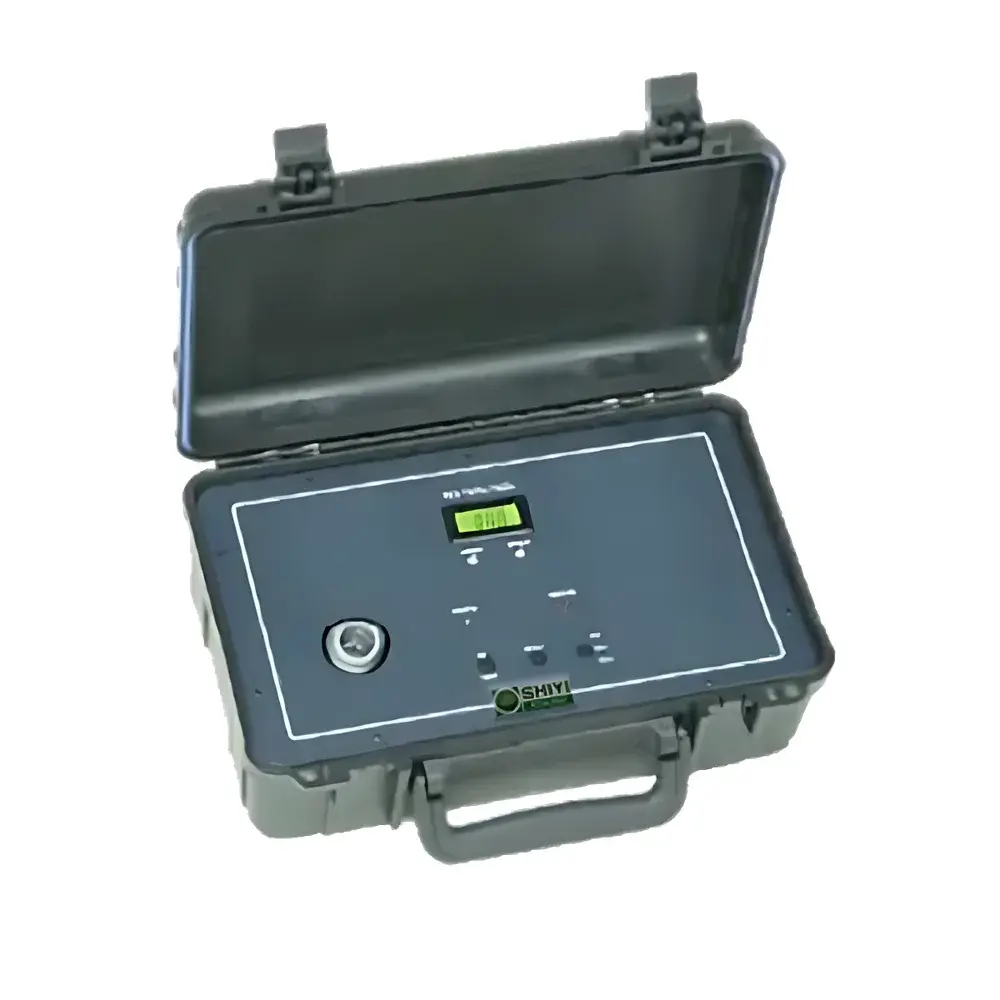
LESHI SE303 Portable Carbon Monoxide Analyzer
| Brand | LESHI |
|---|---|
| Origin | Beijing, China |
| Model | SE303 |
| Instrument Type | Portable |
| Detection Target | Single-component (CO) |
| Detection Principle | Electrochemical or NDIR (Non-Dispersive Infrared) |
| Measurement Ranges | 0–2000 ppm or 0–4.00% CO |
| Compliance | HJ/T 44–1999, HJ 973–2018 |
| Display | Backlit LCD |
| Sampling System | Integrated diaphragm pump, stainless steel probe, PTFE sampling hose, dual-stage filtration (particulate + moisture removal), flow meter |
| Data Output | USB interface, U-disk data export compatible with Excel |
| Optional Expansion | O₂ sensor module |
Overview
The LESHI SE303 Portable Carbon Monoxide Analyzer is an engineered field-deployable instrument designed for accurate, real-time quantification of carbon monoxide (CO) in ambient air, indoor environments, combustion exhaust streams, and occupational settings. It operates on two validated physical detection principles—electrochemical sensing and non-dispersive infrared (NDIR) spectroscopy—enabling method flexibility based on application requirements such as sensitivity, longevity, cross-interference resistance, and regulatory alignment. The electrochemical variant employs a three-electrode cell architecture with a selective permeable membrane, where CO diffuses to the working electrode and undergoes oxidation, generating a diffusion-limited current linearly proportional to gas concentration (per Fick’s law and Faraday’s law). The NDIR configuration utilizes dual-wavelength absorption at 4.67 µm and 4.72 µm—characteristic vibrational absorption bands of CO—applying the Lambert–Beer law to derive concentration from differential absorbance. Both configurations are factory-calibrated against NIST-traceable standards and support user-initiated zero/span verification.
Key Features
- Modular sensor selection: Field-replaceable electrochemical or NDIR CO detection modules—no tooling required
- Integrated sampling train: Stainless steel probe (304 SS), fluoropolymer sampling hose, condensate trap with continuous drainage, particulate filter (5 µm), desiccant-based moisture removal stage, and precision laminar-flow meter (±2% FS)
- Rapid thermal stabilization: Full operational readiness within ≤90 seconds post-power-on for electrochemical mode; ≤60 seconds for NDIR mode
- Backlit high-contrast LCD display (128 × 64 pixels) with adjustable brightness for low-light or outdoor use
- Onboard data logging: Internal memory stores up to 10,000 timestamped readings (date/time/CO value/unit); exportable via USB to FAT32-formatted USB flash drives
- Expandable architecture: Optional O₂ sensing module (electrochemical, 0–25% vol) can be installed without firmware reflash or hardware modification
- Robust mechanical design: IP54-rated enclosure, shock-absorbing silicone boot, and reinforced cable glands for field durability
Sample Compatibility & Compliance
The SE303 is validated for use with dry or moderately humid gas matrices (up to 90% RH, non-condensing). Particulate loading must remain below 1 mg/m³ to prevent filter clogging; optional heated probe accessories are available for high-moisture or sticky aerosol applications. All configurations comply with Chinese environmental monitoring standards HJ/T 44–1999 (“Technical Specification for Determination of Carbon Monoxide in Ambient Air—Electrochemical Sensor Method”) and HJ 973–2018 (“Determination of Carbon Monoxide in Stationary Source Exhaust Gas—NDIR Method”). While not certified to ISO 12039 or EN 15267, its measurement uncertainty profile (<±2.5% of reading ±0.5 ppm for electrochemical; <±3.0% of reading ±10 ppm for NDIR, per manufacturer validation report) aligns with routine industrial hygiene and stack emission screening requirements. Device firmware supports audit-ready event logging (power cycles, calibration actions, sensor swaps) meeting GLP-aligned documentation practices.
Software & Data Management
No proprietary software installation is required. Raw measurement files export as plain-text CSV (comma-separated values) with UTC timestamps, sensor ID, range setting, temperature, and pressure compensation flags. Files open natively in Microsoft Excel, LibreOffice Calc, or Python/Pandas for statistical analysis, trend plotting, or integration into LIMS workflows. The USB interface conforms to USB 2.0 CDC ACM class—recognized automatically by Windows, macOS, and Linux without driver installation. Firmware updates are delivered via signed .bin files loaded from USB drive; version history and checksum verification are displayed pre-installation.
Applications
- Ambient air quality monitoring in urban centers, traffic corridors, and near industrial perimeters
- Indoor air quality (IAQ) assessment in schools, hospitals, office buildings, and residential complexes per GB/T 18883–2022 guidelines
- Combustion efficiency evaluation of boilers, furnaces, incinerators, and gas-fired heaters (O₂ + CO co-monitoring enables excess-air calculation)
- Workplace exposure assessment under GBZ 2.1–2019 permissible exposure limits (PELs) for CO
- Emergency response and fire investigation: rapid CO mapping in smoke-damaged structures or vehicle exhaust scenarios
- Method development and validation support in environmental laboratories accredited to CNAS-CL01 (equivalent to ISO/IEC 17025)
FAQ
What is the expected service life of the electrochemical sensor?
Typical operational lifetime is 24 months under continuous use at 25°C and 50% RH; storage at 5–25°C in sealed packaging extends shelf life to 36 months.
Can the NDIR module detect CO in the presence of CO₂ or methane?
Yes—the dual-wavelength algorithm and optical bandpass filtering minimize interference from CO₂ (absorption at 4.26 µm) and CH₄ (3.3 µm); cross-sensitivity to CO₂ is <0.1% of reading per 1% CO₂.
Is calibration traceable to national standards?
Factory calibration uses NIST-traceable CO reference gases (certified to ISO 6141); users may perform field calibration using EPA Protocol Gases or equivalent certified standards.
Does the device meet electromagnetic compatibility (EMC) requirements for field use?
It complies with GB/T 18268.1–2010 (IEC 61326-1:2012) for Class B industrial environments, including radiated immunity (10 V/m, 80 MHz–2 GHz) and ESD protection (±8 kV contact, ±15 kV air).
How often should the particulate filter and desiccant be replaced?
Filter replacement is recommended every 200 operating hours or upon visible discoloration; desiccant cartridge replacement interval is 500 hours under 70% RH conditions—or sooner if condensate accumulation exceeds 1 mL/hour.







