
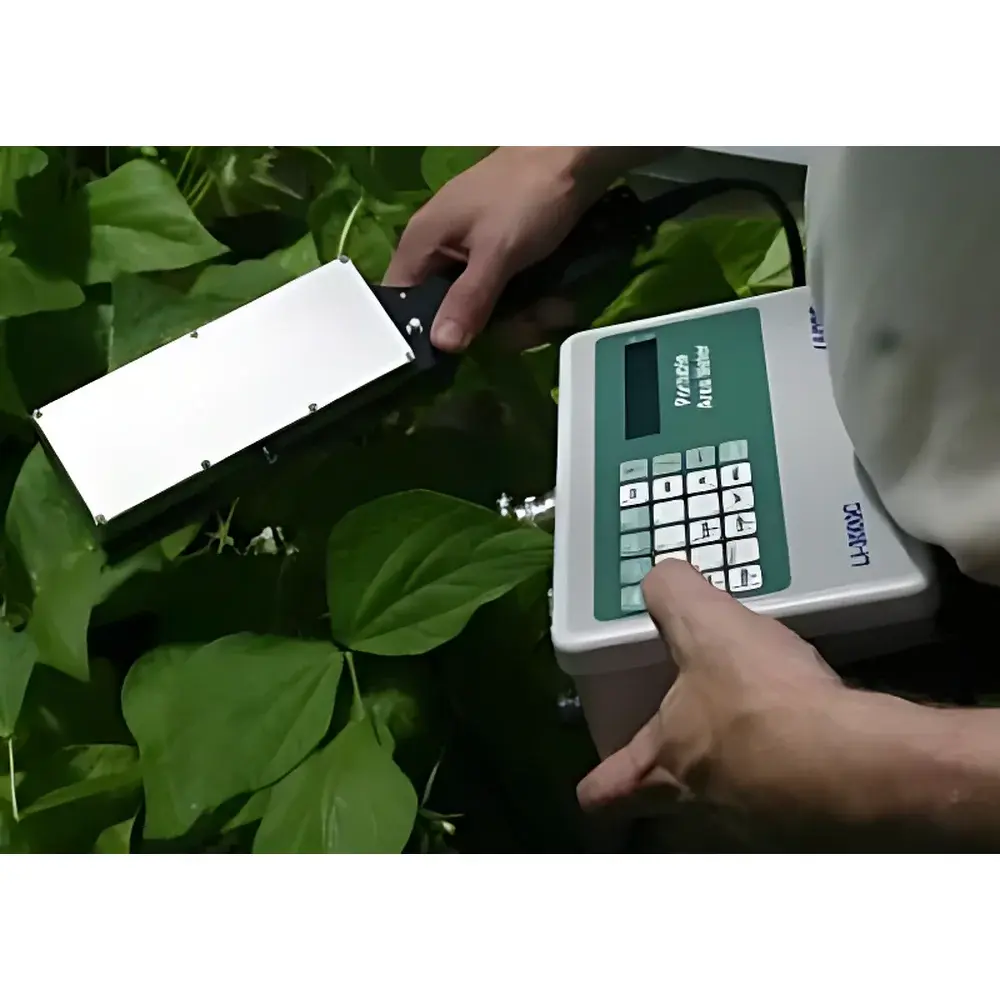
LI-COR LI-3000C Portable Leaf Area Meter
| Brand | LI-COR |
|---|---|
| Origin | USA |
| Model | LI-3000C |
| Resolution | 1 mm² |
| Accuracy | < ±2% for leaf area > 50 cm² |
| Display | 2-line × 16-character LCD |
| Memory | 2.1 MB flash storage (65,000–125,000 measurements) |
| Data Interface | RS-232 and USB 1.1 |
| Power | 6 V rechargeable lead-acid battery (12–15 h operation) or 115/230 V AC, 50/60 Hz, 20 W |
| Operating Environment | 0–55 °C, 0–95% RH (non-condensing) |
| Scan Head Dimensions | 30.5 cm length, 6.4 mm LED source width, 680 g |
| Controller Dimensions | 19.8 × 15.5 × 10.1 cm, 2.0 kg |
| Max Sample Width | 127 mm |
| Max Sample Thickness | 8 mm |
| Max Sample Length | 1 m |
| Max Scan Speed | 1 m/s |
Overview
The LI-COR LI-3000C Portable Leaf Area Meter is a field-deployable, non-destructive optical instrument engineered for rapid, high-reproducibility quantification of leaf morphometric parameters in plant physiology, agronomy, and ecological field studies. It operates on the principle of optical transmission scanning: a linear LED array illuminates the leaf surface as it passes beneath the scan head, and photodiode detection converts shadow-area projection into digital area, length, and width metrics using a calibrated rectangular approximation algorithm. Unlike gravimetric or planimeter-based methods, the LI-3000C eliminates sample preparation artifacts and preserves specimen integrity—critical for longitudinal monitoring of growth dynamics, stress response trials, or phenotyping workflows. Its modular architecture integrates a handheld controller with a detachable scan head, enabling direct measurement of intact leaves on living plants (in situ) or excised samples (ex situ), with optional integration of the LI-3050C transparent conveyor system for high-throughput batch processing.
Key Features
- Non-invasive optical scanning with 1 mm² resolution and < ±2% accuracy for leaf areas exceeding 50 cm²—validated against standardized reference templates per ASTM E2594 guidelines for optical area measurement systems.
- Dual-mode operation: manual hand-scanning for flexible field use or automated conveyor-driven acquisition via LI-3050C accessory (6.3 cm/s at 60 Hz) to support large-scale leaf banks or nursery screening programs.
- Integrated 2.1 MB flash memory stores up to 125,000 complete measurement records—including area (cm²), length (cm), mean width (cm), and maximum width (cm)—with timestamp and operator ID tagging for GLP-compliant data traceability.
- Ruggedized design rated for ambient operation from 0–55 °C and 0–95% RH (non-condensing); scan head sealed against dust and moisture ingress (IP54-equivalent enclosure).
- Intuitive 24-key tactile membrane keyboard with audio feedback and backlit LCD display (2×16 characters) enables real-time verification without external computing hardware.
- RS-232 and USB 1.1 interfaces support bidirectional communication with Windows-based desktop software for data export, statistical summarization, and report generation in CSV, TXT, or PDF formats.
Sample Compatibility & Compliance
The LI-3000C accommodates a broad range of dicot and monocot foliage: leaf widths from 1 mm to 127 mm, thicknesses up to 8 mm, and lengths up to 1 m. Its low-pressure scan head (no mechanical clamping) prevents deformation of delicate or succulent tissues. When used with the LI-3050C conveyor module, sample throughput increases significantly while maintaining 10 cm²—meeting performance thresholds required by ISO 11277 (soil and plant material characterization) and supporting compliance with USDA ARS field protocol standards. All firmware and data handling routines are designed to align with FDA 21 CFR Part 11 principles for electronic records and signatures, including audit trail logging and user-access controls when paired with validated software configurations.
Software & Data Management
The instrument ships with LI-COR’s proprietary Windows-compatible desktop application, providing full control over acquisition settings, calibration management, and post-processing. Users can perform batch corrections for ambient light compensation, apply custom unit conversions (e.g., cm² to m² per plant), generate summary statistics (mean, SD, CV%), and export datasets directly to Excel or statistical packages such as R or JMP. Raw measurement logs include embedded metadata (date/time, battery level, sensor status), enabling retrospective QA/QC analysis. Data exports conform to FAIR principles (Findable, Accessible, Interoperable, Reusable), facilitating integration into LIMS environments or institutional digital repositories.
Applications
- Field-based phenotyping of crop germplasm under drought, heat, or nutrient-stress conditions.
- Longitudinal tracking of leaf expansion rates in controlled-environment growth chambers or greenhouse trials.
- Validation of remote-sensing vegetation indices (e.g., NDVI, LAI) through ground-truthing campaigns.
- Ecological studies assessing canopy structure, leaf area index (LAI) partitioning, and species-specific allometric scaling relationships.
- Teaching laboratories requiring robust, entry-level instrumentation for plant morphology instruction aligned with ABET-accredited life sciences curricula.
FAQ
What is the minimum detectable leaf width?
The LI-3000C reliably measures leaves as narrow as 1 mm wide, provided sufficient optical contrast exists between the leaf margin and background.
Can the LI-3000C measure overlapping or curled leaves?
No—optimal accuracy requires flat, non-overlapping placement; curvature or layering introduces parallax error and violates the rectangular projection assumption.
Is the LI-3050C conveyor module required for routine use?
It is optional but recommended for laboratories processing > 500 leaves per day or conducting time-series experiments where operator fatigue may affect consistency.
Does the device support calibration traceability to NIST standards?
While the LI-3000C does not include built-in NIST-traceable calibration artifacts, LI-COR provides documented calibration procedures using certified area standards, and third-party metrology labs can perform ISO/IEC 17025-accredited verification upon request.
How is battery health monitored during extended field deployments?
The controller displays remaining charge percentage and triggers audible/visual alerts 60 minutes prior to automatic shutdown; low-voltage cutoff prevents deep discharge damage to the lead-acid cell.
Related Products



